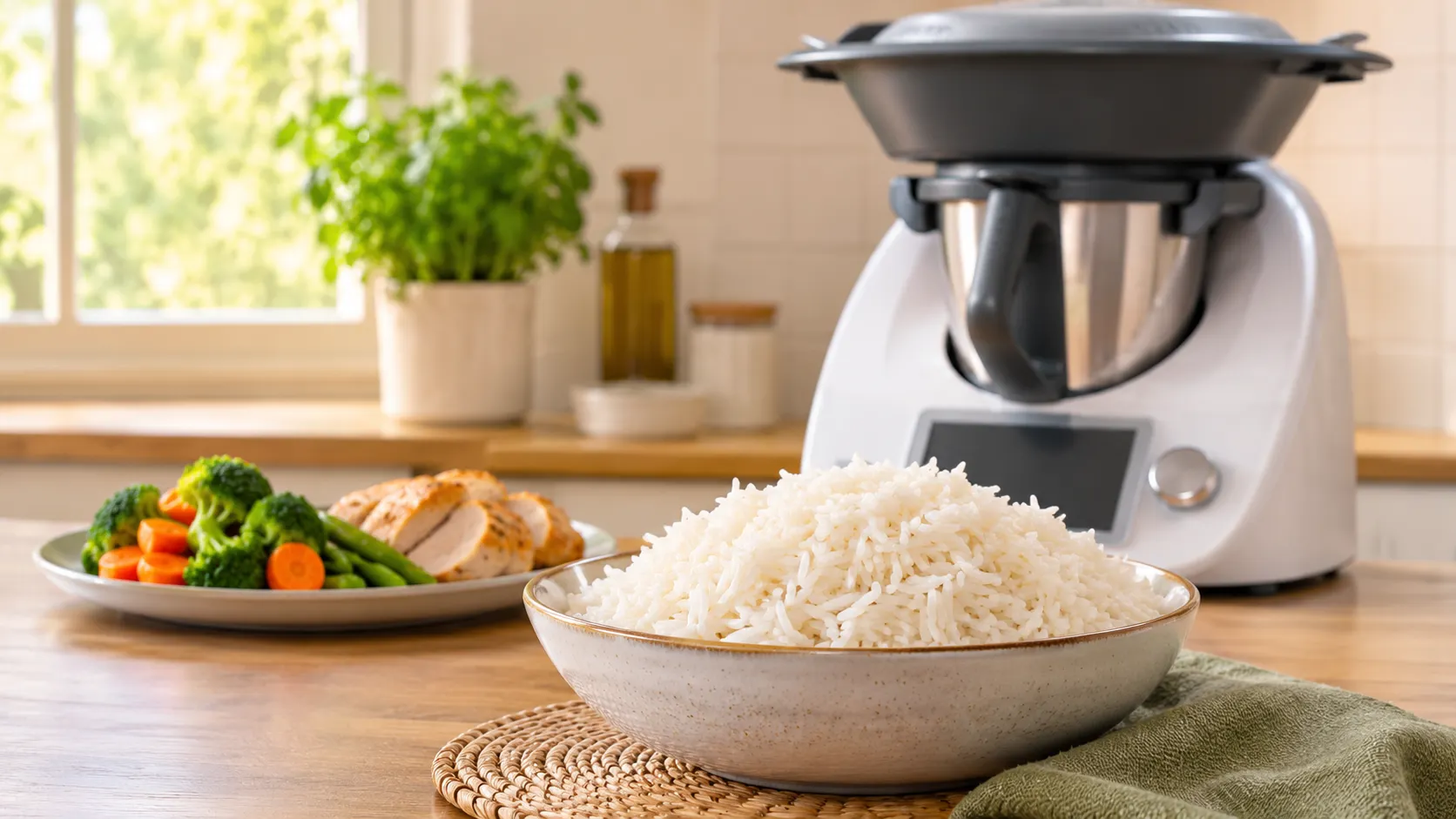
Thermomix rice in the Varoma can be prepared using the simmering basket while another dish cooks in the Varoma above. The important part is choosing the right method for your rice, using an appropriate amount of liquid and allowing steam to circulate properly. However, basket cooking, cooking rice in a Varoma container and using Thermomix Rice Cooker mode are different techniques. They should not share one universal water ratio or cooking time. This guide explains the differences, manufacturer-supported methods and common rice problems so you can choose the right approach.
Quick Summary
- Best-supported method for rice and a main: Put rice in the simmering basket inside the mixing bowl and use the Varoma above when following a compatible recipe.
- Basket capacity: Vorwerk advises against putting more than 350 g of rice in the simmering basket.
- Water and time: Depend on the rice type, quantity, cooking method and machine model.
- Most important checks: Keep within the basket’s maximum mark, follow the correct water-contact instructions and leave Varoma steam openings unobstructed.
Why Rice in the Thermomix Goes Wrong, and How the Varoma Fixes It
Rice can turn mushy, remain hard in the centre, clump together or cook unevenly when its quantity, hydration and cooking method do not match.
The Thermomix offers several ways to prepare rice. The simmering basket sits inside the mixing bowl, while the Varoma is the steaming attachment positioned above it. This arrangement allows rice to cook while chicken, fish or vegetables are prepared in the Varoma.
A separate heatproof container can also be used in a suitable Varoma arrangement, but this changes how the rice receives its cooking liquid. The water inside the container hydrates the rice, while the liquid in the mixing bowl produces steam.
The distinction matters: Vorwerk’s TM5 rice-cooking instructions specifically state that rice in its Varoma-related simmering-basket method must have contact with water. This should not be confused with an entirely separate container-based steaming method.
Vorwerk UK & Ireland+1
Simmering Basket vs Varoma Tray vs Bundt Tin: Which Suits Your Situation?
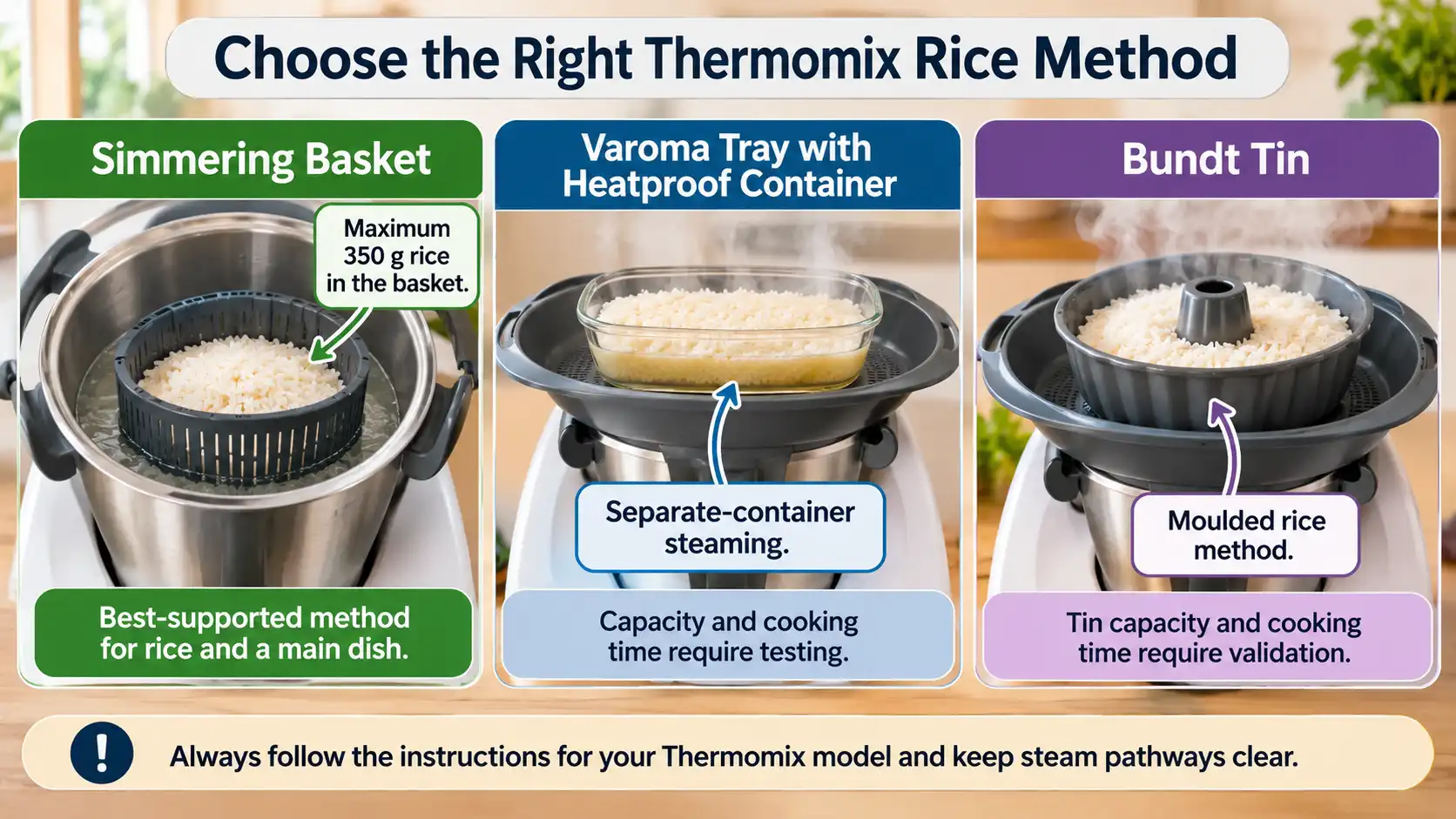
The right method depends on whether you are cooking rice by itself, preparing a main dish simultaneously or experimenting with a different rice shape.
| Method | Best for | Maximum rice per batch | Can a main cook above? | Texture evidence | Main drawback |
| Simmering basket | Rice with a main in the Varoma | Maximum 350 g according to Vorwerk | Yes, with suitable loading | Manufacturer-published recipes available | Basket capacity and water-contact requirements |
| Varoma tray with heatproof container | Experimental container-based rice steaming | Not established | Potentially, but testing is required | No Kitchen Memo comparison available | Container capacity and steam penetration need testing |
| Bundt tin in Varoma | Moulded rice preparation | Not established | Potentially, but testing is required | No verified texture comparison available | Tin size, rice depth and cooking time vary |
| Basket-only method | Rice without using the Varoma attachment | Follow basket and model limits | No | Manufacturer guidance available for specific methods | Not suitable for assuming the same settings for every rice type |
Vorwerk’s simmering-basket capacity guidance states that the basket has a volume of 1.4 litres and should not contain more than 350 g of rice. The maximum marking must also be respected.
The 350 g figure applies to rice in the simmering basket. It should not be reused as a maximum for a bundt tin or another Varoma container.
Is there a no-Varoma option?
Yes. The Thermomix can cook rice without positioning the Varoma attachment above the bowl.
The TM5 has a manufacturer-documented simmering-basket method for ordinary white rice without the Varoma attachment. It is different from the method used to prepare rice alongside another dish.
The TM6 also has Rice Cooker mode, which cooks rice directly in the mixing bowl with the simmering basket positioned on the lid instead of the measuring cup. This is an automated cooking method, not the same as placing rice inside a basket in the bowl for Varoma cooking.
Thermomix Rice Water Ratio and Cooking Time Reference
There is no single Thermomix rice water ratio that works for every variety and cooking arrangement.
A basket method, a separate Varoma container and Rice Cooker mode distribute water differently. Rice varieties also differ in their starch composition and bran content.
Long-grain varieties such as basmati and jasmine generally cook into separate, fluffy grains. Short-grain rice is naturally more cohesive, while glutinous rice is particularly sticky because of its starch composition. Brown rice retains its bran and germ, making it chewier and generally slower to cook than refined white rice.
Master Rice Reference Table
The following table separates a documented manufacturer recipe from settings that still need Kitchen Memo testing.
| Rice type | Dry quantity | Method | Water in bowl | Cooking time | Speed | Result |
| White rice | Not established for a universal Varoma method | Simmering basket | Follow compatible method | Not established | Model-specific | Testing required |
| Basmati | Not established | Basket or suitable tested container | Not established | Not established | Not established | Testing required |
| Jasmine | 350 g in an official Hainanese recipe | Simmering basket with Varoma chicken above | To the 1 L bowl mark in that recipe | 15 minutes for its final rice-and-chicken stage | Varoma / speed 4 | Recipe-specific example |
| Brown rice | Not established | Method-specific | Not established | Not established | Not established | Testing required |
| Sticky rice | Not established | Requires a suitable variety-specific method | Not established | Not established | Not established | Testing required |
The jasmine-rice example comes from Vorwerk’s published Hainanese Chicken and Rice recipe, which is compatible with TM5, TM6 and TM7. The chicken is steamed first, followed by a final stage in which the rice cooks in the simmering basket while the Varoma chicken is returned to the machine. These figures belong to that complete recipe, not to every jasmine-rice batch.
For another approach, Cookidoo’s Rice Cooker Mode guidance explains that water requirements depend on the grain, brand and quantity. It also notes that brown rice and other whole grains may need soaking.
Cooked-Rice Yield and Serving Reference
| Measurement | Current reference |
| Cooked yield per 100 g dry rice | Not measured in the supplied Kitchen Memo test notes |
| Standalone servings from 350 g | Requires a measured serving-size test |
| Approximate portion-planning reference | Cookidoo suggests approximately 2.5 oz (71 g) uncooked rice per person for its Rice Cooker guidance |
| Final cooked weight | Record after cooking and resting |
The portion reference is useful for planning, but it is not a measured Varoma yield. Different varieties and cooking methods can produce different finished quantities.
Why Thermomix Rice Recipes Give Different Water and Time Settings
Different Thermomix rice recipes can recommend different settings because they do not necessarily cook rice in the same place or under the same conditions.
The main variables are:
- Rice position: Rice inside the simmering basket does not behave exactly like rice inside a separate heatproof container.
- Water contact: Rice cooked in the basket may need direct contact with the mixing-bowl liquid, whereas a separate container needs its own measured cooking liquid.
- Rice variety: Long-grain, short-grain, brown and sticky rice have different texture and hydration characteristics.
- Batch size: A deep or heavily loaded rice layer can cook differently from a smaller, more evenly distributed quantity.
- Machine settings: Temperature control, speed and the cooking method can differ between models and recipes.
Speed 1 and speed 4 should not automatically be treated as interchangeable. Different published recipes use different speeds as part of their complete cooking instructions.
For example, Vorwerk’s TM5 rice guidance and its Hainanese chicken-and-rice recipe use different cooking arrangements. Their settings are recipe-specific, not proof that one speed or water amount is universally superior.
A controlled comparison of one rice variety, one quantity and one cooking method at a time would be needed to establish whether changing speed alone improves the finished rice.
How to Cook Rice in a Thermomix with the Varoma: Step by Step
The best-supported starting point for preparing rice alongside a main is the simmering basket inside the mixing bowl, with a compatible Varoma recipe above it.
- Weigh the rice. Measure the dry rice before rinsing. Do not exceed Vorwerk’s 350 g rice limit for the simmering basket.
- Prepare the rice. Follow the washing or soaking instructions for the rice variety and the specific recipe.
- Add the bowl liquid. Use the amount specified by the compatible Thermomix recipe. For basket cooking, follow the manufacturer’s instructions concerning contact between the rice and water.
- Insert the basket. Position the simmering basket correctly inside the mixing bowl and check that it does not exceed its maximum marking.
- Prepare the Varoma. Arrange the chicken, fish or vegetables without covering all the steam openings. Fit the Varoma lid properly.
- Select the correct settings. Use the temperature or mode, speed and cooking time specified by the recipe for your machine.
- Check the result. Rice should be tender, without a hard centre. Remove the basket carefully with the spatula and fluff the rice gently.
The most important step is using instructions designed for the actual rice method. Do not transfer the cooking time from a bundt-tin recipe to basket rice or use a Rice Cooker setting as though it were a Varoma setting.
Do you need to rinse the rice?
Rinsing rice can remove loose surface material, but it should not be treated as a guaranteed solution for clumping.
A published food-science study, Washing rice before cooking has no large effect on the texture of cooked rice, found no large effect on rice hardness or stickiness from the washing procedure studied.
Follow the instructions for your rice variety and recipe. Vorwerk’s Hainanese recipe, for example, specifically directs the cook to rinse the jasmine rice until the water runs clear. That is a recipe-specific instruction rather than a universal requirement.
Time, yield and equipment
| Item | Guidance |
| Preparation time | Depends on weighing, washing and ingredient preparation |
| Cooking time | Use a model-compatible, rice-specific recipe |
| Yield | Measure the finished rice after cooking |
| Rice basket limit | No more than 350 g rice |
| Equipment | Thermomix, simmering basket, Varoma dish, Varoma tray and kitchen scale |
| Optional equipment | Suitable food-safe heatproof container or mould for a separately tested Varoma method |
For more appliance and technique walkthroughs, explore the Kitchen Memo Kitchen Guides collection.
Cooking Rice with Chicken, Fish or Vegetables in the Varoma
Yes, you can cook rice and another dish in the Thermomix during the same cooking process. The most important rule is to leave enough openings for steam to circulate through the Varoma.
A particularly useful manufacturer example is Vorwerk’s Hainanese Chicken and Rice recipe, which is designed for TM5, TM6 and TM7.
The recipe uses:
- A whole chicken weighing approximately 1.7 kg, positioned on chopsticks in the Varoma dish to allow steam circulation.
- 350 g jasmine rice in the simmering basket.
- Water added to the mixing bowl to reach its 1 L mark.
- A final 15-minute Varoma cooking stage at speed 4, with the chicken returned above the rice.
Importantly, the chicken is steamed for an earlier stage before the rice is added. The final rice stage is therefore not a universal cooking time for raw chicken and rice started together.
Rice and Main-Dish Cooking Planner
| Main item | Cut size/weight | Position | Rice method | Cooking schedule | Notes |
| Whole chicken | Approximately 1.7 kg | Varoma dish, raised on chopsticks | 350 g jasmine in basket | 55-minute chicken stage, followed by 15-minute rice stage | Official Hainanese recipe |
| Chicken pieces | Test-specific | Varoma dish or tray | Simmering basket | Requires testing | Do not transfer whole-chicken timings |
| Fish | Test-specific | Varoma tray or dish | Simmering basket | Requires testing | Thickness affects cooking |
| Mixed vegetables | Test-specific | Varoma tray | Simmering basket | Requires testing | Vegetable cut size changes cooking requirements |
Vorwerk’s TM5 safety instructions require some slots in the Varoma dish and tray to remain uncovered so steam can escape in a controlled way. Do not pack food so tightly that steam circulation is obstructed.
The useful takeaway is that the rice and main dish must be planned as one cooking arrangement. Increasing the quantity of either item without considering the available steam space can change the result.
Why Is My Thermomix Rice Mushy, Undercooked or Clumpy?
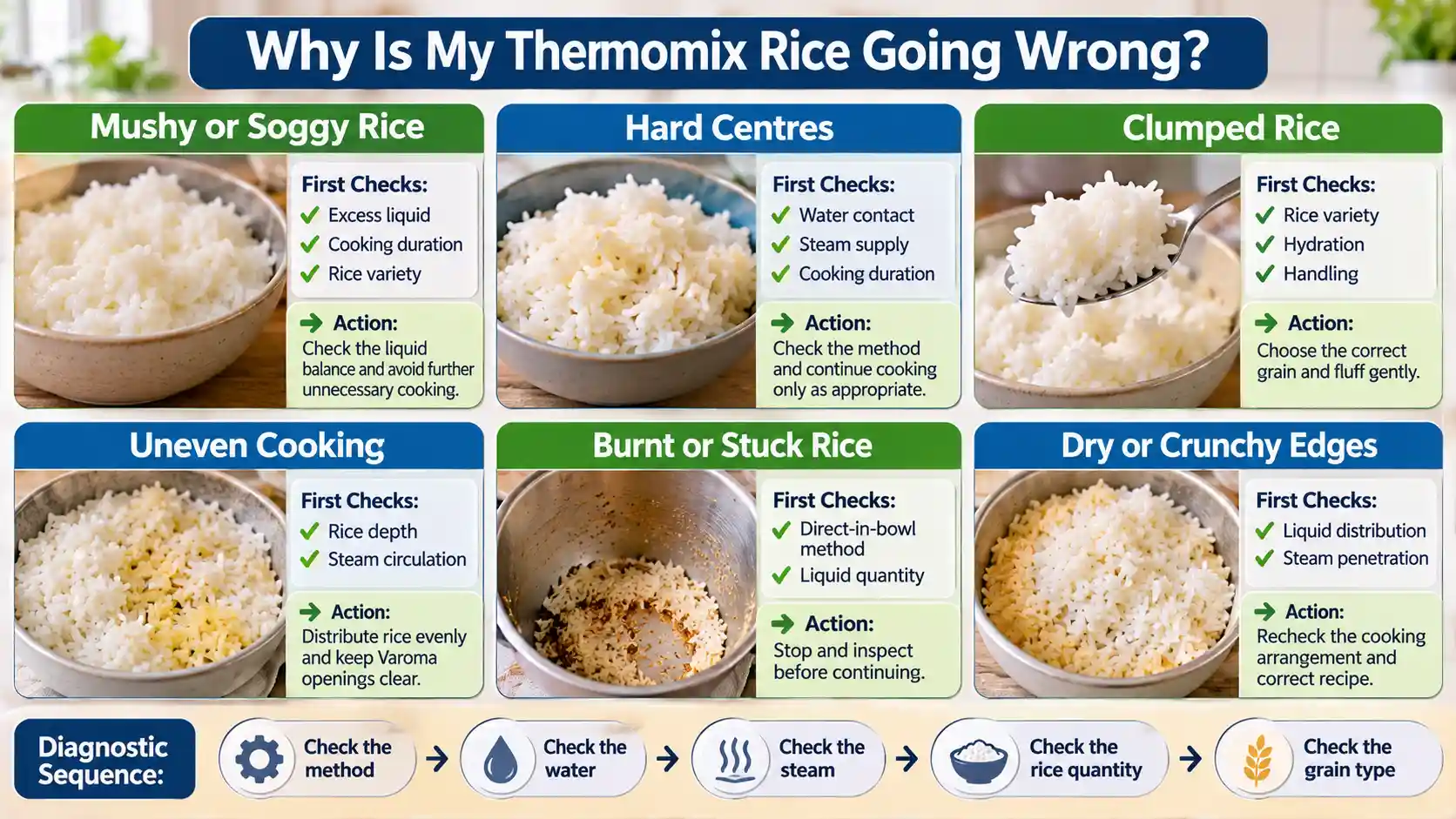
Rice problems are usually easier to diagnose when you first identify where the rice was positioned, how it received its water and whether steam could circulate.
The following table provides practical first checks. These are troubleshooting principles, not a claim that every rescue method has already been tested in the Kitchen Memo test kitchen.
| Symptom | Likely cause | Quick fix | Prevention |
| Mushy or soggy | Excess liquid, excessive cooking or a naturally sticky rice variety | Drain free liquid where appropriate and fluff gently. Broken, overcooked grains cannot be restored | Match the recipe to the rice variety and quantity |
| Hard centres or undercooked rice | Insufficient liquid contact, inadequate steaming or insufficient cooking | Check the water level and continue using the same method only as its instructions allow | Measure rice and liquid accurately |
| Clumped or sticky | Rice variety, hydration, surface material or excessive handling | Gently loosen the grains without crushing them | Choose a suitable rice variety and follow its recipe |
| Uneven top versus bottom | Uneven rice depth or obstructed steam circulation | Redistribute the rice where the cooking arrangement permits | Avoid excessive loading and keep steam pathways open |
| Burnt or stuck on the bottom | More likely with direct-in-bowl cooking when liquid or settings are incorrect | Stop the programme and inspect the bowl; do not scrape burnt material into the rice | Follow the exact Rice Cooker recipe and its liquid instructions |
| Dry or crunchy edges | Insufficient hydration or uneven steam reaching the rice | Check whether the rice needs additional cooking liquid or steaming under its specific method | Use an appropriate container, even rice depth and matching recipe |
One important distinction is that mushy rice and naturally sticky rice are not necessarily the same problem. Short-grain and glutinous varieties are expected to have a more cohesive texture than long-grain basmati.
For a proper Kitchen Memo troubleshooting comparison, photograph the same rice variety cooked using the same quantity and equipment, changing one variable at a time. This makes it possible to identify whether water, time, speed or loading caused the difference.
TM5, TM6 and TM7 Differences, and How to Store and Reheat Rice
Thermomix models do not all present their steaming functions in exactly the same way. Always choose instructions compatible with your particular machine.
Do settings differ by model?
| Model | Varoma/steaming control | Rice-related features | Important distinction |
| TM5 | Varoma temperature setting | Manufacturer-documented simmering-basket rice methods | Follow TM5-specific instructions |
| TM6 | Varoma temperature setting | Dedicated Rice Cooker mode | Rice Cooker mode cooks rice directly in the mixing bowl |
| TM7 | Steaming mode provides Varoma temperature settings | Compatible Rice Cooker recipes are available through Cookidoo | Steaming mode has its own speed limitation |
For the TM7, Vorwerk confirms that the Varoma temperature is accessed through Steaming mode, with a maximum speed of 5 in that mode. Varoma is a steaming function rather than an additional numerical temperature above 120°C. See Vorwerk’s TM7 Varoma guidance.
TM6 Rice Cooker mode is a separate cooking process. It controls the cooking time and temperature automatically and requires the simmering basket on the mixing-bowl lid instead of the measuring cup. Do not mistake this for cooking rice in the basket inside the bowl with the Varoma positioned above.
Cookidoo also publishes separate rice recipes compatible with TM6 and TM7, including Jasmine Rice. Follow the actual Guided Cooking instructions for your model rather than transferring settings from another machine.
Storage and reheating
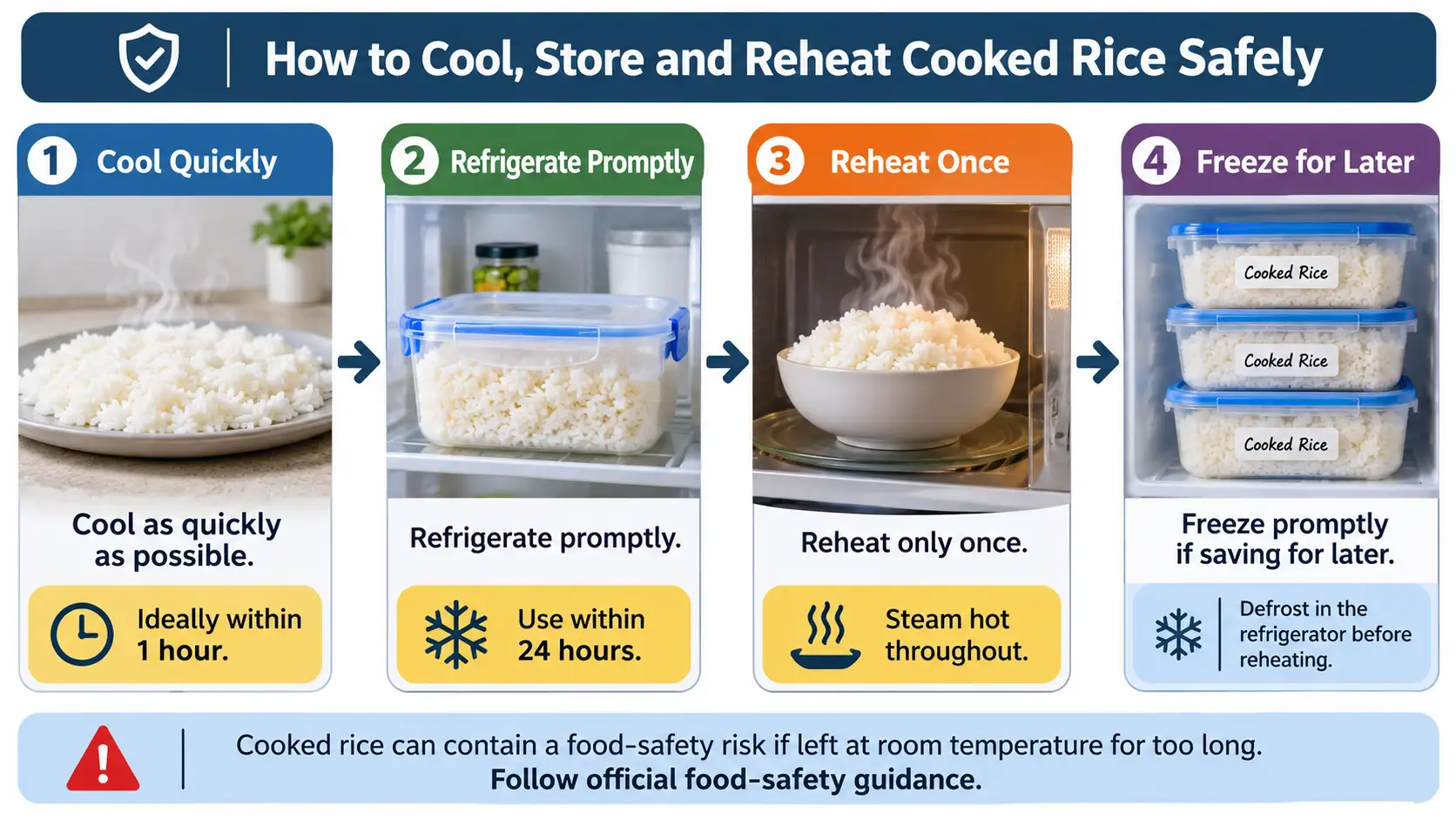
Cooked rice needs particular care because uncooked rice can contain Bacillus cereus spores that may survive cooking. Leaving cooked rice at room temperature for too long allows bacteria or toxins to become a food-safety risk.
For a conservative rice-specific approach, the UK Food Standards Agency recommends:
- Cool cooked rice as quickly as possible, ideally within one hour.
- Divide large quantities into smaller portions to help them cool.
- Refrigerate promptly.
- Consume refrigerated rice within 24 hours.
- Reheat rice no more than once.
- Check that reheated rice is steaming hot throughout.
These recommendations are explained in the government’s Home Food Fact Checker.
| Storage stage | Recommended approach |
| Immediately after cooking | Transfer rice out of the hot cooking equipment |
| Cooling | Spread into smaller portions and cool quickly |
| Refrigeration | Refrigerate promptly and consume within 24 hours |
| Reheating | Reheat once only, until steaming hot throughout |
| Freezing | Cool rapidly and freeze promptly if not eating within the recommended refrigerated period |
For reheating in the Thermomix, use a suitable model-compatible method for the quantity and container. No universal reheating time is established in this guide. The important safety requirement is that the rice becomes steaming hot throughout.
Conclusion
Thermomix rice in the Varoma works best when you match the rice variety, quantity and cooking arrangement. The simmering basket is the best-supported starting point for preparing rice alongside a main, while Varoma containers and bundt tins need their own validated instructions. Follow the basket limit, keep steam pathways open and use the appropriate model settings. Most importantly, do not mistake one published recipe’s water ratio or cooking time for a universal formula.
FAQs
- How do I steam rice in the Thermomix?
Place rice in the simmering basket or a suitable heatproof container, add the required liquid and follow a compatible recipe’s steaming settings.
- What is the Varoma setting on a Thermomix?
Varoma is the Thermomix steaming function. On the TM7, select Steaming mode to access its Varoma temperature settings.
- Can I use my Thermomix as a steamer?
Yes. The Varoma dish and tray allow multilevel steaming, while the simmering basket can cook rice and other foods inside the mixing bowl.
- Do I have to rinse the rice first?
Not always. Rinse when your rice instructions or chosen recipe require it. Rinsing alone is not a guaranteed solution for clumping.
- How much rice can I cook at once?
Vorwerk advises a maximum of 350 g of rice in the simmering basket. Separate Varoma containers require their own validated capacity limits.
- Does the TM7 Steaming mode change rice settings?
It changes how you select the Varoma steaming function. It does not establish one universal rice water ratio or cooking time.
- How do I reheat cooked rice in the Thermomix?
Use a suitable reheating method for your model and quantity. Reheat only once and ensure the rice is steaming hot throughout.