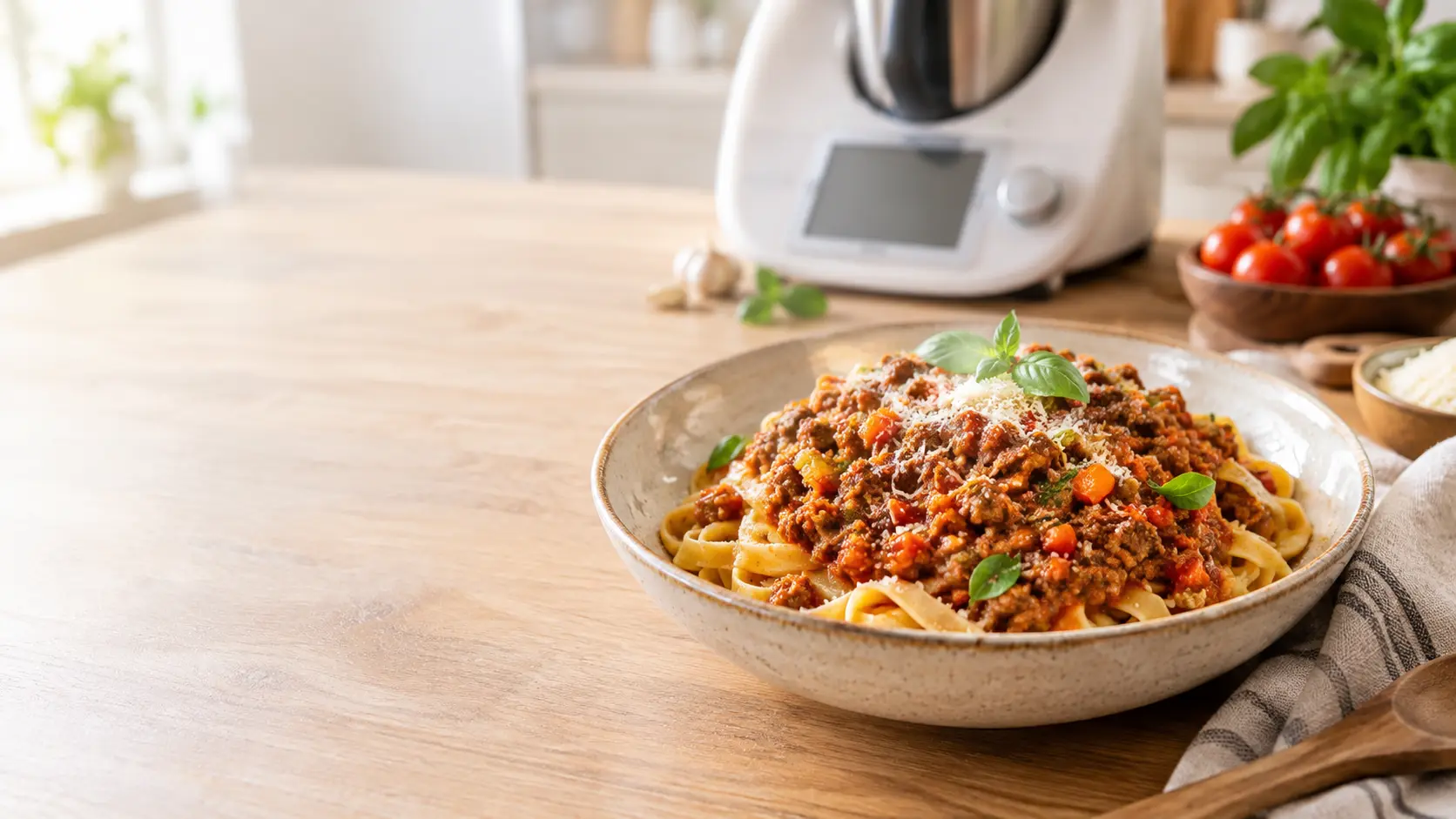
Thermomix risotto can be creamy, rich and properly al dente without requiring the constant stirring of traditional stovetop cooking. The key is choosing suitable risotto rice, measuring the stock carefully and using the correct mixing arrangement for your machine. Arborio, Carnaroli and Vialone Nano are suitable varieties, but their cooking behaviour differs. Whether you use a TM5, TM6, TM7 or TM31, understanding the relationship between rice, liquid, temperature and mixing is essential to avoiding rice soup, gluey grains and an undercooked centre.
Quick Summary
- Use Arborio, Carnaroli or Vialone Nano for traditional-style risotto.
- Measure stock carefully because excess liquid can leave the finished dish watery.
- Check the manufacturer’s butterfly whisk speed restriction before choosing a mixing method.
- Cooking time depends on rice variety, quantity, liquid temperature and Thermomix model.
- Allow the finished risotto to settle before evaluating its final consistency.
Can a Thermomix really match stovetop risotto?
Yes. A Thermomix can make creamy, properly cooked risotto, provided the recipe uses an appropriate rice variety, liquid quantity and mixing arrangement.
Traditional stovetop risotto is prepared by adding warm stock gradually while stirring the rice. This allows the cook to monitor hydration and adjust the amount of liquid as the grains soften.
A Thermomix changes the process by providing controlled heating and mechanical mixing. Many Thermomix risotto recipes add most or all of the stock at the beginning, rather than requiring repeated additions throughout cooking.
However, the machine does not eliminate the need to understand rice cooking. The rice still needs enough liquid to hydrate, and its starch contributes to the creamy sauce.
The important difference is that stovetop cooking allows frequent manual adjustments, whereas a Thermomix recipe depends more heavily on accurate initial quantities and appropriate settings.
Thermomix vs stovetop
| Factor | Thermomix | Stovetop |
| Active time | Less manual stirring | Frequent attention and stirring |
| Total cooking time | Depends on model and recipe | Depends on rice, heat and quantity |
| Stirring effort | Mechanical mixing | Manual stirring |
| Liquid control | Usually measured before cooking | Added gradually |
| Texture control | Depends on programmed settings and batch size | Adjusted during cooking |
| Main advantage | Convenient, controlled heating and mixing | Greater opportunity for continuous adjustment |
| Main challenge | Finding the correct model-specific ratio and settings | Maintaining consistent heat and hydration |
The two methods should be compared using the same rice, stock, ingredients and quantities to make a meaningful judgment.
A useful Kitchen Memo comparison would record the active preparation time, total cooking time, texture and final consistency of both batches. Until that comparison has been completed, neither method should be declared the overall winner.
Which should you choose?
Choose the Thermomix when you want a more automated cooking process and are comfortable following a model-specific recipe. Choose the stovetop when you prefer to control stock additions and grain texture manually.
Which rice should you use, and should you rinse it?
Use Arborio, Carnaroli or Vialone Nano for traditional-style risotto. These Italian rice varieties have characteristics that make them suitable for absorbing cooking liquid while contributing to the creamy consistency associated with risotto.
Rice contains starches, including amylose and amylopectin. During cooking, starch gelatinization and starch released from the grains help thicken the surrounding liquid.
However, the three varieties are not identical. Their grain characteristics and cooking behaviour affect how the finished risotto holds its shape.
Arborio vs Carnaroli vs Vialone Nano
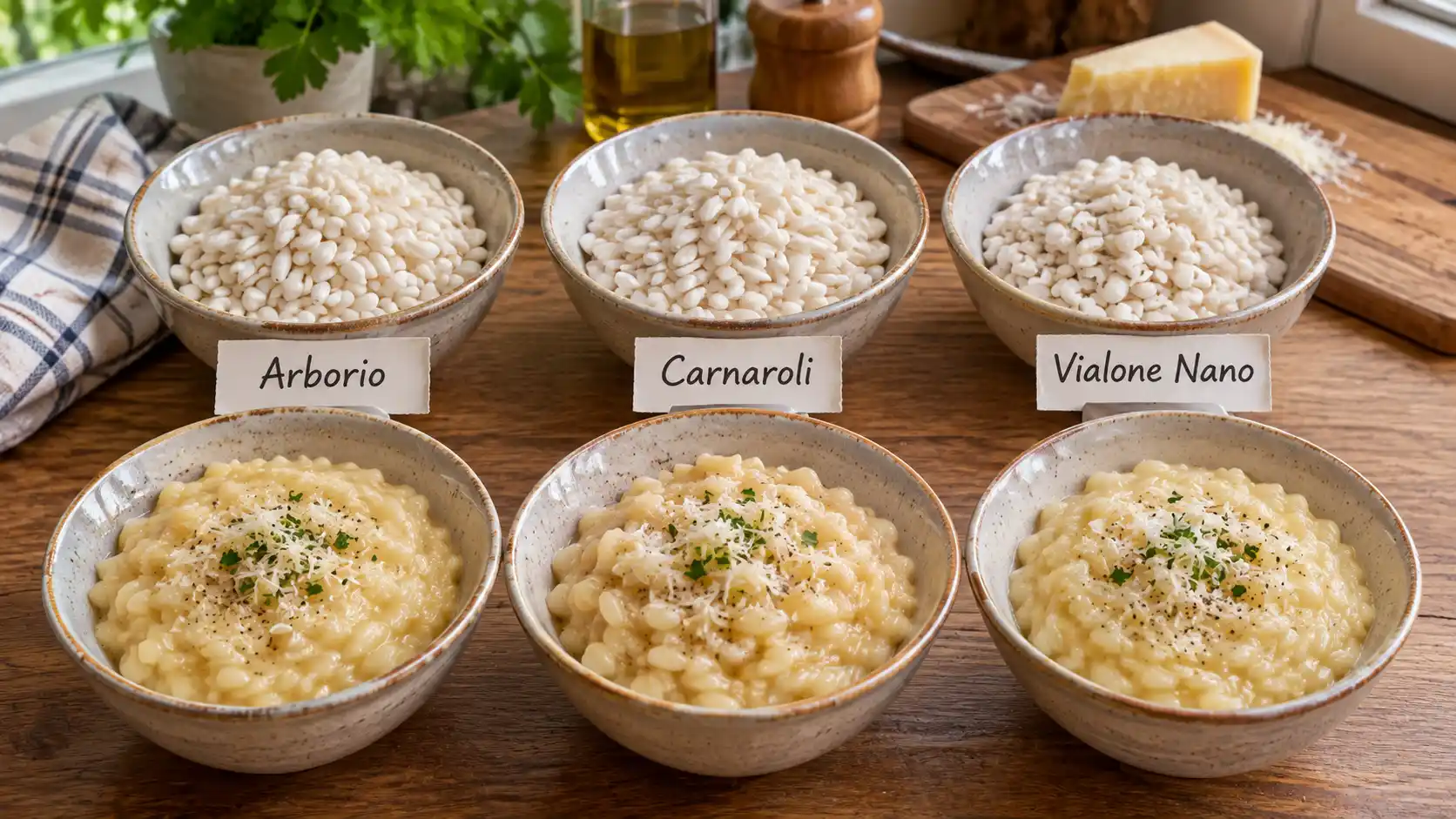
| Rice variety | Grain characteristics | Cooking characteristics | Suitable use |
| Arborio | Large, plump grains | Produces a creamy consistency and has good cooking resistance | Everyday risotto |
| Carnaroli | Large grains with good structural resistance | Generally retains its grain definition during cooking | Risotto where separate, firm grains are preferred |
| Vialone Nano | Smaller, rounder grains | Absorbs seasonings well and is suitable for traditional risotto preparations | Vegetable and seafood risotto |
These distinctions are supported by published Italian rice-variety information. The actual performance of each variety in a Thermomix still depends on the recipe and cooking conditions.
For further reading, the Sustainable EU Rice information on Italian varieties describes the characteristics and culinary uses of Arborio, Carnaroli and Vialone Nano.
Which rice should you choose?
Arborio is a practical starting point because it is widely available and commonly used for risotto.
Carnaroli is worth choosing when maintaining grain definition is especially important.
Vialone Nano offers another suitable option, particularly when a flowing risotto texture is desired.
There is no Kitchen Memo side-by-side Thermomix trial establishing a definitive winner between these three varieties. A fair comparison would use identical ingredient quantities, cooking arrangements and serving conditions.
The comparison should also record texture at several cooking stages rather than judging the rice only after it has finished cooking.
Should you rinse risotto rice?
Rinsing risotto rice is not an absolute requirement, and it is too simplistic to claim that washing automatically removes all the starch needed for creamy risotto.
Many traditional recipes use unrinsed rice, but the effect of washing depends on the rice and cooking method.
A 2019 study published in Food Chemistry, titled Washing rice before cooking has no large effect on the texture of cooked rice, found that washing did not significantly affect the hardness or stickiness of the three rice varieties examined. However, the study was not a Thermomix risotto comparison.
For a consistent master recipe, using the same rice preparation procedure every time is more important than assuming that rinsing is always wrong.
Can you use basmati or cauliflower rice?
Basmati rice
Basmati is a long-grain rice that generally produces more separate grains than traditional risotto rice. It can be used for an adapted Thermomix rice dish, but it will not automatically produce the same cohesive texture as Arborio or Carnaroli.
Its liquid requirements and cooking duration should be established separately.
Cauliflower rice
Cauliflower rice is finely chopped vegetable rather than a rice grain. It does not have the same starch structure or hydration behaviour as traditional risotto rice.
A cauliflower risotto therefore needs a different approach, with attention to moisture release and cooking duration.
Neither substitution should automatically inherit the liquid ratio or cooking time of a traditional Thermomix risotto recipe.
Blade, butterfly whisk, cup and basket: what each setting does
The Thermomix accessories influence how ingredients move during cooking and how steam escapes from the mixing bowl.
For risotto, the goal is to cook the grains evenly without excessive breaking or agitation.
The mixing blade and butterfly whisk are different accessories, and they should not be treated as interchangeable without considering the recipe and machine model.
Blade vs butterfly whisk
| Factor | Mixing blade | Butterfly whisk |
| Main purpose | Chopping, mixing and stirring | Gentle mixing and whipping |
| Grain handling | Depends on speed and direction | Designed for appropriate low-speed mixing |
| Speed restrictions | Follow the relevant model instructions | Maximum speed 4 |
| Dense ingredients | Follow bowl and appliance limits | Avoid ingredients that may block or damage the attachment |
| Risotto suitability | Depends on the validated recipe | Depends on the validated recipe |
The butterfly whisk is particularly useful for whipping cream, beating egg whites and preparing certain sauces and puddings.
However, it has an important manufacturer restriction: do not exceed speed 4 when the butterfly whisk is fitted.
Vorwerk gives this instruction in its official TM5 safety guidance, and the same maximum speed is stated in the TM31 instruction manual and TM7 user manual.
Another important precaution is to avoid placing dense or sticky ingredients in a way that blocks the attachment.
There is not yet a controlled Kitchen Memo comparison establishing whether the butterfly whisk or reverse blade movement produces better risotto texture. The safest recommendation is to use the accessory and settings specified by a recipe designed for the relevant Thermomix model.
Cup on vs off, and basket vs cup on the TM6
The measuring cup and simmering basket have different functions.
The measuring cup fits into the lid opening, while the simmering basket can sit loosely over the lid to allow steam to escape.
For the TM6, Vorwerk provides a specific safety instruction.
When cooking or simmering at 95°C (200°F) or above, use the simmering basket on top of the lid instead of the black TM6 measuring cup.
The reason is that ingredients may rise and become compressed during cooking, restricting steam escape and allowing pressure to build. This can cause hot food to spill unexpectedly.
Vorwerk also specifies that the TM6 mixing bowl must not exceed its 2.2 L maximum fill level.
Read the complete TM6 measuring cup safety announcement before choosing a lid arrangement.
Do not transfer this specific TM6 instruction to another model without checking its own manual.
TM5/TM6/TM7 vs TM31
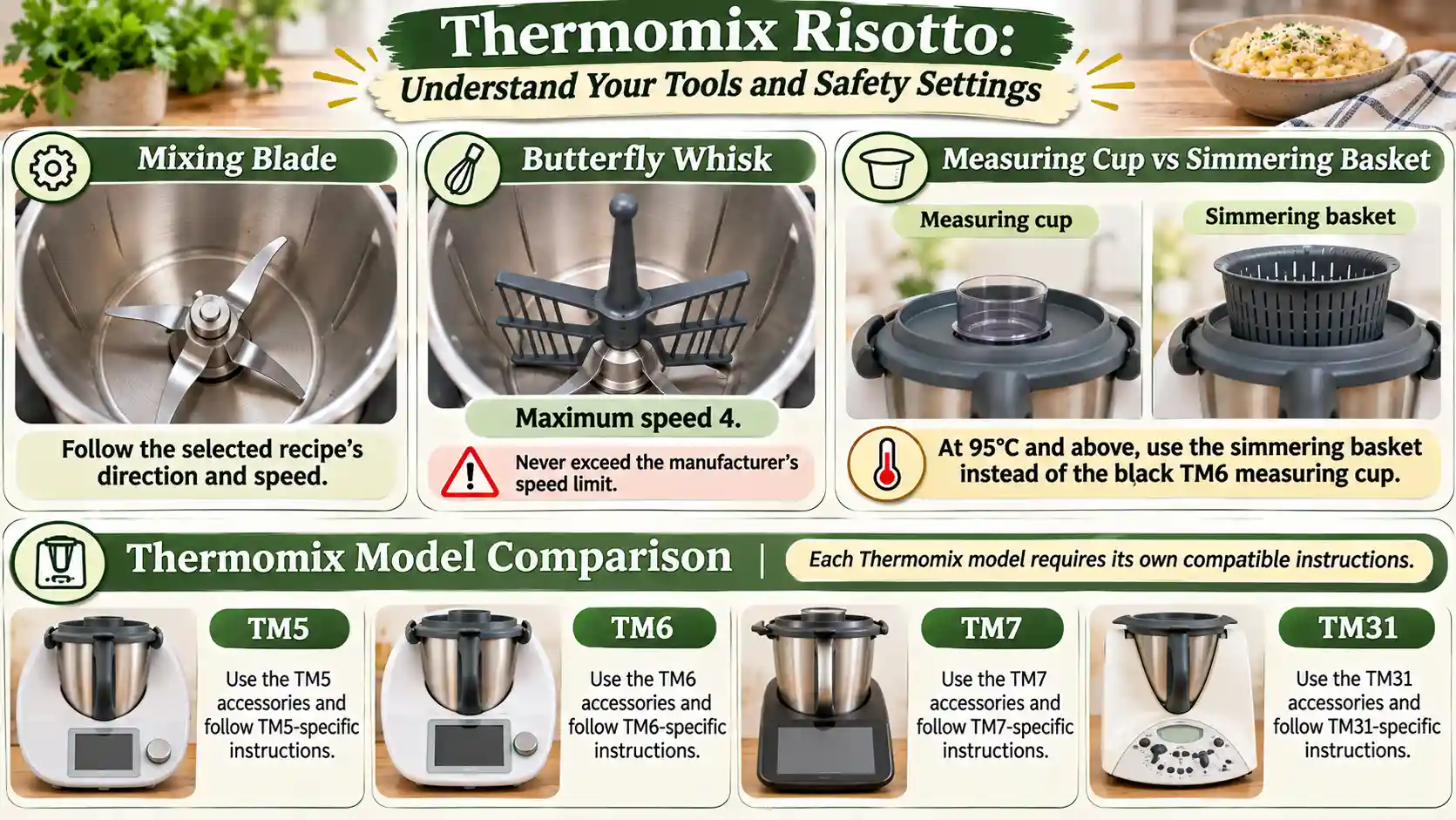
| Model | Accessory guidance | Bowl and safety considerations | Risotto setting |
| TM5 | Butterfly whisk maximum speed 4 | Respect the model’s maximum fill marking | Use a compatible, tested recipe |
| TM6 | Butterfly whisk maximum speed 4 | 2.2 L maximum bowl capacity; simmering basket instead of measuring cup at 95°C and above | Use a compatible, tested recipe |
| TM7 | Butterfly whisk maximum speed 4 | 2.2 L maximum bowl capacity; follow its redesigned lid and accessory instructions | Use a compatible, tested recipe |
| TM31 | Butterfly whisk maximum speed 4 | Follow the original manual’s bowl and accessory instructions | Use a compatible, tested recipe |
The TM7 has a redesigned mixing bowl and operating features that differ from older Thermomix generations. Its manual should be consulted rather than assuming that TM5 or TM6 instructions apply unchanged.
Vorwerk provides a useful collection of official Thermomix instruction manuals.
For additional appliance guidance, readers can explore the Kitchen Memo Kitchen Guides collection.
The master ratio and timing table
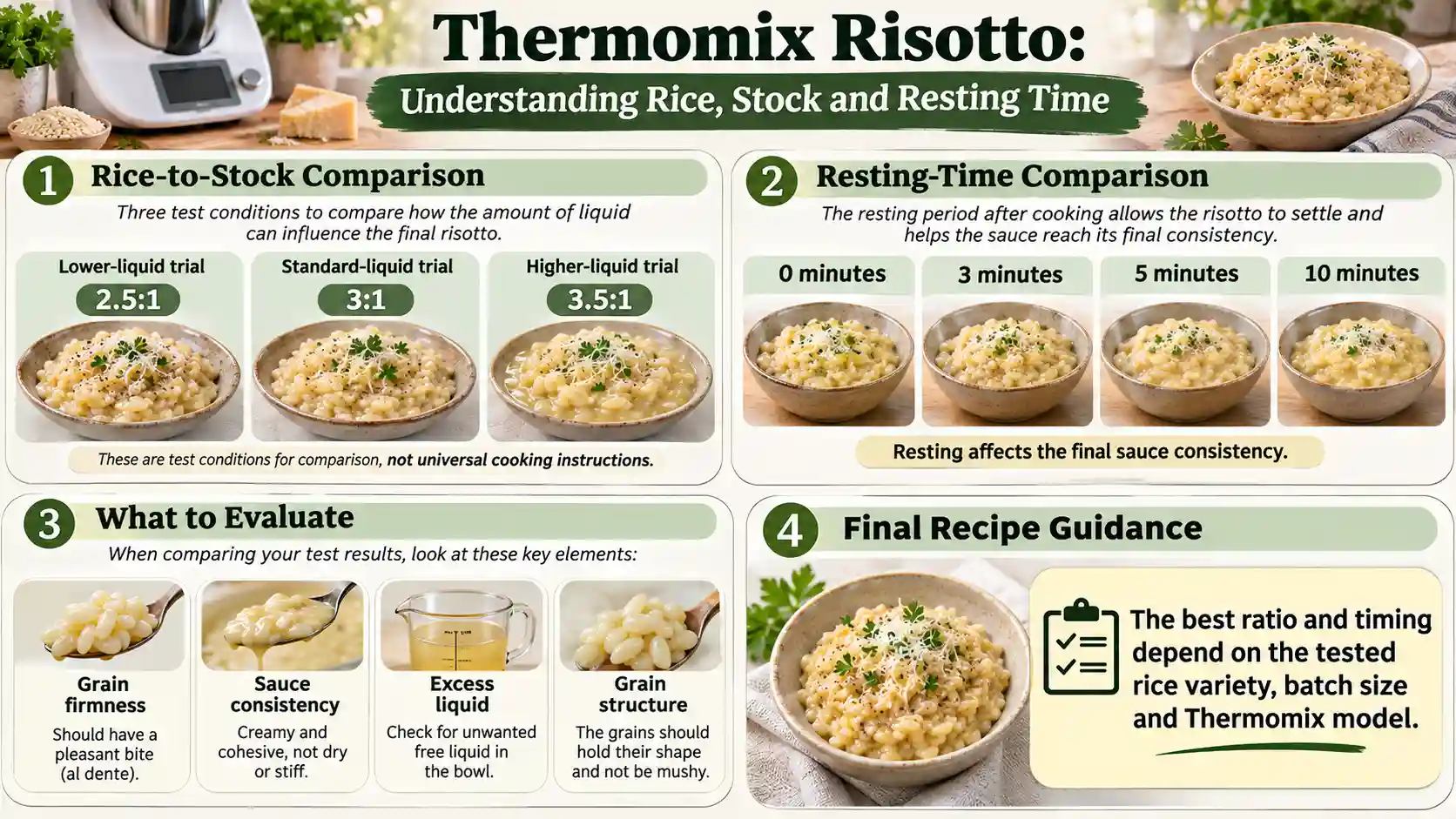
The rice-to-stock ratio is one of the most important factors in Thermomix risotto.
Too much stock can leave excess liquid around the grains, while insufficient liquid may prevent the rice from cooking properly.
However, a single ratio should not be presented as suitable for every rice variety, quantity and Thermomix model without a controlled comparison.
Published Thermomix risotto recipes can have different cooking times because they use different quantities, temperatures, rice varieties and mixing arrangements.
The suggested figures of 16 minutes at Varoma temperature and 25–30 minutes at 100°C are examples from the supplied research brief, not confirmed Kitchen Memo cooking recommendations.
The best approach is to compare different ratios under controlled conditions and record the actual texture.
Proposed rice-to-stock comparison
The following ratios are proposed trial points, not finalized recipe instructions.
| Test batch | Stock-to-rice ratio | Purpose |
| Lower-liquid batch | 2.5:1 | Examine whether the grains hydrate sufficiently without excess liquid |
| Standard-liquid batch | 3:1 | Compare balance between rice hydration and sauce consistency |
| Higher-liquid batch | 3.5:1 | Examine the effect of additional liquid on final consistency |
Use a consistent measurement basis, such as millilitres of stock per gram of dry rice, throughout the experiment. Do not mix different ratio conventions.
The final recommendation should be based on the cooked grains, sauce consistency and resting results.
Resting-time comparison
Risotto continues to change after cooking because the grains and sauce settle and the liquid distribution changes.
| Resting period | What to evaluate |
| Immediately after cooking | Initial sauce flow and grain firmness |
| 3 minutes | Changes in thickness and grain texture |
| 5 minutes | Whether the sauce remains creamy and cohesive |
| 10 minutes | Whether the risotto becomes excessively thick |
The ideal resting period should be selected according to the final serving consistency rather than assuming that every batch needs the same amount of time.
Ingredients and quantities
| Ingredient | Role in the recipe | Quantity |
| Arborio, Carnaroli or Vialone Nano | Main rice ingredient | Depends on tested batch size |
| Vegetable or chicken stock | Hydrates rice and adds flavour | Determined by the selected ratio |
| Onion or shallot | Provides the aromatic base | Determined by recipe testing |
| Olive oil or butter | Helps soften aromatics and coat rice | Determined by recipe testing |
| Dry white wine | Adds acidity and flavour | Optional |
| Parmesan | Adds savoury flavour and richness | Adjusted to taste |
| Additional butter | Finishing fat | Adjusted to taste |
The final recipe should provide exact ingredient weights and liquid measurements once the selected rice variety and batch have been tested.
Time, yield and equipment
| Recipe detail | Recommendation |
| Preparation time | Depends on ingredient preparation |
| Cooking time | Depends on the tested machine settings |
| Total time | Preparation plus validated cooking and resting |
| Servings | Calculate from the finalized rice quantity |
| Equipment | Thermomix, kitchen scale, chopping board and appropriate accessories |
| Bowl capacity | Follow the relevant model’s maximum fill mark |
| Halving | Recheck liquid and cooking behaviour |
| Doubling | Requires a separate capacity and cooking assessment |
The cooking time should not be transferred automatically between TM31, TM5, TM6 and TM7.
Readers who also prepare plain rice in their Thermomix can consult Kitchen Memo’s Thermomix Rice (Varoma): Water Ratios, Times & Fixes. That guide explains why simmering-basket cooking, Varoma-container cooking and other rice methods require different approaches.
The recommended step-by-step method
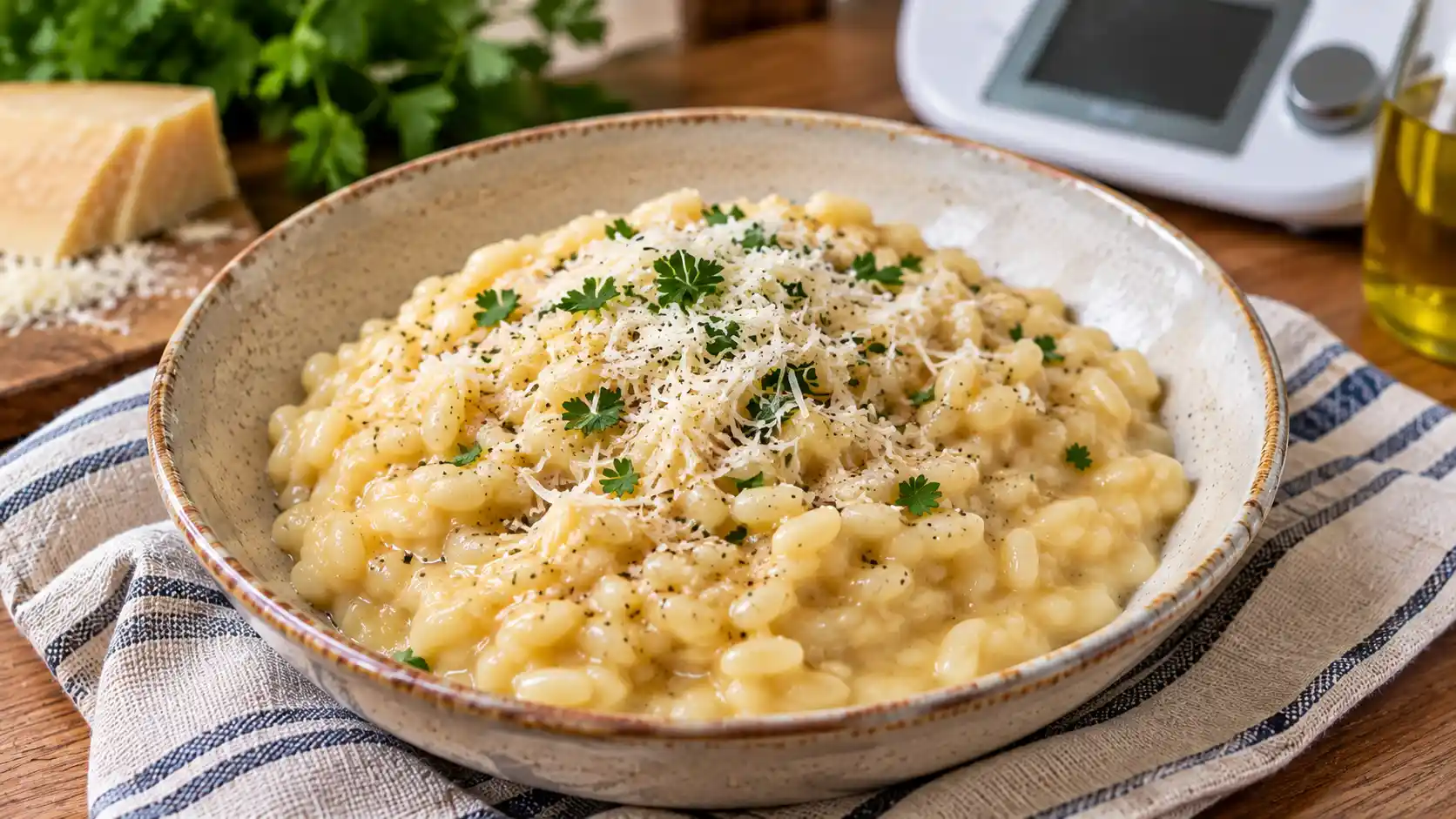
A good Thermomix risotto recipe follows a logical preparation sequence: soften the aromatics, coat the rice, introduce the cooking liquid, cook until the grains reach the desired texture and finish with butter and cheese.
The sequence below explains the method. Exact speed, temperature, direction, quantity and cooking time must follow a validated recipe for the particular Thermomix model.
Step 1: Prepare and soften the aromatics
Peel and prepare the onion or shallot.
Chop it using the appropriate model-specific setting, then add the measured olive oil or butter.
Sauté until softened and fragrant.
What to look for: The onion should be tender and aromatic without becoming dark or burnt.
Step 2: Toast the rice
Add the measured Arborio, Carnaroli or Vialone Nano rice.
Use the validated mixing arrangement to coat the grains with the cooking fat.
Toasting helps develop the flavour of the rice before the stock is introduced.
What to look for: The grains should be evenly coated and warmed, without excessive browning.
Step 3: Add wine and stock
If using white wine, add it according to the recipe’s method.
Allow the wine stage to finish before introducing the measured stock, where the selected recipe calls for separate stages.
The total stock quantity should correspond to the tested rice quantity and preparation method.
What to look for: The ingredients should be evenly distributed, with no dry rice trapped around the bowl.
Step 4: Cook using the correct Thermomix settings
Select the temperature, time, direction and speed specified for your Thermomix model.
Use the appropriate accessory and lid arrangement. When the butterfly whisk is fitted, remain within its maximum speed restriction.
For TM6 cooking at 95°C or above, follow Vorwerk’s simmering-basket instruction.
What to look for: The grains should cook evenly without excessive breaking or an unexpectedly rapid loss of liquid.
Step 5: Check the rice before finishing
The timer is useful, but it should not replace checking the actual grain texture.
Properly cooked risotto should be tender on the outside while retaining a slight bite in the centre.
The centre should not feel hard or chalky, and the grains should not collapse into a paste.
Step 6: Rest and finish
Finish the risotto with the measured butter and grated Parmesan according to the chosen recipe.
Allow it to stand before transferring it to serving plates.
What to look for: The sauce should be creamy and cohesive. It should spread gradually across a plate rather than running like thin soup or holding together like a firm rice cake.
Where most cooks go wrong
A common source of difficulty is assuming that the cooking time alone determines whether risotto is ready.
The same timer setting can produce different results when the rice variety, quantity, stock temperature or mixing arrangement changes.
Another mistake is adding extra stock without checking whether the rice is already cooked.
Always assess the grains and sauce separately. A watery sauce with properly cooked grains is a different problem from watery risotto containing undercooked rice.
What does properly cooked risotto look like?
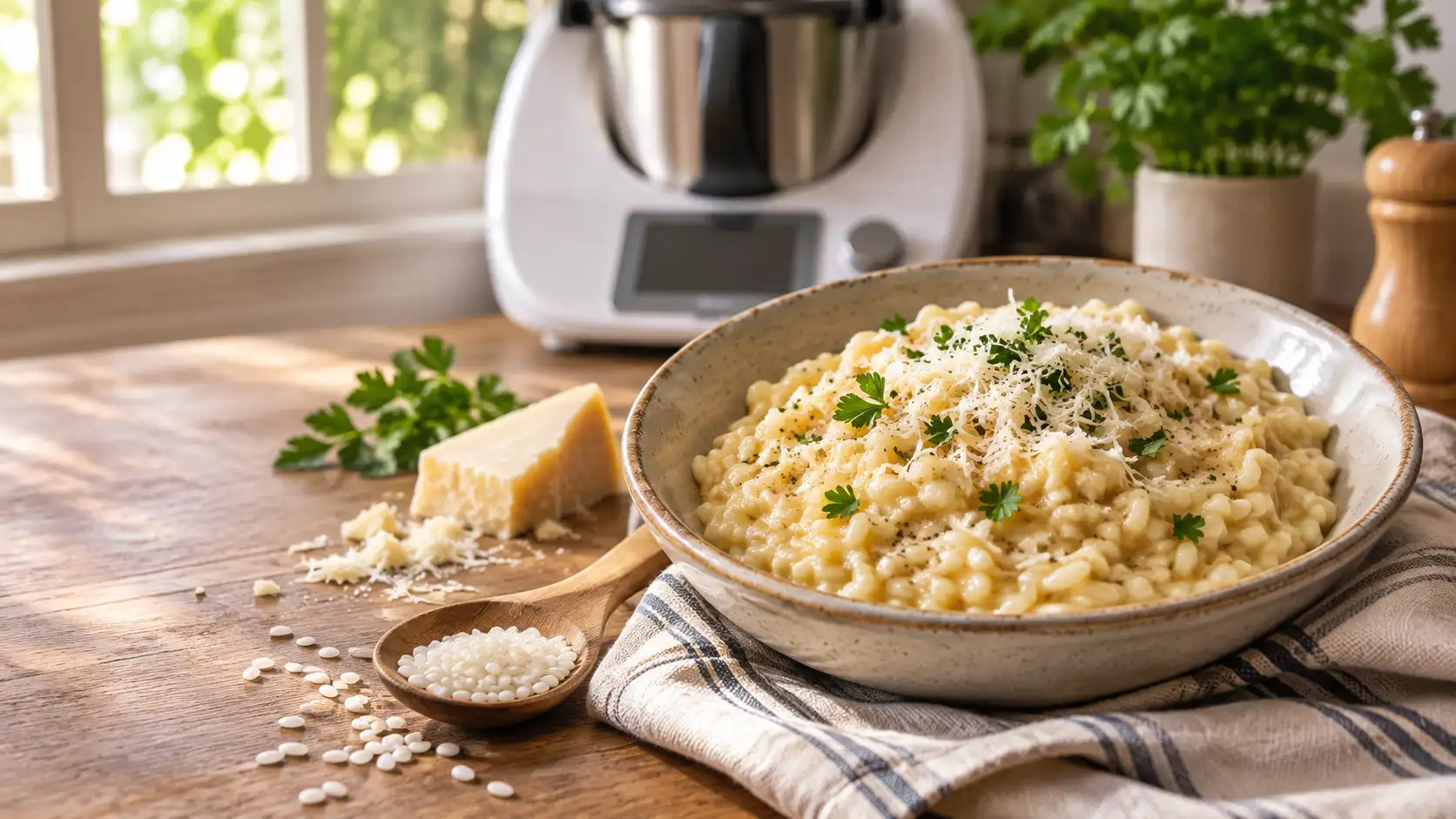
The finished grains should retain their individual shape while being surrounded by a smooth, creamy sauce.
When the risotto is placed on a plate, it should spread gently instead of forming a stiff mound.
A close-up photograph of the finished recipe should show:
- Distinct grains rather than broken rice paste.
- A tender exterior with a slight bite in the centre.
- A glossy, cohesive sauce.
- No excessive pool of watery stock.
- A natural Parmesan finish.
The final texture photograph should come from the actual Kitchen Memo test batch so readers can see the consistency produced by the recommended method.
Flavour variations on the same master method
The basic risotto method can be adapted with mushrooms, chicken, prawns, vegetables and different finishing ingredients.
However, each addition changes the cooking conditions.
Mushrooms can release liquid, prawns cook quickly, chicken requires safe internal cooking and dense vegetables may affect the mixing arrangement.
The most reliable approach is to retain the basic preparation sequence while adjusting ingredient timing according to the food being added.
Variation guide
| Variation | When to add | Liquid adjustment | Texture consideration |
| Mushroom risotto | Add according to the selected mushroom preparation | Account for moisture released by mushrooms | Avoid excess free liquid |
| Truffle risotto | Use mushroom base and finish with truffle flavour | Depends on the base recipe | Keep the truffle flavour balanced |
| Chicken risotto | Follow a validated chicken cooking sequence | Account for chicken quantity and moisture | Chicken must reach a safe internal temperature |
| Prawn risotto | Add near the finishing stage according to the tested method | Avoid unnecessary additional stock | Prevent overcooking |
| Vegetable risotto | Add according to vegetable density and cooking time | Depends on vegetable moisture | Maintain the intended grain texture |
| Vegetarian risotto | Use vegetable stock and suitable finishing ingredients | Maintain the tested base balance | Check seasoning and cheese ingredients |
| Pumpkin risotto | Prepare pumpkin separately or use a validated integrated method | Account for pumpkin moisture | Avoid obstructing the mixing attachment |
| Seafood risotto | Add seafood according to individual cooking requirements | Account for liquid released during cooking | Protect the texture of delicate seafood |
Thermomix mushroom risotto and truffle risotto
Mushrooms contribute savoury flavour but also release moisture as they cook.
That moisture can affect the final consistency of the risotto, particularly when the stock quantity is already close to the upper end of the selected ratio.
One useful approach to compare is preparing mushrooms separately, allowing their moisture to escape before incorporating them into the finished risotto.
This also offers greater control over the final mushroom texture.
For truffle risotto, use mushrooms as a flavour foundation and add the truffle ingredient during the finishing stage according to its form and strength.
The finished dish should retain the character of the rice rather than allowing the truffle flavour to overpower everything else.
Thermomix chicken risotto
Chicken risotto requires additional attention because the meat must cook safely without the rice becoming excessively soft.
Raw chicken should reach a minimum internal temperature of 165°F (74°C), measured using a food thermometer.
The USDA provides this recommendation in its safe minimum cooking temperature guidance.
Chicken may be prepared separately or incorporated using a method designed to cook the meat thoroughly.
Do not assume that a risotto cooking timer automatically establishes that the chicken is safe to eat.
Thermomix prawn risotto
Prawns cook more quickly than the rice in a typical risotto preparation.
Adding them too early can leave them overcooked by the time the rice reaches its desired consistency.
A practical approach to test is preparing the risotto base first and introducing the prawns near the end of cooking.
The actual addition point and cooking duration should reflect the prawn size and the tested preparation method.
Thermomix vegetable risotto and vegetarian risotto
Vegetable risotto is particularly flexible because different vegetables contribute different flavours, textures and amounts of moisture.
For example:
- Mushrooms release moisture during cooking.
- Pumpkin and sweet potato soften and contribute body.
- Peas need less cooking than many dense vegetables.
- Leafy vegetables generally require shorter cooking periods.
Dense or sticky vegetables should also be considered when using the butterfly whisk.
The attachment should not be overloaded with ingredients that could block or damage it.
For vegan Thermomix recipes, use suitable plant-based butter, vegetable stock and vegan Parmesan alternatives.
Vegetarian Parmesan should also be selected carefully because traditional Parmesan may contain animal rennet.
Readers looking for additional meal ideas can explore the Kitchen Memo Recipes collection.
Why did mine go wrong? Symptom → cause → fix
Most Thermomix risotto problems can be traced to liquid quantity, rice variety, cooking duration, mixing method or finishing technique.
The first step is identifying exactly what happened.
Adding more stock, extending the cooking time or increasing the speed without understanding the problem can make the texture worse.
Troubleshooting table
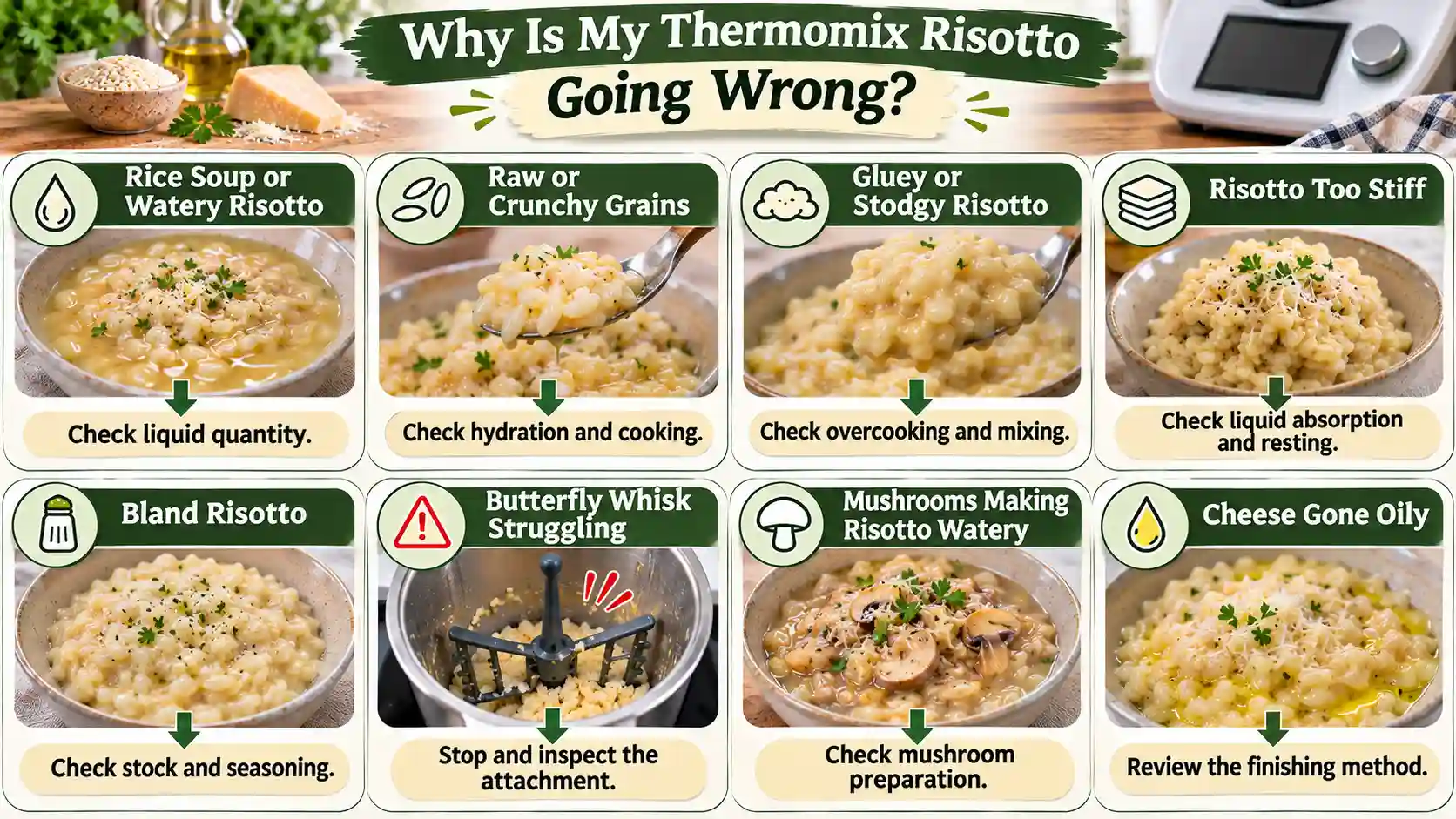
| Symptom | Likely cause | What to do now | How to prevent it |
| Rice soup or watery risotto | Excess stock or insufficient liquid reduction | Check whether the grains are cooked before deciding how to reduce the liquid | Measure stock accurately |
| Raw or crunchy grains | Insufficient hydration or cooking | Add a measured amount of suitable stock if needed and continue using an appropriate method | Match the liquid quantity and rice variety |
| Gluey or stodgy risotto | Overcooking, excessive agitation or broken grains | Avoid further aggressive mixing; adjust consistency only if possible | Control time, speed and mixing |
| Risotto too stiff | Excessive absorption during cooking or resting | Add a small amount of warm stock and stir gently | Evaluate the finished consistency after resting |
| Bland risotto | Weak stock or insufficient seasoning | Taste and adjust seasoning | Use appropriately seasoned stock |
| Butterfly whisk struggling | Attachment blocked or unsuitable ingredients | Stop the machine and inspect the attachment safely | Follow accessory instructions and speed restrictions |
| Mushrooms making risotto watery | Additional moisture released by mushrooms | Check the free liquid and avoid adding more stock unnecessarily | Prepare mushrooms separately when appropriate |
| Cheese becoming oily | Excess heat or poor finishing technique | Stop heating and evaluate the separated mixture | Follow a controlled finishing method |
Why is Thermomix risotto too runny?
Watery risotto usually indicates that the amount of liquid is too high for the quantity and type of rice under the selected cooking conditions.
However, the dish should not be judged immediately after the cooking cycle ends. The rice and sauce continue to settle.
First check whether the grains are properly cooked.
If the rice is tender but the sauce is too loose, the problem is different from a dish containing undercooked grains and excess stock.
Why is Thermomix risotto gluey?
Gluey risotto can result from excessive cooking, unsuitable mixing or grains breaking down.
Once the grains have lost their structure, additional cooking cannot restore them.
The better solution is prevention: use an appropriate rice variety, control agitation and check grain doneness before finishing.
Can you make Thermomix risotto without the butterfly whisk?
Yes, a risotto preparation does not automatically require the butterfly whisk.
Some methods use the mixing blade with gentle movement, while others use a specified accessory.
The important consideration is whether the selected method protects the grains and operates within the machine’s instructions.
For the TM6, reverse movement can help stir delicate ingredients without the usual chopping action. However, that does not establish a universal risotto speed or guarantee that every recipe will work without the butterfly.
Readers can explore more practical troubleshooting advice through the Kitchen Memo Cooking Tips collection.
Scaling, dietary adaptations, storage and nutrition
Thermomix risotto can be adjusted for different portions and dietary preferences, but changing the batch size or ingredients can affect liquid absorption and cooking behaviour.
The safest way to adapt the recipe is to make controlled changes and evaluate the finished texture.
Substitutions and dietary adaptations
| Dietary requirement | Suggested adaptation | Important consideration |
| Vegan | Plant-based butter, vegetable stock and vegan Parmesan alternative | Check that all finishing ingredients are vegan |
| Vegetarian | Vegetable stock and suitable vegetarian cheese | Traditional Parmesan may not be vegetarian |
| Dairy-free | Olive oil or suitable dairy-free fat | Expect changes in flavour and richness |
| Gluten-free | Gluten-free stock and appropriately labelled ingredients | Check packaged ingredient labels |
| Lower sodium | Reduced-sodium stock and controlled salt additions | Taste before adding extra salt |
Vegetables can improve the variety of ingredients in the finished meal, but they should be added in a way that maintains the rice’s cooking requirements.
Storage, make-ahead and reheating
Cooked risotto contains rice, which requires careful handling because uncooked rice can contain spores of Bacillus cereus.
These spores can survive normal cooking. If cooked rice remains at room temperature for too long, the bacteria can multiply and produce toxins.
The Food Standards Scotland guidance recommends cooling cooked rice quickly, ideally within one hour, refrigerating it promptly and consuming it within 24 hours.
It also recommends reheating rice only once and ensuring that it is steaming hot throughout.
Read the official Food Standards Scotland rice storage guidance.
| Storage stage | Recommended approach |
| Immediately after cooking | Transfer leftover risotto out of the hot Thermomix bowl |
| Cooling | Divide into smaller, shallow portions |
| Refrigeration | Chill within one hour and refrigerate promptly |
| Refrigerated storage | Consume within 24 hours |
| Freezing | Cool rapidly and freeze promptly if it will not be eaten within the refrigerated storage period |
| Defrosting | Defrost in the refrigerator |
| Reheating | Reheat once until steaming hot throughout |
Can you freeze Thermomix risotto?
Cooked rice dishes can be frozen when handled and cooled safely.
However, freezing can change the texture of risotto. After thawing, the grains may be softer and the sauce may no longer have the same creamy consistency as freshly prepared risotto.
For better results, freeze individual portions in suitable containers and label them with the preparation date.
Defrost in the refrigerator and reheat thoroughly. Follow the relevant food-safety advice rather than assuming that the frozen dish will retain its original texture.
The exact freezer storage period and the best method for restoring the original risotto consistency depend on the recipe and have not been established through a Kitchen Memo comparison.
Is Thermomix risotto healthy?
Thermomix risotto can fit into different eating preferences, but its nutritional profile depends on the ingredients, quantities and portion size.
Butter, Parmesan, stock and additional fats influence the final energy, fat and sodium content.
A few adjustments can change the nutritional composition:
- Reduce the amount of butter if less added fat is preferred.
- Add vegetables for greater variety.
- Choose reduced-sodium stock when appropriate.
- Adjust the Parmesan quantity according to taste.
- Keep serving sizes consistent.
Calories, protein, carbohydrates, fat and sodium should be calculated from the finalized ingredient quantities and actual serving weight.
Without a completed recipe and defined portions, publishing numerical nutrition estimates would risk giving readers misleading information.
Conclusion
Great Thermomix risotto depends on choosing suitable rice, measuring stock carefully, using the correct accessory and avoiding overcooking. TM5, TM6, TM7 and TM31 users should follow model-specific instructions rather than assuming identical settings. Get the rice and liquid balance right, protect the grain texture and allow the finished risotto to settle before serving.
FAQs
1. Do I need the butterfly whisk for Thermomix risotto?
Not necessarily. Some methods use gentle reverse blade movement, while others specify the butterfly whisk. Follow a tested method for your model.
2. How long does Thermomix risotto take?
Cooking time depends on rice variety, quantity, stock temperature, mixing arrangement and machine model. Use a compatible recipe.
3. Can I use basmati or cauliflower rice?
Yes, for adapted dishes, but neither produces the same traditional risotto texture. Both require different cooking and liquid adjustments.
4. Can I halve a Thermomix risotto recipe?
A smaller batch may need different liquid and cooking adjustments. Check the manufacturer’s minimum and maximum quantities before scaling.
5. How do I fix runny or gluey Thermomix risotto?
Check the rice doneness and remaining liquid first. Adjust a runny sauce carefully; overcooked, broken grains cannot be restored.
6. Can I freeze and reheat Thermomix risotto?
Yes, when cooled and frozen promptly. Defrost in the refrigerator, reheat once and ensure it is steaming hot throughout.
7. Is Thermomix risotto healthy?
It depends on ingredients and serving size. Butter, cheese, stock and vegetables all influence its nutritional composition.