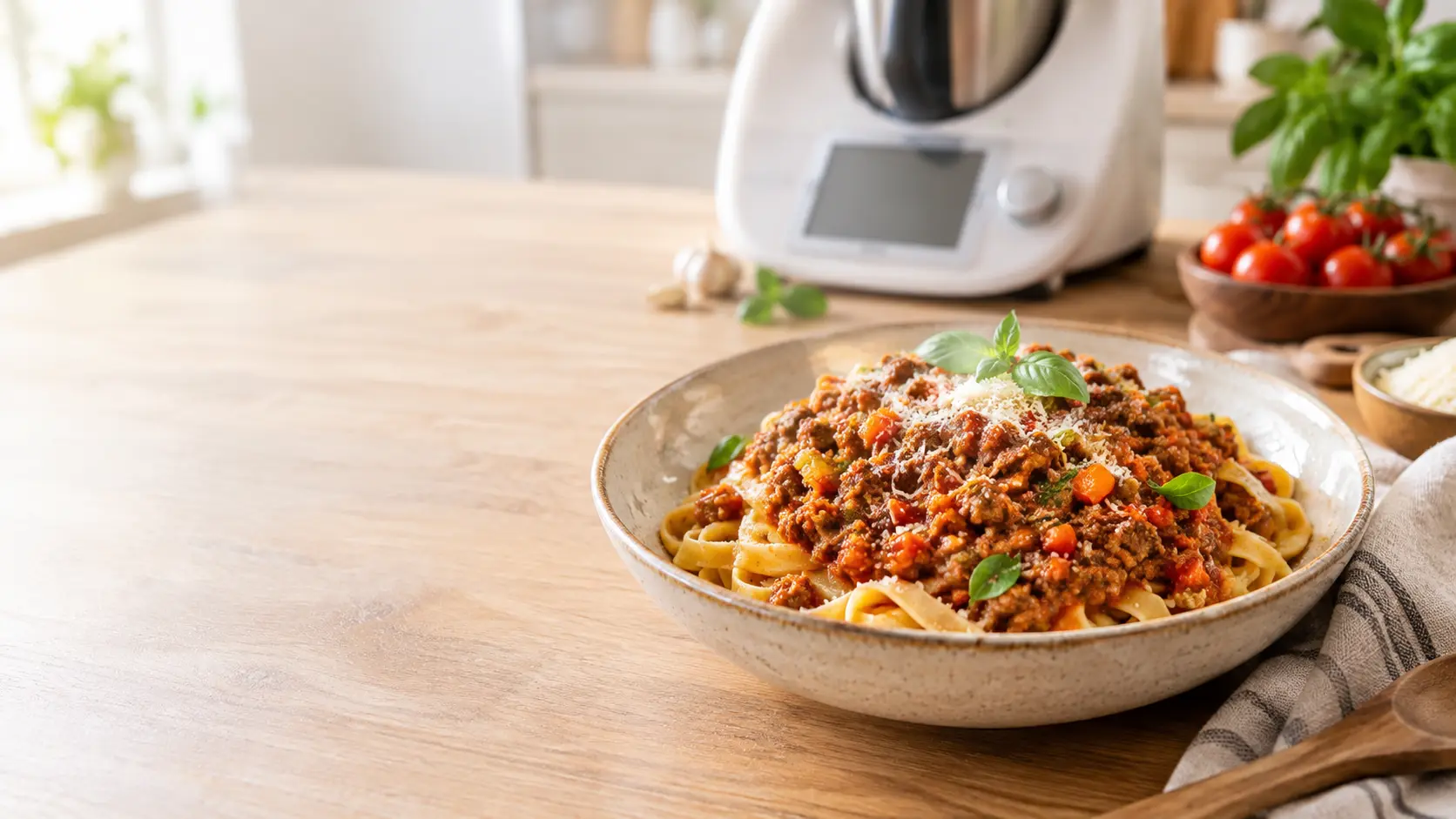
Thermomix bolognese sauce is fast, but it often comes out watery, or with the mince broken down to mush. It is a slow-simmered meat sauce built on a chopped soffritto (onion, carrot, celery), minced beef (often with pork), tomato and optional wine, made in the Thermomix bowl. This guide gives you a method that fits your model, the texture you want, and fixes for when your thermomix bolognese (or thermomix bolognaise, a common regional spelling) goes wrong.
Quick Summary
- The mince method decides the texture. Varoma or Butterfly for chunky, stirring in the bowl for a finer sauce (recommendation, untested).
- Watery sauce is nearly always a reduction problem. Cook with the simmering basket on instead of the measuring cup. That is also Thermomix’s own safety instruction at 95°C (200°F) and above.
- Beef plus pork gives a richer flavour and a softer bite than beef alone.
- Storage baseline (USDA general leftovers guidance): refrigerate within 2 hours, keep 3–4 days in the fridge, or freeze for 3–4 months for best quality. Treat these as upper limits for your own batch.
Thermomix vs. Stovetop Bolognese: What You Gain and Lose
A Thermomix saves most of the chopping and stirring, but its closed bowl traps steam, so less liquid evaporates than in an open pan and the sauce can finish looser. The blade’s stirring also breaks mince into small crumbs. That trade-off applies whether you call the result Thermomix meat sauce or Thermomix spaghetti sauce. This is an informational comparison, not a buying pitch: a good stovetop bolognese is still the benchmark for browning and reduction.
| Factor | Thermomix | Stovetop |
| Hands-on time | Less chopping and stirring; the exact saving depends on your model and batch | More chopping and occasional stirring |
| Browning depth | Limited by bowl temperature (see the model table below) | Deeper in a wide, hot pan |
| Evaporation | Lower in a closed bowl; improves with the simmering basket on | Higher in an open pan |
| Texture control | Blade and speed can crumb the mince; method choice matters | You control chunk size by hand |
| Cleanup | One bowl plus accessories | One pan plus board and knife |
| Batch size | Bowl maximum is 2.2 L | As large as your pan |
How much time and texture quality you gain or lose against the stovetop depends on your model and batch size, so the fairest test is cooking both side by side in your own kitchen.
Three Ways to Cook the Mince and What Each Does to Texture
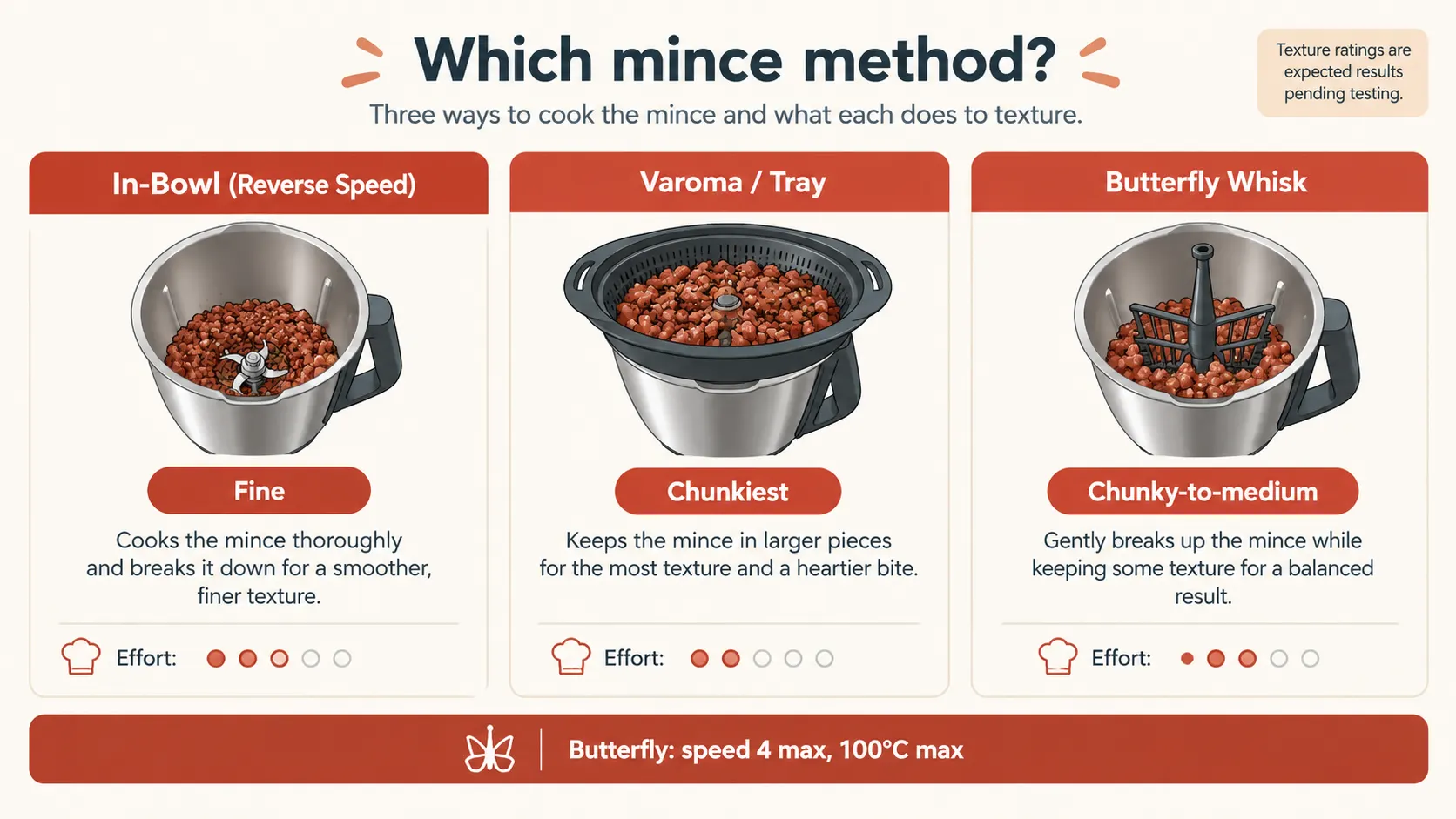
Cooking mince in the Varoma or with the Butterfly keeps it chunkiest; stirring it in the bowl gives a finer, saucier texture. The mechanism: the blade and direct bowl heat break mince into small crumbs, the Varoma steams it away from the blade, and the Butterfly moves it gently. Competing recipes disagree on mince handling and rarely explain why, so the table below ends with a “choose this if” verdict. The descriptions are expected outcomes based on how each method works, not measured test results, so cook the methods side by side to see the difference on your own machine.
In-Bowl (Reverse Speed)
Cook the mince directly in the bowl on reverse speed. Reverse turns the blade more gently than forward, but the blade still crumbs the mince, so the result is a finer sauce that clings to pasta and suits lasagne. A lower speed gives a chunkier result. Exact speed and time depend on your model, so start low and check the mince often.
Varoma or Varoma Tray
Steam the mince in the Varoma tray while the sauce base cooks in the bowl below. The mince never touches the blade, so it stays in larger pieces. The trade-off is flavour: steam is about 100°C, so the mince does not brown, and depth has to come from the sauce base or from browning the mince in a pan first. Steamed mince still needs to reach a safe internal temperature (see the method). Tray loading and steaming time depend on your model and how much mince you cook, so check your manual and steam until it is cooked through.
Butterfly Whisk
Fit the Butterfly and cook the mince in the sauce. It moves the mince around the bowl more gently than the blade does, so pieces stay larger. Thermomix limits the whisk to speed 4 at most, 100°C at most, and 2 hours at most, per the TM7 user manual. Scrub raw meat from the whisk thoroughly after use. Within those limits, the exact settings depend on your model.
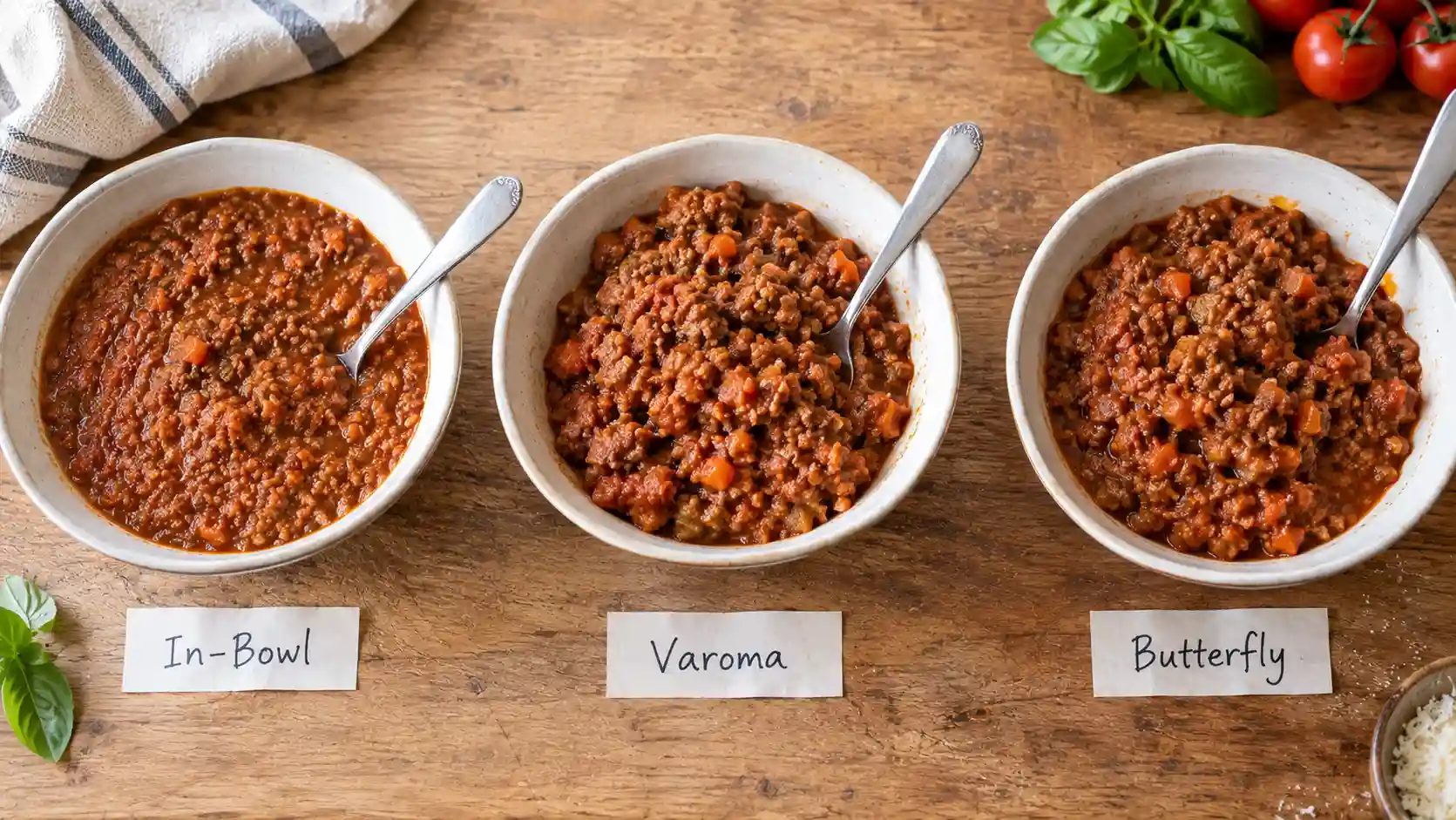
| Method | Texture (expected) | Flavour depth | Effort | Best for |
| In-bowl (reverse speed) | Fine, saucy crumb | Good if the mince is browned first | Lowest | Lasagne, pasta bakes, hidden-veg sauce |
| Varoma or tray | Chunkiest | Lowest unless browned in a pan first | Highest (extra parts to load and wash) | Very chunky sauce |
| Butterfly | Chunky to medium | Good | Low to medium (whisk to scrub) | Chunky spaghetti bolognese with one-bowl convenience |
Working verdict (untested): choose the Butterfly for a chunky thermomix bolognese with the least fuss, the Varoma for the chunkiest result, and in-bowl for a finer sauce. Confirm after testing. These choices also suit anyone searching for a chunky spaghetti bolognese Thermomix method or a Thermomix chunky bolognese.
Why Thermomix Bolognese Goes Wrong and How to Fix It
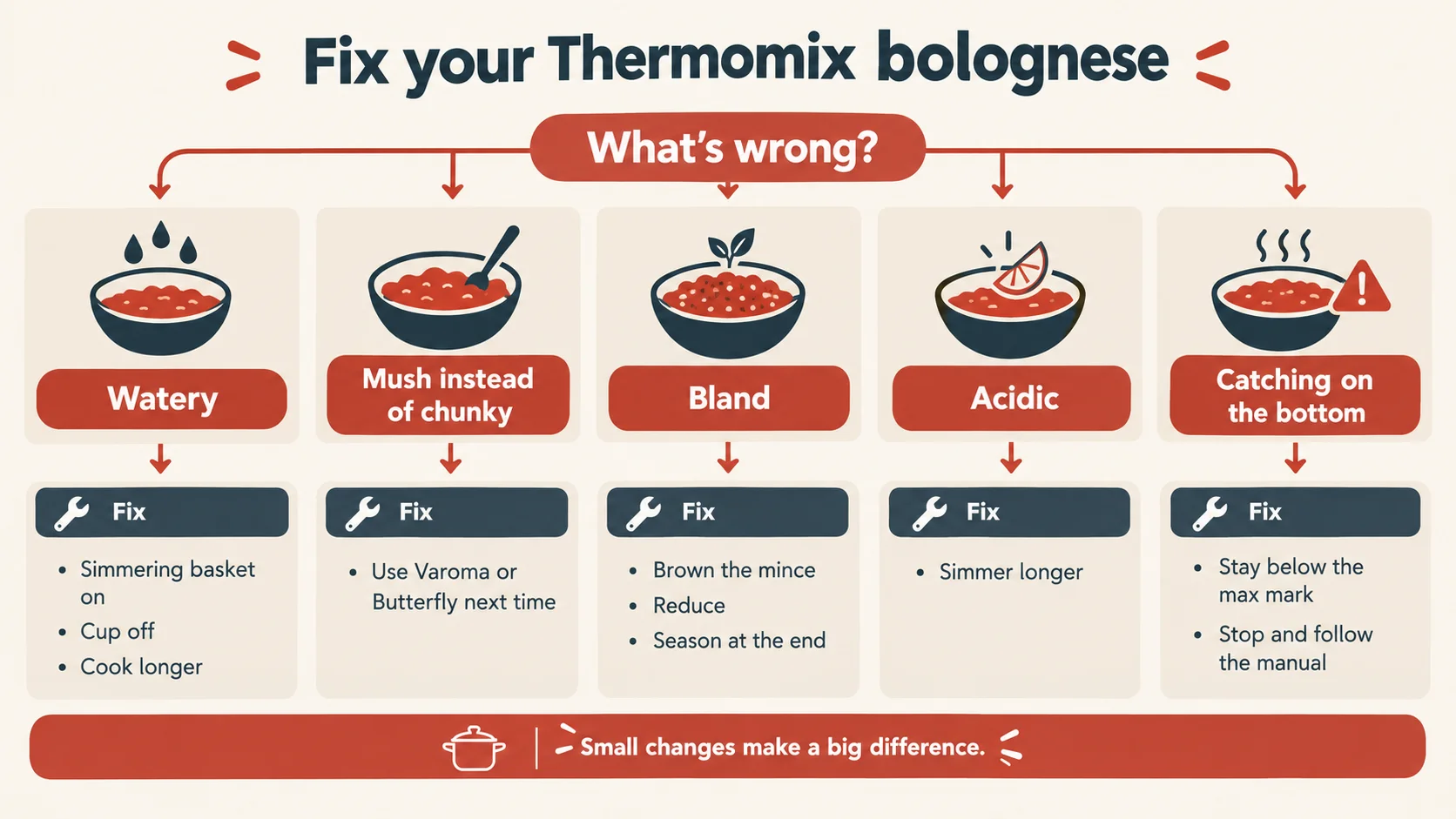
Most failures come from too much liquid, wrong mince handling, or skipped browning. Each problem below gets a cause, a fix and a prevention step. How much liquid is left after cooking, and how many extra minutes of reduction rescue a watery batch, depend on your tomatoes, batch size and model, so judge by the spoon-trail cue in the method rather than the clock.
| Problem | Why it happens | Fix | Prevention |
| Watery sauce | Trapped steam, high-water tinned tomatoes, measuring cup left in place | Keep cooking with the simmering basket on and the cup off; stir in a spoonful of tomato paste. Keep going until the spoon-trail cue appears | Add the least liquid that works; choose thick-pulp tomatoes |
| Mush instead of chunky | Method and speed: raw mince in contact with the blade at higher speed | You cannot un-crumb mince; use it as a finer sauce for lasagne or pasta bakes | Use the Varoma or Butterfly (speed 4 or lower), or a lower reverse speed |
| Bland flavour | No browning, under-seasoning, too little reduction | Reduce further, season at the end, add browned mince or cooked-off paste | Brown the mince in a pan first; taste and season after reducing |
| Acidic or sharp taste | Tomato brand or ripeness, short cook | Simmer longer; add a tiny pinch of sugar if needed | Taste the tomatoes; give the sauce time to reduce |
| Stuck or catching on the bottom | Overfilling, no stirring, reduction too hot | Stop the machine and follow the manual before scraping; see our guide to cleaning the Thermomix bowl | Stay below the max mark, keep stirring, avoid unnecessarily high temperature |
The same liquid-management logic applies to other Thermomix dishes, as in our thick, never-watery Thermomix pumpkin soup. Browning matters because browned meat develops far more flavour than meat that has only been simmered, a result of the Maillard reaction.
Thermomix Bolognese Sauce Recipe: The Recommended Method
Ingredients and Quantities
A reliable base is a soffritto, beef plus pork mince, tomato, stock or wine, and herbs. Each earns its place: carrot and celery add sweetness and body, pork adds richness and a softer bite, tomato adds acidity and body, and wine adds depth. Tinned tomatoes vary widely in water content by brand and style, so a thin, juicy tin needs longer reduction; look for thick, deep-red pulp rather than mostly juice. Our Thermomix tomato sauce guide compares fresh and tinned tomatoes, and our tomato paste explainer shows how paste adds body without extra water. A pork bolognese Thermomix version should taste richer than an all-beef one, though that is the expected result rather than a tested one. Quantities depend on your batch size, so weigh the ingredients and stay below the bowl’s max mark.
| Ingredient | Metric | US | Role in the dish |
| Onion | Varies by batch | Varies by batch | Sweet, savoury base |
| Carrot | Varies by batch | Varies by batch | Sweetness and body |
| Celery | Varies by batch | Varies by batch | Savoury depth |
| Olive oil | Varies by batch | Varies by batch | Softens the soffritto, carries flavour |
| Beef mince | Varies by batch | Varies by batch | Meaty flavour and chew |
| Pork mince | Varies by batch | Varies by batch | Richness and a softer bite |
| Tinned tomatoes | Varies by batch | Varies by batch | Acidity and body |
| Tomato paste | Varies by batch | Varies by batch | Concentrated tomato flavour, thickness |
| Dry wine (optional) | Varies by batch | Varies by batch | Depth and gentle acidity |
| Stock | Varies by batch | Varies by batch | Liquid and seasoning |
| Herbs, salt, pepper | To taste | To taste | Seasoning; salt after reducing |
Step-by-Step Method
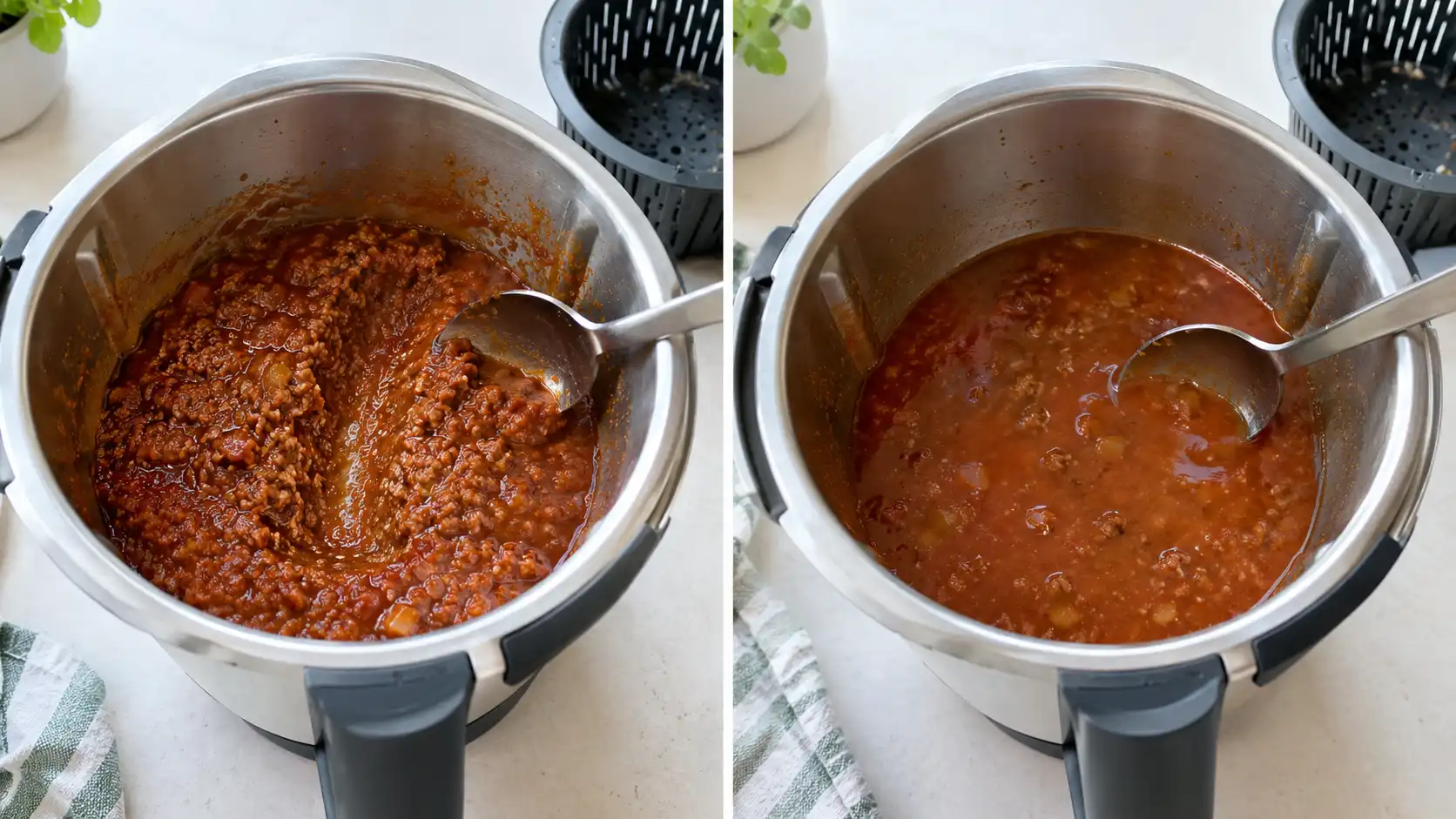
This is the thermomix bolognese sauce recipe flow. Speeds, times and temperatures vary by model, so use your manual together with the look, smell and sound cues in each step.
- Chop the soffritto. Onion, carrot and celery in the bowl. Chop in short bursts and check often; look for small, even pieces, not purée.
- Soften it in oil. Cook until soft and sweet-smelling, with no browning. Time and temperature vary by model, so go by the cue.
- Brown the mince. For the deepest flavour, brown it in a hot frying pan first, then add it to the bowl. Browning in the bowl is limited by temperature (see the model table), and settings vary by model. Cue: the raw pink colour is gone and you can see browned bits.
- Deglaze with wine (optional). Cue: the sharp alcohol smell fades, which takes longer with more wine.
- Add tomato, paste and stock. Use the least liquid that works and stay below the max mark. Quantities vary by batch.
- Reduce with the simmering basket on and the measuring cup off. This is the step where most cooks go wrong. The basket lets steam escape so the sauce thickens. It is also a safety rule: Thermomix says to use the simmering basket instead of the TM6 measuring cup when cooking at 95°C (200°F) and above, because the tight-fitting cup can let pressure build and cause sudden spillage of hot food. Cue: a spoon dragged across the base leaves a trail that closes slowly, with no loose pool of liquid around the mince. Time and temperature vary by model, so keep reducing until you see the cue.
- Check the mince and season. Use a food thermometer: USDA’s safe minimum for ground meats is 160°F (71°C). Do not rely on colour, especially for Varoma or Butterfly mince that was never browned. Then season and taste for acidity.
For spaghetti, serve over cooked pasta; a thermomix spaghetti bolognese is an adapted dish (see the tradition section below).
Model differences (TM5, TM6, TM7). Where a cell says “same”, the feature is identical. Our Kitchen Guides cover more Thermomix basics. Facts below come from Thermomix and Vorwerk sources; tested settings are still needed. For temperature ranges see Thermomix’s TM5 vs TM6 comparison and Vorwerk’s TM7 page.
| Step or feature | TM5 | TM6 | TM7 |
| Bowl capacity | 2.2 L | Same | Same |
| Lid opening at 95°C+ | Use the simmering basket if you fit a TM6 cup; the cup that sits loosely on a TM5 is a different part | Simmering basket, not the tight-fitting TM6 cup | Follow the TM7 manual and check it for your machine |
| Browning mince in the bowl | Manual temperature up to 120°C | Up to 160°C, only in Guided Cooking | Browning mode available in manual cooking |
| Butterfly whisk | Speed 4 maximum | Same | Same |
| Varoma / steaming | Varoma temperature setting | Same | Steaming mode instead of a Varoma temperature (per published comparisons; check your machine) |
| Settings for this recipe | Not yet tested on this model | Not yet tested on this model | Not yet tested on this model |
Time, Yield and Fill Line
Prep time, cook time and servings depend on your model and batch size. When doubling, never fill past the bowl’s “max” mark, which is 2.2 litres per the TM7 user manual. Overfilling risks spills and leaves no room for steam, which blocks evaporation and keeps the sauce watery. If a double batch will not fit, cook in two batches or finish the reduction in a wide pan. Doubled batches have not been tested here, so check the sauce thickness before serving.
How Thermomix Bolognese Differs from Traditional Ragù
In 1982 the Italian Academy of Cuisine (Accademia Italiana della Cucina) filed a classic ragù recipe with the Bologna Chamber of Commerce, which has since recorded an updated reference text and notes that the recipe is a guide, not the only possible version. It was filed to dress tagliatelle, not spaghetti. The earlier text, as reproduced on Bologna’s official tourism portal, is meat-forward: about 450 g of beef and pork to 300 g of tomato, with white wine and milk. Many Thermomix versions use more tomato (volume, family taste), which makes “spaghetti bolognese” its own adapted dish. Beef-only is leaner and less rich than beef and pork, and wine adds depth. This is general culinary background, not the result of a taste test.
Prevention and Next Steps: Storage, Freezing and Reheating
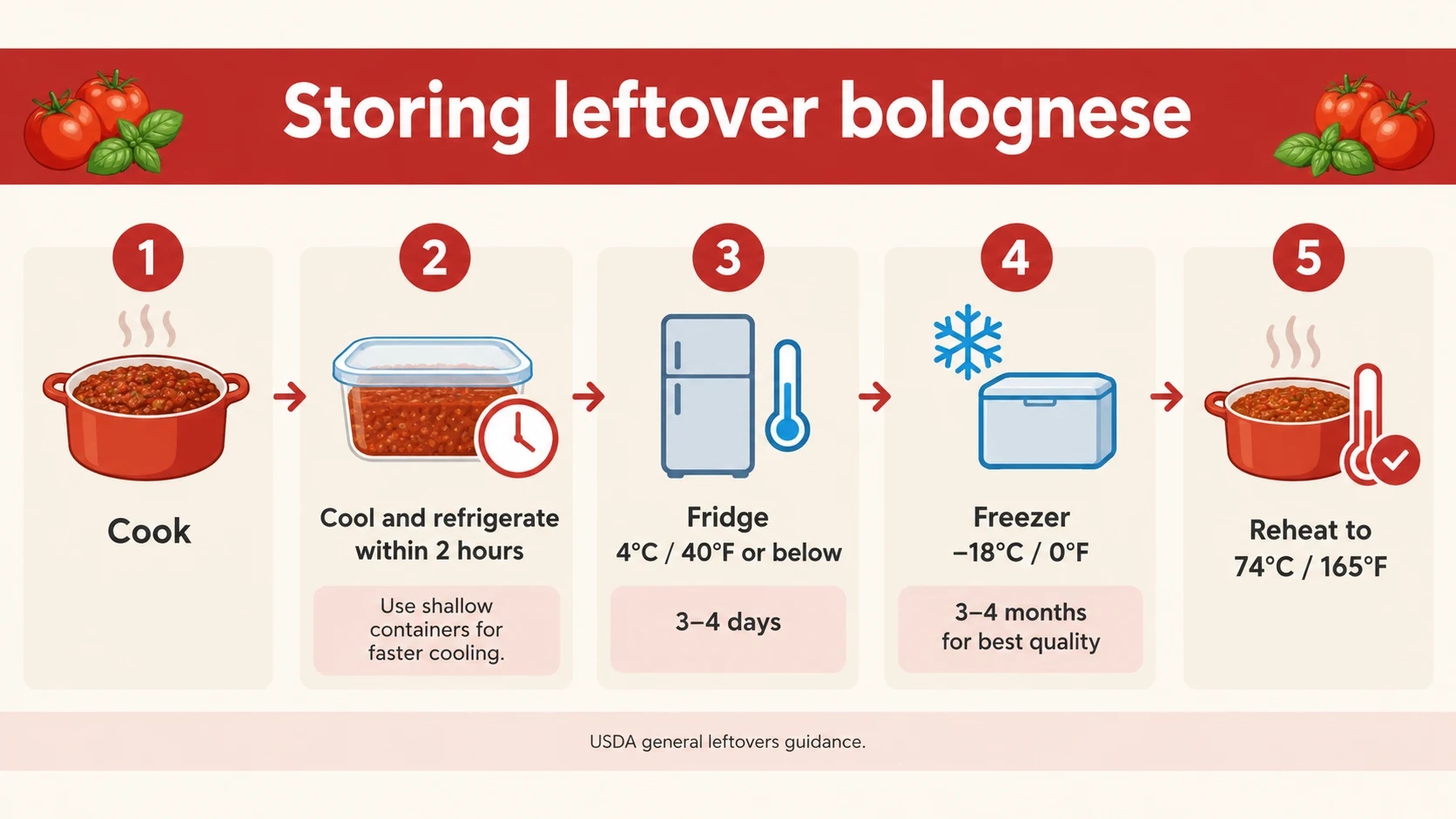
Cool quickly, then refrigerate or freeze in portions. USDA’s leftovers and food safety guidance says to refrigerate within 2 hours, divide large amounts into shallow containers, keep leftovers 3–4 days in the fridge or 3–4 months in the freezer, and reheat to 165°F (74°C). Portions also cool, thaw and reheat faster and more evenly. For related tips, see our guide to freezing Thermomix soups. How the texture holds up after thawing depends on your freezer and portion size, so treat the USDA durations as upper limits.
| Storage method | Container | Duration | Reheat method | Spoilage signs |
| Fridge (4°C / 40°F or below) | Shallow, airtight | 3–4 days (USDA baseline) | Heat to 165°F (74°C), stirring until steaming hot throughout | Off smell, slime, mould. Harmful bacteria cannot be seen, smelled or tasted, so go by time and temperature |
| Freezer (−18°C / 0°F) | Portioned, freezer-safe, airtight | 3–4 months for best quality (USDA baseline); texture may change after thawing | Thaw in the fridge or reheat from frozen; reach 165°F (74°C) | Dry patches or freezer burn, flat or off flavour after thawing |
Adaptations: Hidden Veg, Lasagne, Baby-Friendly, Dairy-Free, No Wine
Use the swaps below, and check ingredient labels for allergens and dietary claims.
| Need | Swap | What changes in taste and texture |
| Hidden veg | Blend extra vegetables into the sauce | Adds water, so reduce longer (see the troubleshooting table); sweeter, smoother |
| Lasagne | Reduce further until the sauce is thick | Holds its shape between layers instead of weeping |
| Baby-friendly | No wine; reduced or no added salt; low-salt stock | Milder, less depth; finer texture if blended. For feeding questions, follow your child’s health professional |
| Dairy-free | Cook in olive oil; add no milk, butter or cheese | Naturally dairy-free when made this way; check stock and tin labels |
| No wine | Stock plus a splash of vinegar, or extra tomato | Slightly less deep flavour |
| Same-session pasta | Cook pasta in the same session | Not tested yet, so treat it as an experiment and keep the bowl below the max mark |
Conclusion
For a chunky, non-watery Thermomix bolognese sauce, choose the mince method for your texture, reduce with the cup off and the simmering basket on, and adjust settings for your model. When a batch misbehaves, go back to the troubleshooting table; for a baseline, follow the recommended method. More fixes live in our Cooking Tips, and more Thermomix mains in our Recipes.
FAQs
Why is my Thermomix bolognese watery?
Too much liquid and trapped steam. Reduce with the measuring cup off and the simmering basket on, then cook longer.
How do I keep the mince chunky in a Thermomix?
Use the Varoma or Butterfly method and avoid high-speed stirring.
Can I use beef only instead of beef and pork?
Yes. The sauce will be slightly leaner and less rich.
Do I need wine?
No. Swap in stock plus a splash of vinegar or extra tomato; expect a slightly less deep flavour.
Can I double the recipe?
Only up to the max fill line. Otherwise cook in two batches or finish in a pan. Doubled batches have not been tested here.
How long does it keep, and can I freeze it?
USDA’s general baseline is 3–4 days refrigerated and 3–4 months frozen for best quality; treat those as upper limits.
Can I cook the pasta in the same session?
It has not been tested here, so treat it as an experiment: keep the bowl below the max mark and make sure the sauce is thick enough first.