Can you freeze Thermomix soup? Yes. Most blended vegetable, tomato, pumpkin, lentil, and broth-based chicken soups freeze well when cooled, portioned, and stored correctly. The biggest challenge is texture: cream and coconut milk may separate, while potatoes, rice, and noodles can become grainy or mushy. For the most reliable result, freeze the soup base before adding delicate ingredients, then finish the soup after thawing. This guide explains which Thermomix soups freeze well, how long to store them, and how to reheat them safely.
Quick Summary
- Freeze as is: Most blended vegetable, carrot, pumpkin, tomato, lentil, and broth-based soups.
- Freeze with a tweak: Chicken noodle, minestrone, and leek and potato soups may need adjustments to preserve their texture.
- Best storage window: Aim for 2–3 months for the best quality. Soup kept continuously frozen at 0°F (−18°C) remains safe longer, although quality can deteriorate.
- Best texture fix: Reheat thoroughly and briefly re-blend smooth soups if needed. Re-blending will not reverse every texture change.
Can You Freeze Thermomix Soup? Which Soups Freeze Well and Which Don’t
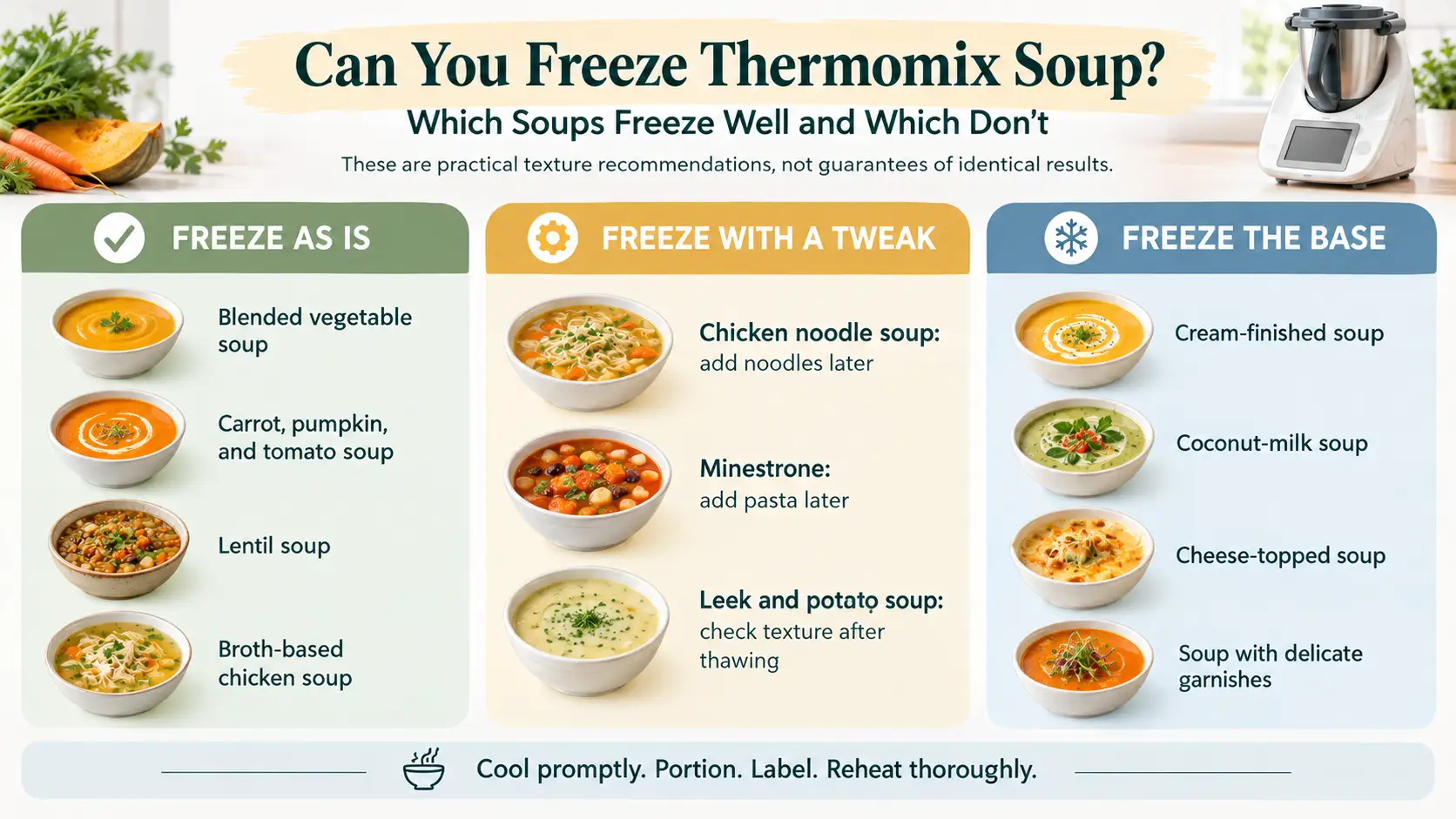
Yes. Most Thermomix soups can be frozen, but the best approach depends on the ingredients and the texture you want after reheating. Use three categories: freeze as is, freeze with a tweak, or freeze the base and finish later.
Freeze as is
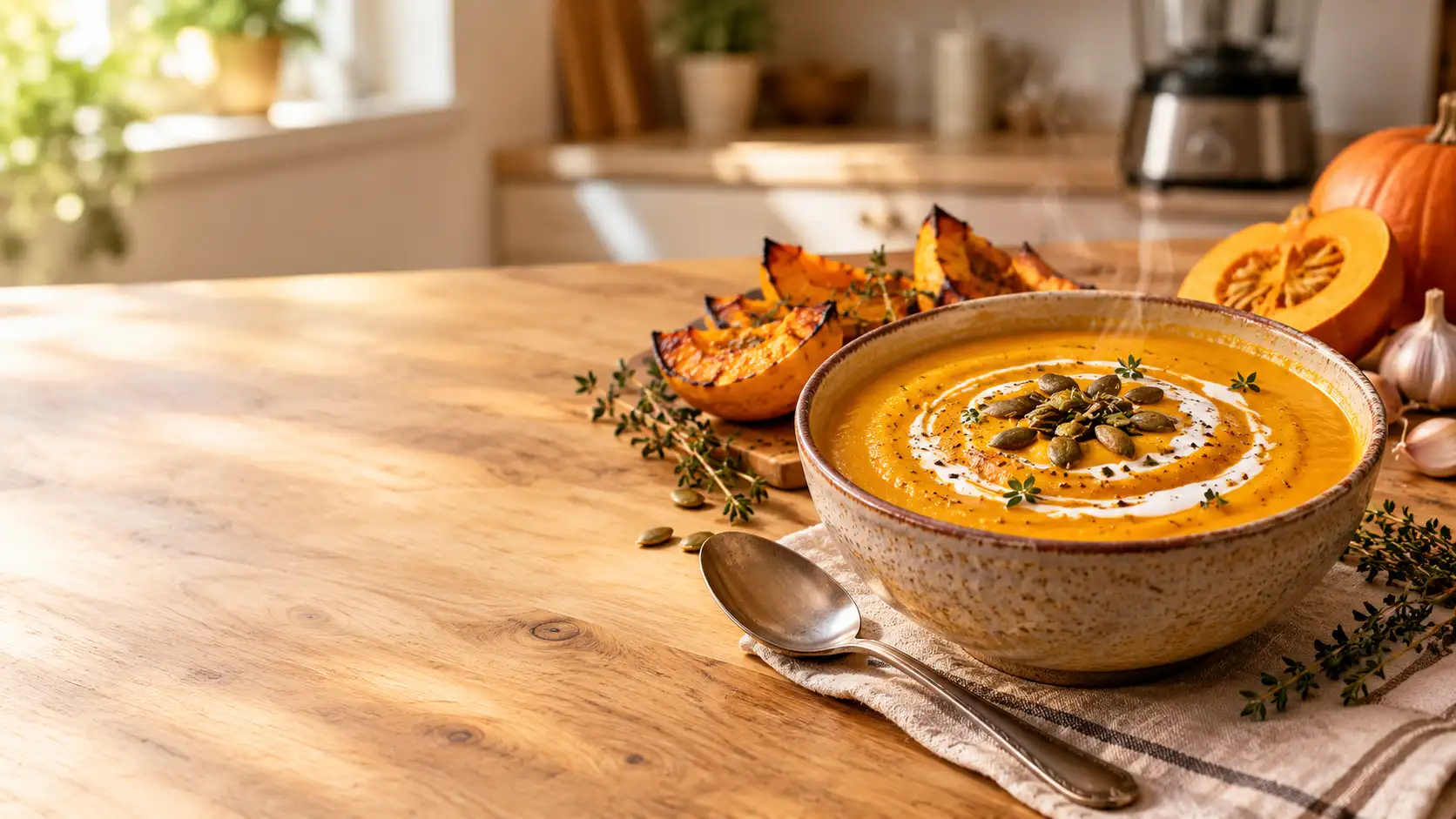
Smooth vegetable soups without delicate additions are generally the easiest to freeze. Tomato, carrot, pumpkin, and lentil soups are practical choices, as are many vegan Thermomix soups made with vegetables, legumes, stock, and seasoning.
For example, Kitchen Memo’s Thermomix pumpkin soup guide explains how ingredient moisture and liquid balance affect the finished soup. If you normally add cream or fresh herbs, consider reserving them until serving.
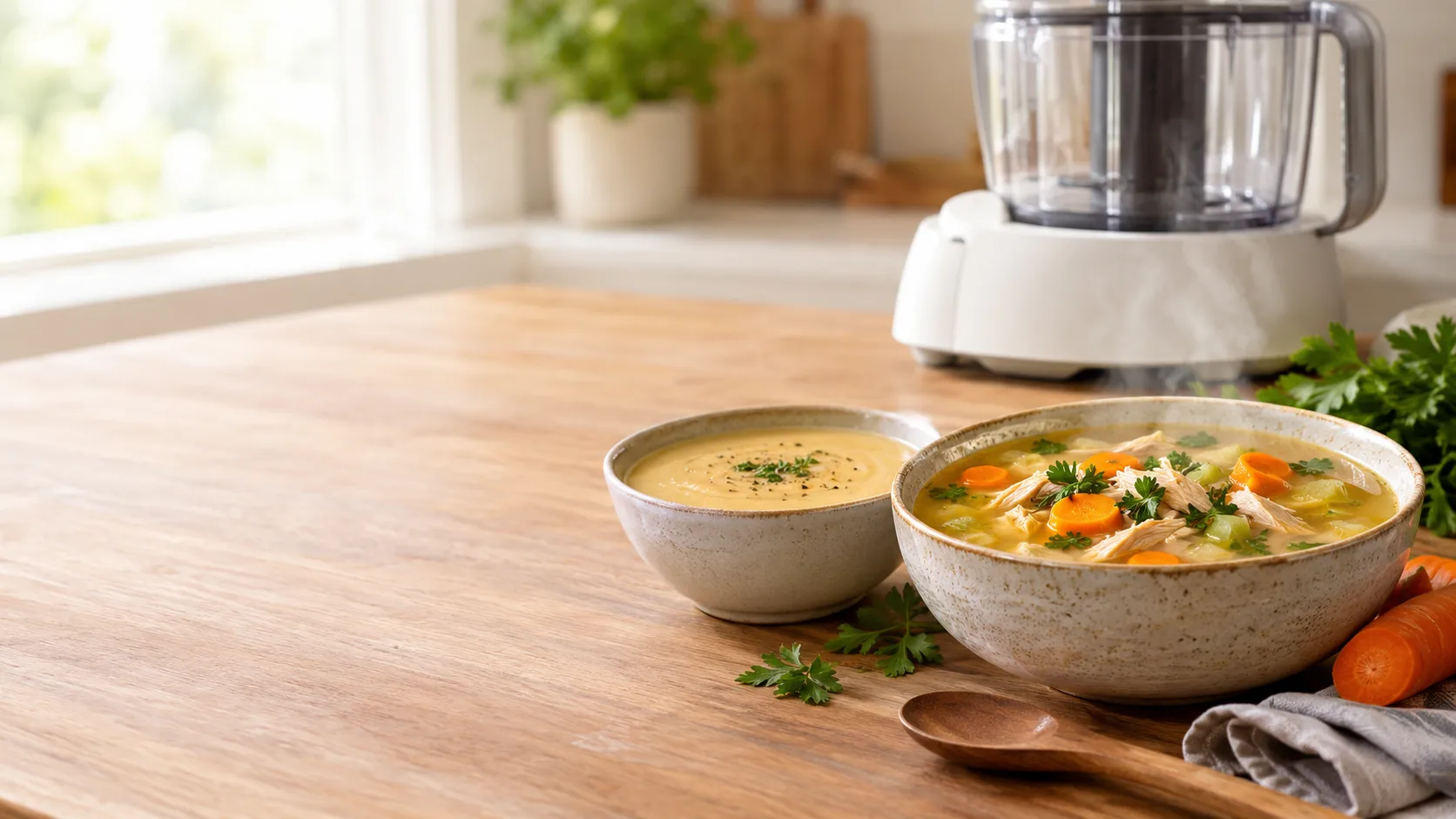
Broth-based chicken soup also works well as a freezer meal. Freeze cooked chicken with its broth and vegetables, accepting that some vegetables may soften after thawing. See the Thermomix chicken soup guide for related preparation and appliance guidance.
Freeze with a tweak
Some soups are worth freezing, but separating delicate ingredients can improve the result.
- Chicken noodle soup: Freeze the chicken-and-broth base without the noodles. Add freshly cooked noodles during reheating.
- Minestrone: Freeze the vegetable and bean base, then cook pasta separately and add it after thawing.
- Leek and potato soup: Freeze in portions and check the texture after reheating. Blending may help if the soup becomes slightly grainy.
- Cream-finished soup: Freeze before adding cream, then incorporate it while reheating.
- Chicken and vegetable soup: Freeze as is if you are happy with softer vegetables, or reserve delicate vegetables for later.
Don’t freeze, or rethink
Cream, cheese, and coconut milk do not automatically make soup unsuitable for freezing. The main concern is that the finished soup may separate, become grainy, or lose its original consistency.
Cheese toppings, croutons, fresh herbs, and toasted bread are usually better added just before serving. For a dish with separate bread and cheese toppings, such as French onion soup made in the Thermomix, keeping the toppings separate also helps retain their intended texture.
The better choice for a delicate creamy soup is often to freeze the base and add the finishing ingredients later.
Freeze as is vs. freeze base and finish later
| Approach | Best for | Main advantage | Main drawback |
| Freeze as is | Blended vegetable soups and broth-based soups | Quick and convenient | Texture may change slightly |
| Freeze the base | Creamy, coconut-milk, or cheese-finished soups | Greater control over final consistency | Requires a finishing step |
| Freeze without starches | Chicken noodle and minestrone soups | Keeps pasta from becoming overly soft | Pasta must be prepared later |
Soup-by-soup guide
The following table gives ingredient-based recommendations rather than claiming measured Kitchen Memo test results. Actual texture and flavour depend on the recipe, freezing duration, thawing method, and reheating technique. Comparative freezer-test results have not yet been recorded for these soup combinations.
| Soup | Recommendation | What to change | Texture after thaw | Flavour after thaw |
| Carrot, pumpkin, or tomato | Freeze as is | Add delicate herbs later | Check thickness and smoothness after reheating; results vary by recipe | Taste after reheating; no side-by-side Kitchen Memo results are available |
| Lentil or vegan vegetable | Freeze as is | Adjust liquid after thawing if needed | Lentils may thicken the soup during storage; assess the consistency | Recheck seasoning after reheating |
| Chicken and vegetable | Freeze as is | Expect vegetables to soften | Vegetable firmness will depend on the cuts and cooking method | Taste after reheating; comparative results are not yet available |
| Chicken noodle | Freeze with a tweak | Leave noodles out | Freshly cooked noodles avoid the additional softening caused by storage in broth | Season the base after reheating |
| Minestrone | Freeze with a tweak | Add pasta later | The base can be adjusted separately from the pasta | Check seasoning after reheating |
| Leek and potato | Freeze with a tweak | Re-blend briefly if necessary | Potato texture may become grainy or pasty | Taste and adjust after reheating |
| Cream-, cheese-, or coconut-milk-finished | Freeze the base | Add delicate ingredients later | Separation or graininess is possible with the finished mixture | Taste after finishing; comparative results are not yet available |
Why Some Thermomix Soups Freeze Better Than Others
Freezing affects water distribution and the structure of some ingredients. Vegetables can soften, starch-rich foods may become grainy or mushy, and creamy mixtures can separate during thawing.
Dairy and coconut milk
Cream and coconut milk can separate or develop a grainy appearance after freezing. The soup may still be usable, but the mouthfeel may change. Freezing the base without these ingredients gives you more control over the finished texture.
Potato, rice, noodles
Potatoes can become grainy or pasty, while rice and pasta can absorb liquid and soften further during storage. For chicken noodle soup and minestrone, cooking pasta separately is a practical way to avoid overly soft noodles.
Potatoes also behave differently depending on their preparation. Kitchen Memo’s Thermomix potato bake guide discusses how potato starch influences texture in a different dish; soup will behave differently because it contains more free liquid.
Why the Thermomix helps
Many Thermomix soups are blended, making it easier to restore a smooth consistency after thawing. A short, careful re-blend may improve a soup that has separated slightly. It cannot restore the original texture of every damaged ingredient, however, and over-blending can make starchy soups pasty.
How to Freeze Thermomix Soup Step by Step
The practical method is straightforward: cool promptly, portion, label, and freeze. Leave delicate ingredients out if they are likely to compromise the finished texture.
Cool the bowl contents first
Transfer soup from the Thermomix mixing bowl into shallow, heat-safe containers. Smaller portions cool faster than one deep container and are easier to freeze and reheat.
Follow the food-safety guidance applicable to your location. The USDA permits hot food to go directly into the refrigerator or to be rapidly chilled in an ice or cold-water bath. Its leftover safety guidance recommends prompt refrigeration or freezing. The UK Food Standards Agency’s chilling, freezing, and defrosting guidance recommends cooling food quickly and refrigerating it within one to two hours.
Do not leave a full bowl of soup on the counter for hours to cool. The refrigerator cools and holds the soup; the freezer is for longer storage.
Portion and choose a container
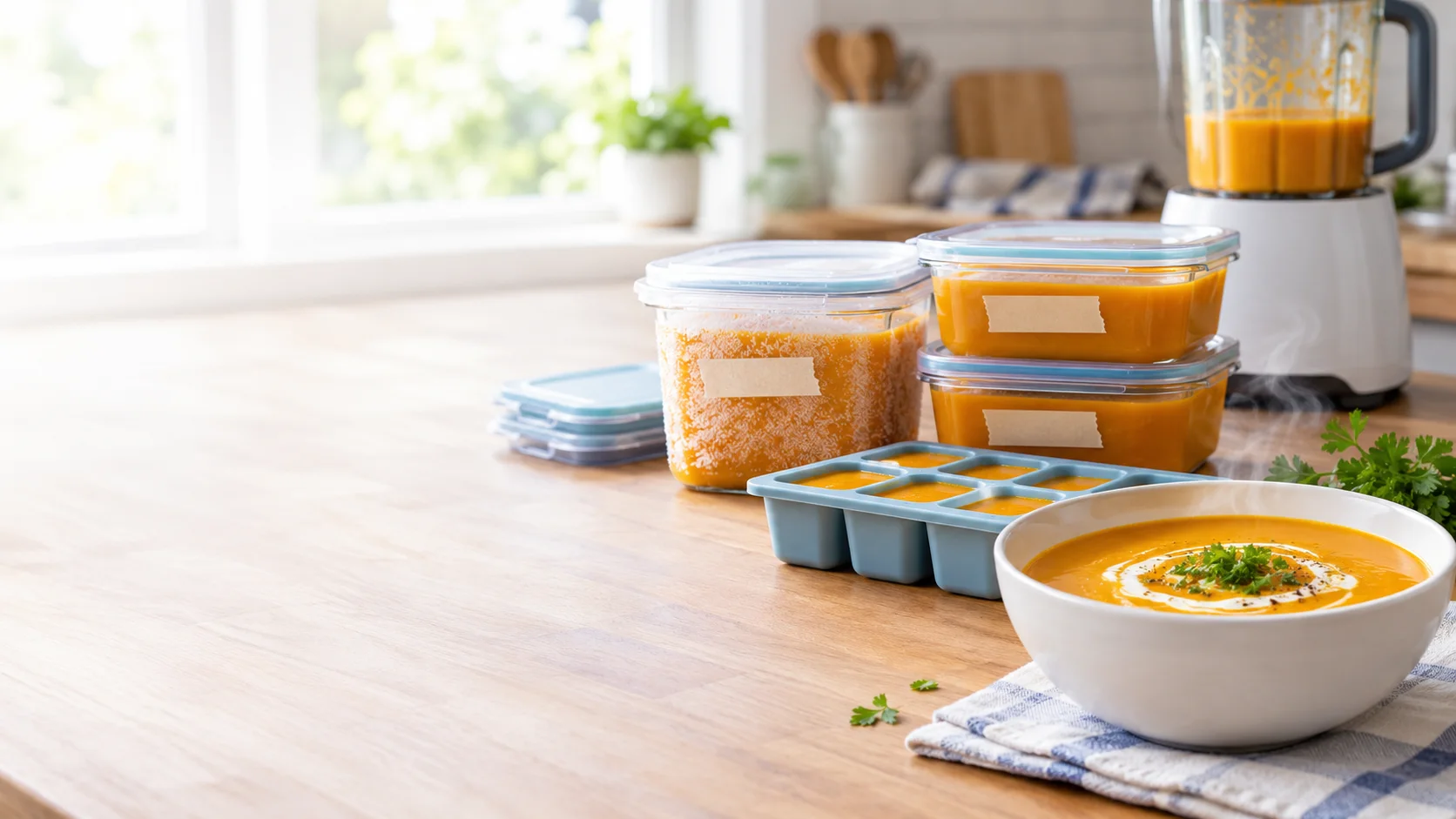
Use airtight, freezer-safe containers or suitable freezer bags. Leave enough headspace for expansion, follow the manufacturer’s fill guidance, and label each portion with the soup name and freezing date.
Single-serving portions make it easier to thaw only what you need. For more practical kitchen equipment advice, browse Kitchen Memo’s Kitchen Guides collection.
What to add after thawing
Reserve cream, cheese, fresh herbs, noodles, and rice when their texture matters. Add them during reheating or just before serving. This is particularly useful for soups where the creamy finish or pasta texture is part of the intended result.
The “freeze the base” method
- Cook the soup in your Thermomix, stopping before adding delicate finishing ingredients.
- Transfer the soup to shallow containers and cool it promptly.
- Refrigerate and then freeze in labelled portions.
- Thaw safely before reheating when possible.
- Add cream, coconut milk, cooked pasta, rice, or fresh herbs as appropriate.
- Blend briefly if a smooth soup needs help coming back together.
Containers vs. bags vs. silicone trays
| Option | Best for | Headspace needed | Pros | Cons | Kitchen Memo’s experience |
| Rigid freezer containers | Family portions and liquid soup | Leave room for expansion | Stackable and easy to seal | Take up more freezer space | A direct comparison of storage performance has not yet been recorded |
| Freezer bags | Flat, space-saving portions | Leave room for expansion without overfilling | Store flat and stack well | Require careful sealing to prevent leaks | Leak-prevention and storage results have not yet been compared |
| Freezer-safe silicone trays | Small portions | Follow the tray’s fill guidance | Convenient for individual servings | Small portions may need transferring after freezing | A comparative soup-storage test has not yet been completed |
How Long Does Thermomix Soup Last, and Is It Safe?
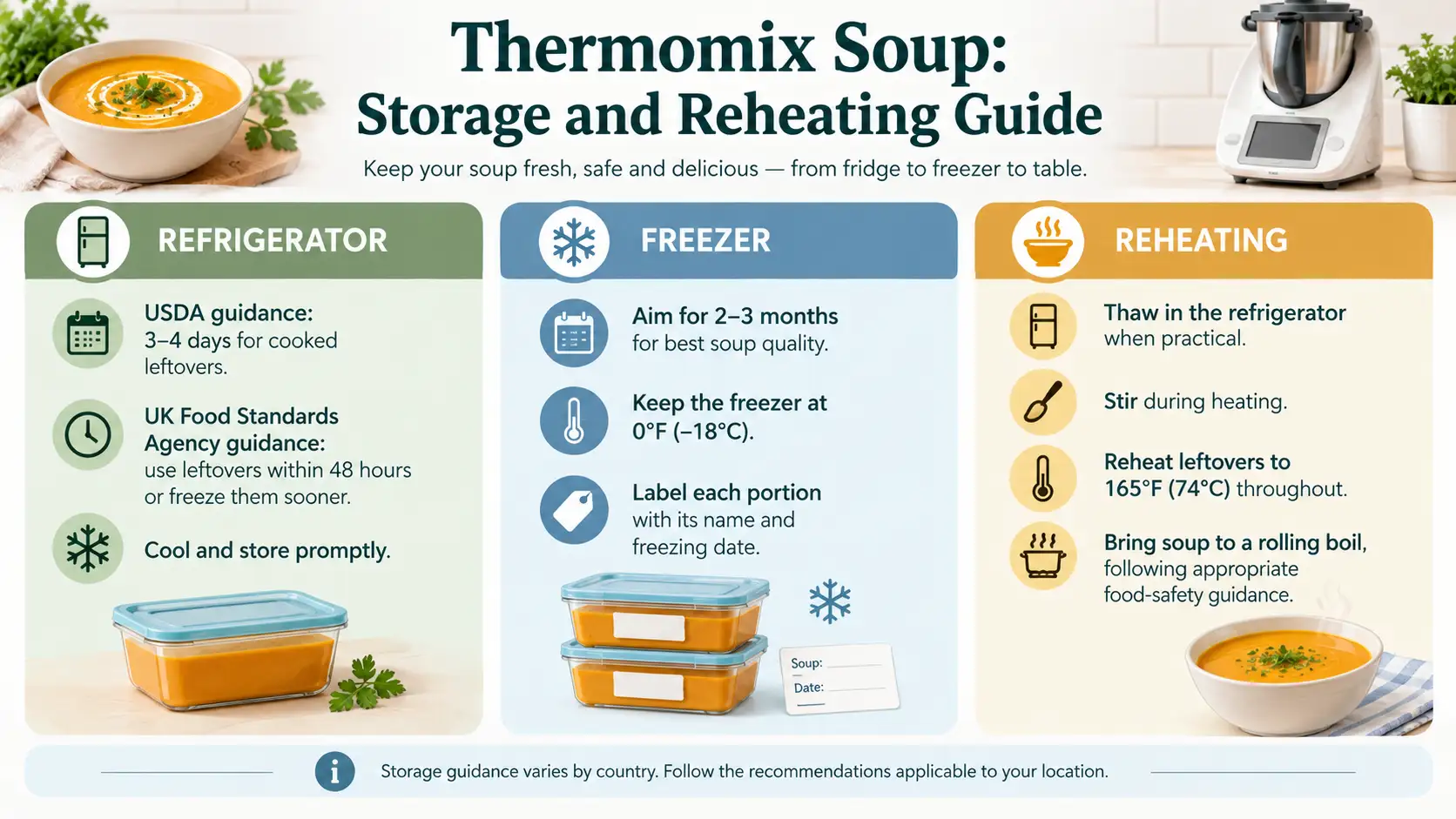
Storage safety and food quality are different questions. At a constant 0°F (−18°C), properly handled frozen soup remains safe indefinitely, although flavour and texture may deteriorate. The USDA’s freezing guidance lists 2–3 months for soups and stews for best quality.
Freezer time
Aim to use Thermomix soup within 2–3 months for the best quality. Airtight packaging and clear labels help limit freezer burn and make older portions easier to identify.
Fridge time before freezing
Under USDA guidance, cooked leftovers should generally be refrigerated for 3–4 days. The UK Food Standards Agency recommends eating leftovers within 48 hours or freezing them sooner.
If soup has been refrigerated for five days, do not freeze it to extend its life. Under the USDA guidance, it has exceeded the usual refrigerated-leftover window and should be discarded. Freezing does not make food safe again if it has already been stored unsafely.
Refreezing
Soup thawed in the refrigerator can generally be refrozen if it has remained safely chilled, although the texture may deteriorate. USDA guidance also explains that leftovers thawed in the refrigerator can be refrozen.
Do not refreeze soup that has been left at room temperature for more than two hours; discard it instead. Use local food-safety guidance if it sets stricter limits.
Signs it has gone bad
Discard soup with mould, an unusual foul smell, or an abnormal slimy texture. Do not taste suspicious soup to check whether it is safe. These signs are reasons to discard it, but their absence does not guarantee safety.
Freezer burn is different: it mainly affects quality and does not by itself mean food is unsafe if it has remained continuously frozen.
Storage times
| Storage stage | Recommended time | Quality note | Safety note |
| Refrigerator after cooking | USDA: 3–4 days; UK FSA: 48 hours | Use sooner for the best flavour | Follow the guidance applicable to your location |
| Freezer at 0°F (−18°C) | 2–3 months for best quality | Flavour and texture may decline afterward | Safe indefinitely if properly handled and continuously frozen |
| Room-temperature cooling | Refrigerate promptly; USDA advises no more than 2 hours at room temperature | Long exposure is not recommended | Discard food left out beyond the recommended limit |
How to Thaw and Reheat Frozen Thermomix Soup
Thawing soup in the refrigerator overnight is a practical way to prepare it for reheating. Frozen soup can also be reheated directly from frozen in a saucepan or microwave, provided it is heated thoroughly. The USDA confirms that frozen soup and stew can be reheated without thawing first.
Thawed vs. from frozen
Thawed soup is generally easier to stir and heat evenly. For frozen soup, use a saucepan or microwave and allow extra time, stirring as it loosens.
For Thermomix reheating, thawing first is the more predictable approach. Do not assume a frozen solid block can be placed directly into every Thermomix model and heated using the same settings as refrigerated soup.
Microwave vs. stovetop vs. Thermomix
- Microwave: Convenient for single portions. Cover appropriately, stir during heating, and check for cold spots.
- Stovetop: Useful for larger quantities and soups that need frequent stirring while thawing and heating.
- Thermomix: Useful for stirring and blending while reheating, provided the chosen procedure is suitable for the exact model.
Consult the official Thermomix TM6 manual or the manual for your particular model. Universal reheating times and speeds should not be assumed across TM31, TM5, TM6, and newer machines.
When and how to re-blend
If thawed soup looks separated or slightly grainy, reheat it thoroughly first. Then blend briefly at a suitable speed, increasing gradually and following the appliance’s hot-liquid instructions. Check the texture before blending again.
Avoid unnecessary high-speed blending of very hot soup, which can cause splashing and burns.
Reheat until steaming hot
For leftover safety, USDA guidance recommends reheating food to 165°F (74°C) throughout. It also recommends bringing soups, sauces, and gravies to a rolling boil. See its safe reheating methods.
Use a food thermometer when possible, especially with thick soup or larger portions. In a microwave, stir and check several places because cold spots can remain.
Reheating methods
| Method | Best for | Time | Texture result |
| Microwave | Single portions | Depends on portion size and appliance; check temperature | Stirring helps distribute heat; comparative Kitchen Memo results are not yet available |
| Stovetop | Larger quantities and soups needing stirring | Depends on quantity and starting temperature | Allows gradual heating and adjustment; no side-by-side result has been recorded |
| Thermomix | Thawed soup needing stirring or re-blending | Follow model-approved settings and check temperature | Convenient for smooth soups; comparative texture-restoration results have not yet been recorded |
Fixing Common Problems and Avoiding Beginner Mistakes
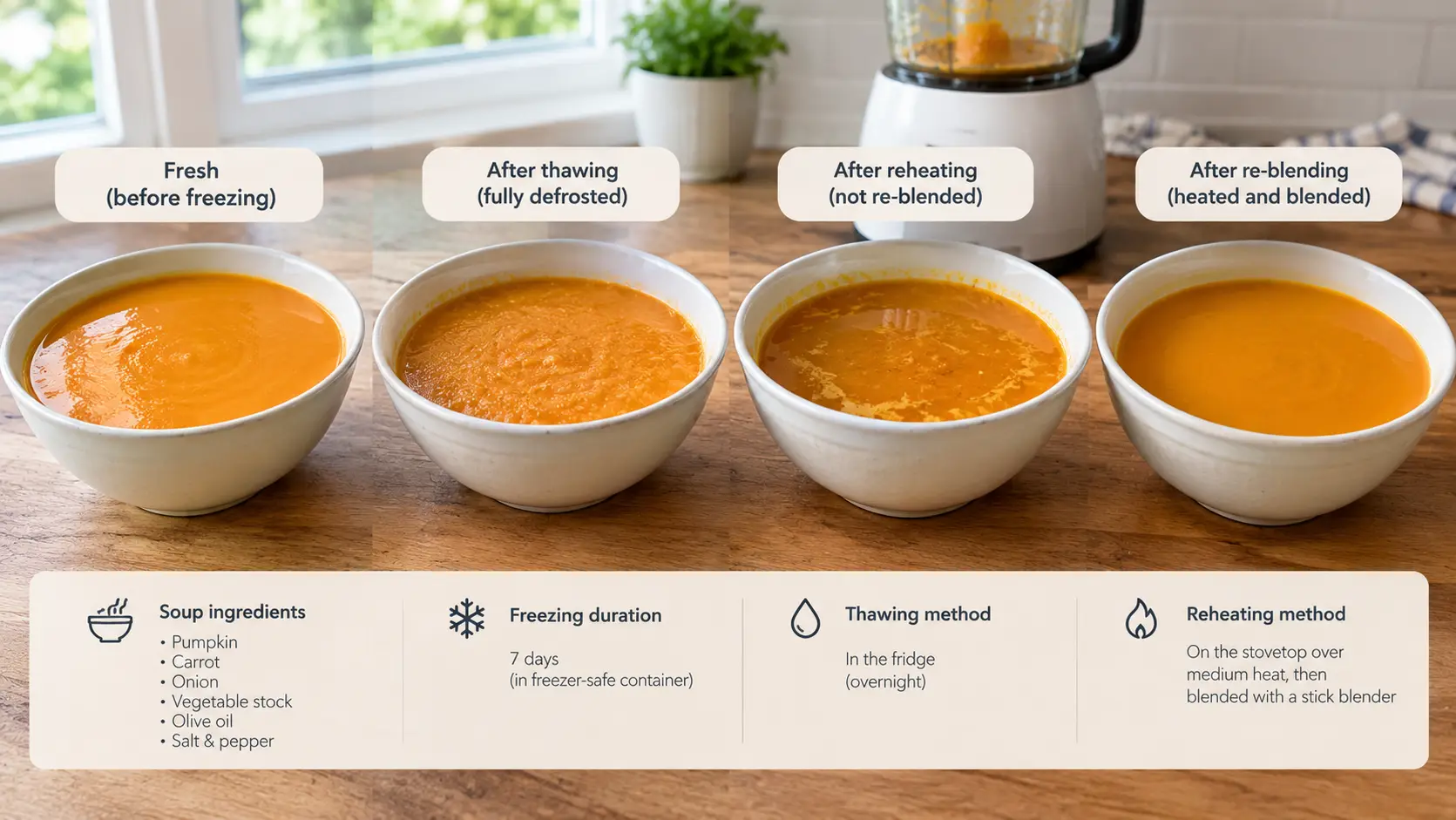
Some freezer-related changes can be improved with gentle heating and careful blending. Others, such as overcooked noodles, cannot be fully reversed.
Soup that separated or looks curdled
Cream or coconut milk may separate during freezing and thawing. Reheat the soup gently and try a short re-blend. To reduce the chance of separation next time, freeze the base before adding dairy or coconut milk.
Grainy or mushy soup
Potato may become grainy, while rice and noodles can turn mushy. Brief re-blending may improve a smooth potato soup, but do not expect it to restore every texture change. For noodle soups, remove overly soft noodles and add freshly cooked ones.
Watery soup
If the soup is too thin after thawing, simmer it gently to reduce excess liquid, then check the seasoning. If appropriate for the recipe, blend some of the cooked vegetables into the liquid to add body.
Bland soup
Taste can seem different after freezing and reheating. Adjust salt cautiously, then try fresh herbs or a small amount of lemon juice or vinegar. Taste again before adding more seasoning.
Mistakes to avoid
Avoid leaving a large hot batch on the counter for hours, filling containers to the brim, freezing soup without labels, or leaving delicate toppings in the soup. Never exceed the Thermomix bowl’s marked maximum fill line when reheating.
Model and scale notes
TM31, TM5, TM6, and newer Thermomix machines do not necessarily share identical programs or controls. Follow the instructions for your particular model, use suitable portions, and do not assume that a full batch can be reheated with the same settings as a single serving.
For more practical cooking techniques and troubleshooting, browse Kitchen Memo’s Cooking Tips collection.
Conclusion
Can you freeze Thermomix soup? Yes, with the right handling. Freeze simple vegetable, lentil, and broth-based soups as they are; freeze pasta and creamy soups with a tweak; and freeze the base when texture matters most. Cool promptly, portion, label, and reheat thoroughly. A careful re-blend may help restore a smooth soup after thawing.
FAQs
Can you freeze Thermomix soup with chicken?
Yes. Cooked chicken and broth-based soup can be frozen when handled safely. For the best texture, freeze without noodles or rice and add them after thawing. See the Thermomix chicken soup guide for related preparation guidance.
Can you freeze Thermomix soup in the fridge?
No. A refrigerator keeps soup chilled for short-term storage; it does not freeze it. Cool and refrigerate the soup promptly, then transfer it to the freezer for longer storage.
What soups should you not freeze?
Most soups can be frozen, but finished cream-based soups and soups containing delicate pasta or potato pieces may change texture. Freezing the base and adding delicate ingredients later is often the better choice.
Can I freeze soup 5 days after making it?
Under USDA guidance, cooked leftovers should generally be refrigerated for 3–4 days. Five days is beyond that recommended window, so discard the soup rather than freezing it to extend its life.
Can I eat 2-year-old frozen soup?
If the soup was handled safely before freezing and remained continuously frozen at 0°F (−18°C), it may remain safe, although its flavour and texture may be poor. Discard it if you cannot establish that it was stored safely.
How long does Thermomix soup last in the freezer?
Aim for 2–3 months for the best quality. Properly handled soup kept continuously frozen remains safe longer, but its flavour and texture may decline.