Is a Thermomix worth it when the latest TM7 costs $1,699 before tax and its connected recipe platform adds an ongoing subscription cost? The answer depends on how frequently you cook, which kitchen appliances you already own, and whether you will regularly use its combination of weighing, chopping, blending, heating, steaming and mixing. The Thermomix TM7 is a multifunctional cooking appliance, not a complete replacement for an oven, frying pan or air fryer. This guide calculates its five-year ownership cost and cost per use to help you decide whether the investment makes practical sense.
Quick Summary
- A Thermomix is most attractive to people who regularly cook from scratch and use several of its functions every week.
- The US TM7 costs $1,699. Adding five years of Cookidoo membership at $65 annually brings the illustrative ownership cost to $2,024, before tax and optional accessories.
- It combines several food-preparation and cooking functions but does not replace an oven, air fryer or conventional high-heat frying pan.
- Consider skipping it if you cook occasionally, already own and regularly use the appliances it would duplicate, or do not want a connected recipe subscription.
What does a Thermomix really cost over 5 years?
The purchase price is only the starting point. A realistic ownership calculation includes the machine, Cookidoo membership, optional accessories and potential expenses after the standard warranty expires.
For US buyers, the TM7 is listed at $1,699. Cookidoo adds $65 per year, making the five-year machine-and-subscription estimate $2,024. This calculation assumes five full annual subscription charges at today’s rate, with no future price increases.
Upfront price by market
The following prices were checked against regional manufacturer information on November 21, 2026.
| Market | TM7 purchase price | Annual Cookidoo subscription |
| United States | $1,699 | $65 |
| United Kingdom | £1,349 through an Advisor | £50 |
| Australia | A$2,649 | A$89 |
In the UK, purchasing directly online costs £1,374, including a £25 processing fee. The £1,349 price is available through a Thermomix Advisor.
These are local market prices, not currency conversions. Taxes, promotions, delivery arrangements and purchasing conditions can differ.
Cookidoo subscription and what happens without it
Cookidoo is Thermomix’s connected recipe platform. It provides Guided Cooking, searchable recipes, meal planning, saved recipes and synchronization between supported devices.
The annual US subscription currently costs $65. Eligible new TM7 customers can also receive a three-month introductory trial, subject to the regional eligibility conditions.
A subscription is not compulsory for basic TM7 operation.
Without paid Cookidoo membership, owners can:
- Use manual cooking settings.
- Access the machine’s built-in cooking modes.
- Use the 200 built-in Manifesto recipes after connecting the machine to the internet and downloading them.
- Continue using manual cooking and the available offline recipes.
The main limitation is reduced access to the full Guided Cooking library and connected features.
Someone who enjoys improvising recipes may be comfortable without a subscription. A beginner who prefers step-by-step instructions, automatic ingredient weighing and guided settings may find Cookidoo more valuable.
Before buying, consider how you prefer to cook rather than assuming that a subscription is automatically necessary.
Warranty, accessories and hidden costs
The standard TM7 warranty is generally two years in the US, UK and Australia, subject to the applicable regional warranty terms.
This means that a five-year ownership calculation extends beyond the standard warranty period. Buyers should consider potential repair expenses during the remaining ownership period.
The standard package includes the main machine, mixing bowl, mixing knife and important cooking accessories. You do not need to purchase numerous optional accessories before using the appliance.
Examples of separately listed US accessories include:
| Optional accessory | Listed US price |
| Additional TM7 mixing bowl | $299 |
| Cutter+ | $149 |
| Blade Cover & Peeler | $49 |
These accessories are optional. Promotions can also change the effective purchase price. For example, the US manufacturer listed a limited November 2026 offer for the Blade Cover & Peeler.
Five-year ownership estimate
| Cost component | United States | United Kingdom | Australia |
| TM7 machine | $1,699 | £1,349 | A$2,649 |
| Five annual Cookidoo charges | $325 | £250 | A$445 |
| Five-year baseline | $2,024 | £1,599 | A$3,094 |
The UK total uses the Advisor purchase price. Purchasing online instead would make the baseline £1,624.
These estimates exclude sales tax where applicable, electricity, ingredients, optional accessories, repairs and future subscription price changes.
The most useful starting US budget is therefore approximately $2,024 rather than $1,699.
Is a price rise coming?
Vorwerk has announced a TM7 price increase effective January 1, 2027, in response to rising electronic-component costs.
Its Germany-specific announcement identifies the January 2027 increase, but does not provide a new price in the notice. The German Black Weeks promotion runs from November 9 to November 30, 2026.
Buyers in the US, UK and Australia should not assume that Germany’s promotional conditions or any particular price increase percentage applies to their markets. Check the relevant local price before purchasing.
What does a Thermomix replace, and what doesn’t it?
A Thermomix is valuable because it combines several kitchen functions in one appliance. However, having a function is not the same as completely replacing a dedicated appliance.
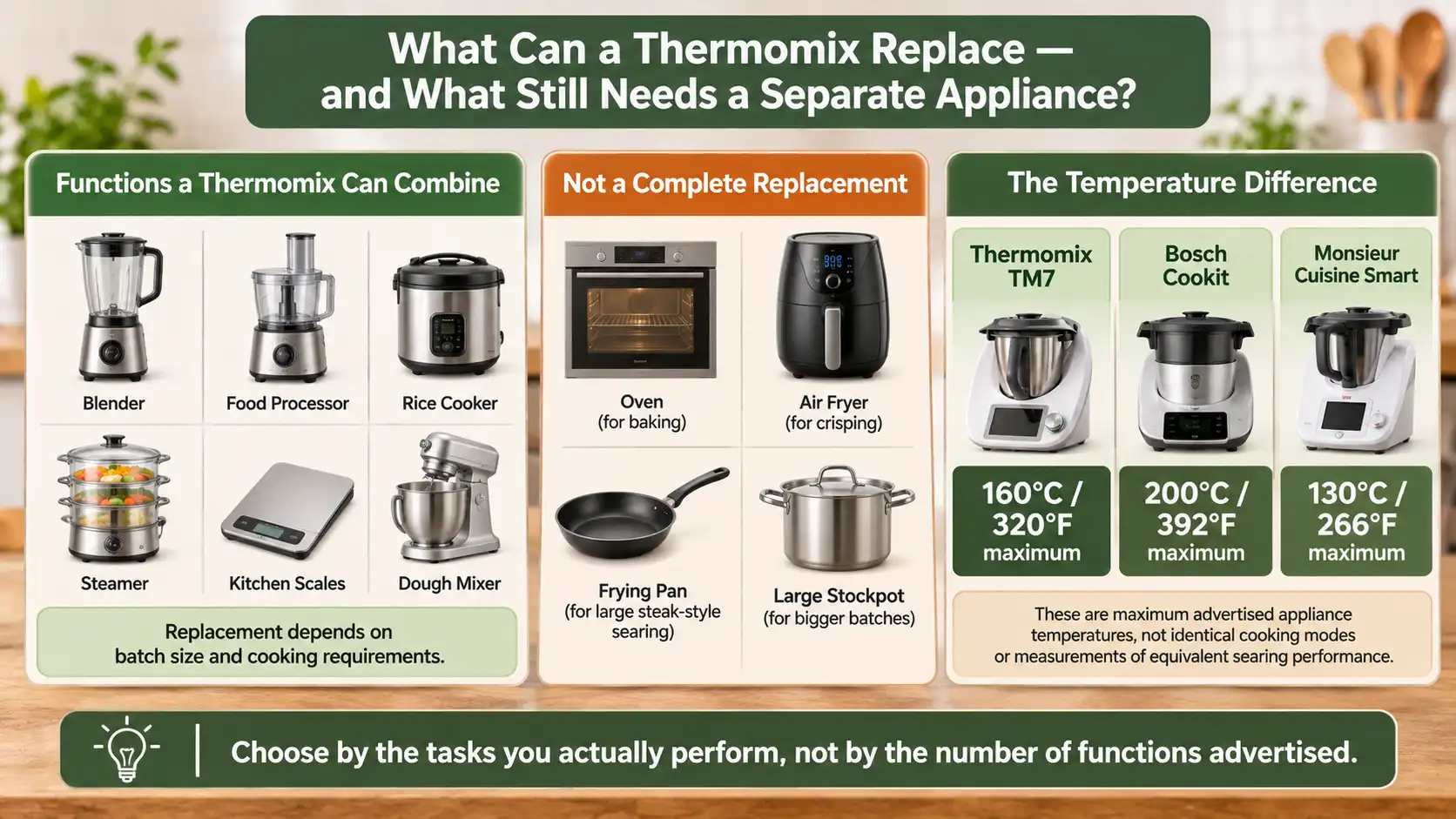
The TM7 can weigh, chop, blend, grind, mix, knead, steam, heat and stir. It also provides dedicated modes for tasks such as rice cooking, slow cooking, sous-vide and fermentation.
The important question is not how many functions appear in the product description. It is how many of those functions you will actually use.
Appliances it can replace
The following replacement ledger helps identify potential savings without assuming every existing appliance will disappear from your kitchen.
| Existing appliance | Possible Thermomix replacement | When replacement makes sense |
| Blender | Yes, for many blending tasks | You regularly make smoothies, purées and soups |
| Food processor | Partly | Most of your work involves chopping, mixing and smaller preparation tasks |
| Rice cooker | Often | Your usual rice recipes work with the Thermomix method |
| Steamer | Yes, for many tasks | You regularly steam vegetables, fish and other suitable ingredients |
| Slow cooker | Partly | Your meals suit its slow-cooking mode and capacity |
| Kitchen scales | Yes | You use its integrated weighing function |
| Stand mixer | Partly | Your dough quantities and recipes suit its kneading function |
For example, a reader who regularly makes soup, risotto and steamed vegetables may find several existing appliances less necessary.
Kitchen Memo’s Thermomix pumpkin soup guide demonstrates how the appliance can combine chopping, heating and blending within one preparation sequence.
Similarly, its Thermomix rice and Varoma guide explains another way to use the machine for everyday meal preparation.
A replacement becomes financially meaningful only when you genuinely stop using or avoid purchasing the other appliance. Keeping your blender, food processor and rice cooker while purchasing a Thermomix does not automatically save their purchase prices.
Replacement ledger example
Before purchasing, list the appliances you already own and estimate how much you would save by no longer needing each one.
| Appliance already owned | Would you stop using it? | Potential saving |
| Blender | Yes / No | Enter your actual replacement value |
| Food processor | Yes / No | Enter your actual replacement value |
| Rice cooker | Yes / No | Enter your actual replacement value |
| Steamer | Yes / No | Enter your actual replacement value |
| Stand mixer | Yes / No | Enter your actual replacement value |
Only count an appliance as a replacement when you realistically expect to stop using it.
What it can’t do
A Thermomix should not be treated as a complete replacement for every cooking appliance.
| Task | Thermomix suitability | Better alternative |
| Baking bread or cakes | Prepares and mixes ingredients but does not bake | Oven |
| Air frying | Not an air fryer | Air fryer |
| Deep frying | Not designed for deep frying | Suitable deep fryer or stovetop equipment |
| Large steak-style searing | Limited compared with a dedicated frying pan | Heavy frying pan |
| Very large food batches | Constrained by mixing-bowl capacity | Larger cooking pot or food processor |
| Large batches of dough | Limited by model and recipe quantities | Suitable stand mixer |
The TM7’s mixing bowl has a marked maximum capacity of 2.2 litres according to its technical documentation. Its redesigned Varoma provides a separate 6.8-litre total steaming capacity, including the tray.
These are two different measurements. The larger Varoma does not make the mixing bowl larger.
The 160°C ceiling explained
One important TM7 limitation is its maximum temperature.
The TM7 can reach temperatures up to 160°C (320°F) through specific high-temperature cooking modes. This is useful for certain browning tasks, but it does not provide the same cooking surface or operating conditions as a dedicated frying pan.
The official Thermomix TM7 temperature guidance explains its supported heating modes and maximum temperature, helping users understand why it cannot replace every high-heat frying or searing technique.
For comparison, Bosch advertises the Cookit with temperatures up to 200°C (392°F), using a pan-sized cooking surface intended for frying and browning.
The practical distinction is:
- Use the Thermomix for controlled heating, stirring, blending, steaming and supported browning functions.
- Use a frying pan when you need a large contact surface and stronger direct browning.
- Use an oven when a recipe needs baking or roasting.
This is not a criticism of the Thermomix. It is a difference between two types of cooking equipment.
TM7 vs TM6 vs refurbished: is the upgrade worth it?
The TM7 is the current-generation machine, but a refurbished TM6 may offer better value to someone who prioritizes basic cooking functions over the latest interface.
| Feature | TM7 | TM6 | Refurbished TM6 |
| Display | 10-inch touchscreen | 6.8-inch touchscreen | Same as TM6 |
| Rotary selector | No | Yes | Yes |
| Maximum bowl capacity | 2.2 L marked capacity | 2.2 L | 2.2 L |
| Varoma | Redesigned, larger | Previous design | Previous design |
| Open Cooking | Yes | No equivalent TM7 mode | No |
| High-temperature capability | Up to 160°C in specific modes | Up to 160°C in supported modes | Same as TM6 |
| Cookidoo | Supported | Supported | Supported |
| Warranty | Two years in the US | Depends on original purchase | Depends on seller and coverage |
The TM7’s main changes include:
- Larger touchscreen.
- Redesigned insulated mixing bowl.
- Quieter low-speed operation.
- Redesigned Varoma.
- Open Cooking mode.
- Updated cooking interface and modes.
The TM6 remains capable of many everyday cooking tasks, including chopping, blending, steaming, heating, kneading and Guided Cooking.
My practical recommendations:
- Choose TM7 if buying new, wanting the latest interface and planning to use the newer cooking modes.
- Choose TM6 if you find a significantly cheaper, well-maintained unit and do not need TM7-specific features.
- Consider refurbished if the savings justify the machine’s age, condition and warranty limitations.
A second-hand purchase deserves careful inspection. Check the serial number, accessories, mixing bowl condition, service history, screen, weighing function and remaining warranty.
A refurbished machine is not automatically a bargain simply because it costs less than a new TM7. Its value depends on what is included and how much useful ownership time remains.
Thermomix vs Instant Pot, food processor and Bosch Cookit/Monsieur Cuisine
These appliances solve overlapping but different kitchen problems. The best choice depends on whether you value pressure cooking, food preparation, high-heat frying or an integrated guided-cooking environment.
Thermomix vs Instant Pot
Thermomix TM7
Choose it for chopping, blending, precise weighing, stirring, steaming, kneading and guided cooking.
Instant Pot
Choose it for pressure cooking, rice, slow cooking, steaming, sautéing and larger cooking batches.
The Instant Pot is primarily useful when pressure cooking is important to your routine. The Thermomix offers a broader integrated food-preparation and mixing role but is not a pressure cooker.
Choose Instant Pot if: Your priority is pressure-cooked meals, beans, stews and larger batches at a lower equipment cost.
Choose Thermomix if: You regularly need blending, chopping, weighing, kneading and controlled stirring alongside cooking.
Thermomix vs food processor
A food processor is often the more practical option when your main priority is chopping, slicing, grating and processing larger quantities.
A Thermomix adds heating, cooking, weighing and stirring to those preparation functions.
| Factor | Thermomix | Food processor |
| Chopping | Yes | Yes |
| Slicing and grating | With suitable accessories | Often a core function |
| Heating and cooking | Yes | Usually no |
| Blending hot soup | Yes, following model safety instructions | Depends on appliance |
| Dough preparation | Yes | Model-dependent |
| Guided recipe platform | Cookidoo | Depends on brand |
Choose a food processor if: Most of your preparation involves chopping large quantities or processing ingredients quickly.
Choose Thermomix if: You regularly move from weighing and chopping ingredients to cooking and blending them in the same bowl.
Thermomix vs Bosch Cookit/Monsieur Cuisine
These machines are closer competitors because they combine cooking and food preparation.
| Feature | TM7 | Bosch Cookit | Monsieur Cuisine Smart |
| Maximum advertised temperature | 160°C | 200°C | 130°C |
| Bowl/pot capacity | 2.2 L marked maximum | 3 L | 3 L |
| Integrated weighing | Yes | Yes | Yes |
| Guided recipes | Cookidoo | Home Connect | Built-in recipes and updates |
| High-heat browning | Dedicated modes | Pan-style cooking | Supported searing function |
The temperature specifications are manufacturer figures. They do not represent identical cooking modes or guarantee equal results when preparing the same food.
Bosch’s higher temperature capability makes Cookit an interesting alternative for readers who prioritize browning. Its larger pot also makes it worth considering for larger family batches.
Monsieur Cuisine Smart provides a larger stated vessel capacity, integrated scales and more than 600 preloaded recipes, with free monthly recipe updates according to Lidl’s product information.
Availability, regional pricing and after-sales support should be checked in the buyer’s country.
Choose Bosch Cookit if: It is available in your country and its higher-temperature frying function matters more than the Thermomix ecosystem.
Choose Monsieur Cuisine if: You want an all-in-one cooking processor with a larger stated capacity and a lower maximum temperature.
Choose Thermomix if: You value its Cookidoo environment, integrated weighing and combination of food preparation and controlled cooking.
Why owners split: who keeps using it and who doesn’t
Owner experiences vary because households have different cooking habits and expectations.
Some owners use the machine several times a week or even daily for soup, dough, risotto, sauces and meal preparation. Others find that the excitement fades once they have tried a few new recipes.
Public owner discussions illustrate both experiences.
In a September 2024 discussion on Reddit, long-term owners described regular use for pizza dough, yoghurt, banana bread, steamed salmon, risotto and everyday cooking. Other contributors explained that their usage became less frequent after the initial excitement.
A September 2026 owner discussion also included complaints about disappointing cooking results, limited usefulness for certain recipes and the ongoing subscription cost.
These comments are useful for understanding individual experiences, but they are not a representative customer satisfaction survey.
What regular users tend to value:
- A repeatable routine for everyday cooking.
- Guided recipes and automatic ingredient weighing.
- One appliance for several preparation stages.
- Soup, sauce, dough and steaming functions.
- Less need to transfer ingredients between multiple appliances.
Why some owners become disappointed:
- The appliance does not replace as much equipment as expected.
- Some recipes still require separate pans or oven cooking.
- The mixing bowl is smaller than their preferred batch size.
- They do not enjoy guided cooking or subscription-based recipe access.
- The appliance occupies valuable counter or storage space.
The most useful owner question is not simply whether people like the machine. It is whether their cooking habits are similar to yours.
If you regularly prepare soup, dough, steamed vegetables, sauces and risotto, you have several natural opportunities to use it.
If your meals mainly involve high-heat frying, oven roasting or conventional stovetop cooking, you may have fewer reasons to switch on the machine.
The break-even: how often must you use it?
A Thermomix becomes easier to justify when its cost is spread across frequent cooking sessions. The important measure is not the number of recipes in Cookidoo; it is the number of times you will actually switch on the machine.
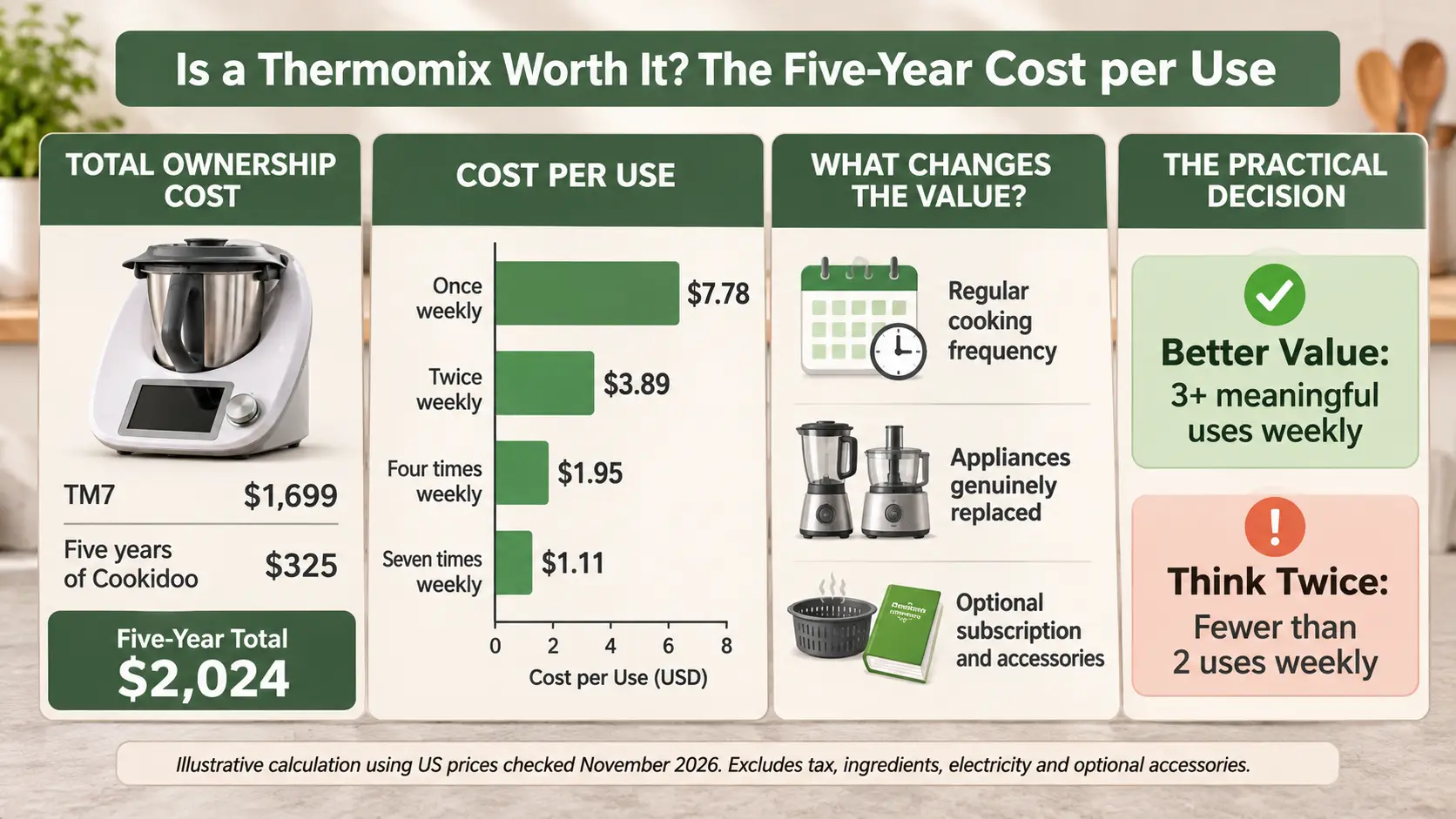
Using the US TM7 price of $1,699 and five annual Cookidoo charges of $65, the illustrative five-year ownership cost is $2,024.
The cost-per-use formula
Cost per use =
(Machine price + Subscription × Years owned) ÷ (Uses per week × 52 × Years owned)
For this example:
- Machine: $1,699
- Annual Cookidoo subscription: $65
- Ownership period: 5 years
- Five-year subscription cost: $325
- Five-year total: $2,024
A use means one cooking or preparation session, not one ingredient or one function within a recipe.
Five-year cost per use
| Uses per week | Uses over five years | Machine only | Including subscription |
| 1 | 260 | $6.53 | $7.78 |
| 2 | 520 | $3.27 | $3.89 |
| 4 | 1,040 | $1.63 | $1.95 |
| 7 | 1,820 | $0.93 | $1.11 |
These figures assume unchanged prices for five years. They exclude tax, electricity, ingredients, optional accessories and repairs.
The figures reveal something important: the same machine can be an expensive occasional purchase or a relatively low-cost daily-use appliance.
However, cost per use is not the same as financial payback. It does not prove that you save money compared with purchasing separate appliances. That requires knowing which appliances you would genuinely avoid buying and what those alternatives would cost.
Decision matrix
| Cooking frequency | Household situation | Existing equipment | Practical assessment |
| Less than once weekly | Any size | Several specialized appliances | Usually skip |
| 1–2 times weekly | One or two people | Most appliances already owned | Weak financial case |
| 2–3 times weekly | Small or medium household | Some appliances could be replaced | Consider carefully |
| 3–4 times weekly | Regular home cooking | Two or more appliances could become unnecessary | Stronger case |
| Daily or nearly daily | Regular scratch cooking | Limited overlapping equipment | Best potential value |
Household size is not a standalone reason to buy one.
A person cooking for themselves can benefit from weighing, mixing and preparation functions. A larger family may value combined steaming and preparation capabilities, but the mixing bowl can mean preparing some dishes in multiple batches.
For larger households, the relevant question is whether the bowl and Varoma capacities suit the actual meals you prepare.
Skip it if…
The following are practical warning signs:
- You cook from scratch fewer than twice a week.
- Most of your meals depend on searing, baking, roasting or crisping.
- You do not want to pay for Cookidoo and are unlikely to enjoy manual cooking.
- You already own and regularly use a food processor, blender and multi-cooker.
- You need substantially larger cooking batches than the mixing bowl can conveniently handle.
These are decision guidelines rather than scientifically established cutoffs. A person making one time-consuming preparation each week may still value the appliance.
Buy it if…
The proposed practical threshold is:
- You expect at least three meaningful uses each week.
- You can identify at least two existing appliances that would genuinely become unnecessary.
- You regularly make soups, sauces, dough, risotto, steamed meals or similar preparations.
- You appreciate Guided Cooking or are comfortable entering your own settings.
- You accept that a frying pan and oven will remain part of your kitchen.
For example, someone who prepares soup twice weekly, makes dough regularly and steams vegetables for family meals has several natural opportunities to use the machine.
Kitchen Memo’s Thermomix risotto guide and Thermomix bread dough basics guide explain two recurring tasks that can help make a Thermomix part of a regular cooking routine.
The three-uses-per-week and two-appliance replacement rule is a proposed buying threshold, not the result of a controlled household-use study.
Common problems and beginner mistakes
Buying the appliance does not automatically make everyday cooking easier. Many disappointments come from choosing the wrong tasks, misunderstanding its capabilities or failing to build a consistent routine.
| Problem | Why it happens | Fix | Prevention |
| It sits unused | Too few repeatable weekly cooking tasks | Start with three familiar recipes | Make a weekly-use list before buying |
| Food does not brown as expected | Temperature and bowl design differ from a frying pan | Finish suitable ingredients in a hot pan | Understand high-temperature limitations |
| Watery results | Too much liquid or unsuitable quantities | Check ingredient ratios and texture | Follow compatible recipes and fill limits |
| Batch is too big | Mixing-bowl capacity is limited | Divide into suitable batches | Check maximum quantities before scaling |
| Subscription lapses | The buyer depends entirely on Guided Cooking | Switch to manual cooking and available built-in recipes | Learn manual controls before relying on paid content |
It sits unused
The first few weeks can be exciting because the machine provides access to different recipes and functions. That enthusiasm may fade if you do not have repeatable meals.
Fix: Choose three regular tasks, such as a soup, a sauce and a dough preparation. Repeat them until the appliance becomes part of your ordinary routine.
Prevention: Make the weekly-use ledger before purchasing instead of assuming you will discover enough uses later.
Food doesn’t brown
The TM7 offers dedicated browning functions, but it cannot reproduce every result of a conventional frying pan. Its maximum temperature and cooking surface differ from a pan designed for direct high-heat contact.
Fix: Use a suitable frying pan or oven finishing step when the recipe needs stronger surface browning.
Prevention: Decide beforehand whether you regularly prepare foods that depend on high-heat searing.
Watery or underwhelming results
Food texture depends on ingredient quantities, liquid, cooking conditions and how a recipe is adapted.
A machine does not automatically correct an unsuitable ingredient ratio.
Fix: Check the amount of liquid, ingredient tenderness and recipe compatibility. Adjust consistency gradually rather than immediately adding more ingredients.
Prevention: Start with model-compatible instructions. Keep notes when adapting your own recipes.
Batch too big or too small
The TM7 has a 2.2 L maximum marked mixing-bowl capacity. However, that is not a recommendation to fill the bowl to its maximum for every cooking process.
Fix: Divide larger preparations into batches and use the Varoma for suitable multi-level cooking.
Prevention: Check actual recipe quantities and maximum-fill markings before buying for a large household.
Subscription lapses
Without a paid Cookidoo subscription, the machine does not become unusable. Manual cooking and the built-in Manifesto recipes remain available under the manufacturer’s stated arrangements.
Fix: Learn how to set time, temperature and speed manually, and download the built-in recipes you intend to use.
Prevention: Test the machine without relying exclusively on Guided Cooking during the introductory period.
Conclusion
Is a Thermomix worth it? The TM7 makes the strongest financial and practical case when you use it at least three times a week, regularly benefit from several of its functions and can genuinely replace two or more appliances. At fewer than two uses weekly, with existing equipment and a preference for high-heat or oven-based cooking, the illustrative five-year cost of $2,024 is much harder to justify.
Frequently Asked Questions
1. Is a Thermomix worth it if I already have an Instant Pot and food processor?
Only when it adds enough useful functions to replace equipment you actually use or removes meaningful preparation work.
2. Do you need the Cookidoo subscription to use a Thermomix?
No. Manual cooking and built-in TM7 recipes remain available, but the full Guided Cooking library requires membership.
3. Can a Thermomix sear or brown meat?
It has dedicated browning modes, but its 160°C ceiling and bowl design cannot replace every pan-style searing task.
4. How many times a week do I need to use it to make it worth it?
Three or more meaningful weekly uses provide a stronger case, particularly when the machine replaces other equipment.
5. Is the TM6 still a good choice now that the TM7 is out?
Yes. A well-maintained TM6 can offer value when discounted, while the TM7 provides a newer interface and additional cooking features.
6. Is a Thermomix worth it for one or two people?
It can be, provided you cook frequently. Its 2.2 L mixing-bowl capacity is an important consideration.