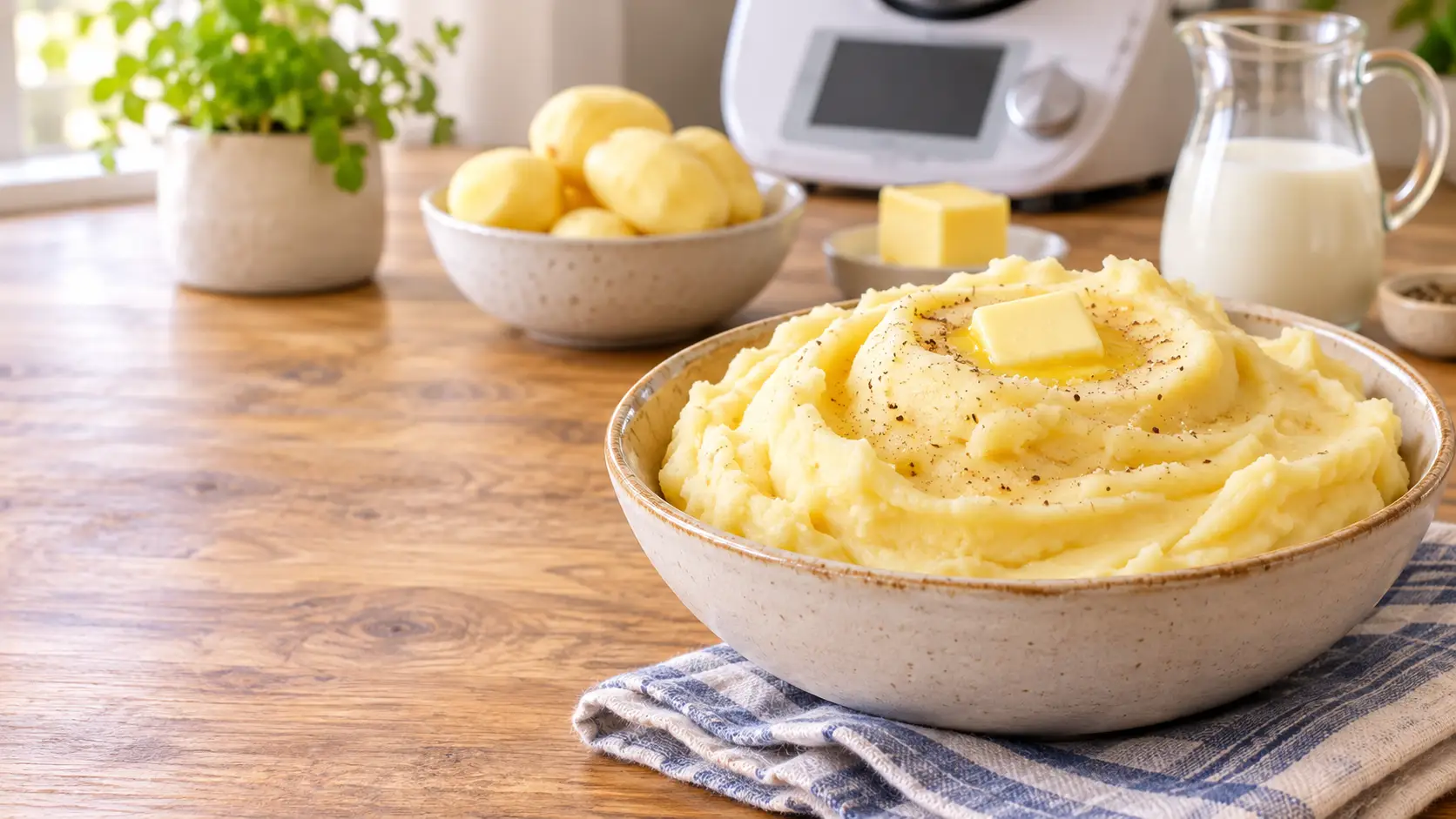
Yes, you can make smooth, creamy Thermomix mashed potato, but the same powerful mixing action that makes preparation convenient can also turn cooked potatoes gluey. The key is choosing a suitable potato, cooking it until completely tender and using a short finishing stage rather than continuing to mix. This guide explains the differences between floury and waxy potatoes, gives weight-based ingredient quantities, and shows how to identify and handle gluey, lumpy or watery mash.
Quick Summary
- Choose floury potatoes for lighter, fluffier mash or suitable yellow potatoes for a richer, creamier texture.
- Cook evenly cut potatoes until completely tender.
- Follow a recipe designed for your Thermomix model.
- Stop mixing as soon as the potatoes reach the desired consistency.
- Gluey mash cannot reliably be returned to its original fluffy texture, but it may be repurposed.
Why Does Thermomix Mashed Potato Turn Gluey?
Gluey Thermomix mashed potato usually results from excessive mechanical mixing. Cooked potatoes contain softened cells and gelatinized starch. When the potato structure is damaged through excessive processing, released starch and other cell components contribute to a sticky, pasty consistency.
The Thermomix requires particular attention because its mixing knife continues working whenever the appliance runs. More mixing does not necessarily produce smoother mash. It can instead destroy the texture you are trying to achieve.
The Idaho Potato Commission’s explanation of pasty mashed potatoes discusses how excessive mashing damages potato structure and creates a gluey result.
What gluey, lumpy and watery mash look and feel like
| Texture problem | What you notice | Likely explanation |
| Gluey | Sticky, elastic, pasty consistency | Excessive processing |
| Lumpy | Firm pieces throughout | Uneven cooking or insufficient mashing |
| Watery | Loose, runny consistency | Too much cooking liquid |
| Dense | Heavy, compact consistency | Potato variety or excessive working |
The exact speed and time at which a particular potato batch becomes gluey have not yet been established through Kitchen Memo side-by-side Thermomix tests. Potato variety, cooking time and moisture all influence the result.
Blade vs butterfly whisk
The mixing knife and butterfly whisk serve different purposes.
The mixing knife cooks and moves the potatoes during the initial cooking stage. The butterfly whisk is designed for gentle mixing and is used in some Thermomix mashed potato recipes for the finishing stage.
For example, Thermomix Australia’s published mashed potato method cooks the potatoes using the mixing knife before inserting the butterfly whisk for a short final mash.
The TM6 instruction manual specifies that the butterfly whisk must never exceed speed 4. It must also be correctly attached before operation. Always follow the corresponding manual for your appliance.
Vorwerk’s official TM6 instruction manual
Which Potatoes Work Best, and Which to Avoid?
Potato variety has a significant influence on mashed potato texture. Floury potatoes contain more starch and generally produce a lighter, fluffier result, while waxier varieties hold their shape more readily and can produce a denser mash.
The FAO potato guide explains the relationship between potato starch content and cooking characteristics.
Potato varieties by region
| Region | Good choice | Alternative | Less suitable for fluffy mash |
| US/Canada | Russet | Yukon Gold | Waxy red potatoes |
| UK | Maris Piper, King Edward | Desiree | Salad potatoes such as Maris Peer |
| Australia/NZ | Royal Blue, Red Pontiac | Desiree | Very waxy salad varieties |
Russets are particularly suitable for light, fluffy mashed potatoes. Yukon Gold potatoes offer a richer, creamier style. These are different texture preferences rather than a universal ranking.
For Australia and New Zealand, Thermomix’s published recipes specifically identify Red Pontiac, Royal Blue and Desiree as suitable choices.
These recommendations are based on published variety and recipe guidance, not a Kitchen Memo comparison of all the listed varieties. The exact results can vary with the crop and storage condition.
Cut size and weight
Cut potatoes into evenly sized pieces so they cook at a similar rate.
Thermomix Australia’s six-portion recipe specifies peeled potato pieces measuring 2–3 cm (approximately ¾–1¼ inches).
Avoid combining very small pieces with much larger chunks. Their cooking times can differ, leaving some pieces fully tender while others remain firm.
The same recipe uses 1,000 g (2.2 lb) of potatoes rather than an approximate number of large potatoes.
New potatoes may also behave differently from mature floury potatoes because their cells tend to retain their structure more strongly.
Milk, Water, Stock or Steam: How to Cook the Potatoes
The cooking method affects the amount of moisture remaining in the finished mash.
| Method | Texture considerations | Flavour | Main consideration |
| Water, then drain | Easier to control final moisture | Neutral | Drain thoroughly |
| Milk and water in the bowl | Depends on the recipe’s liquid ratio | Richer | Avoid excess liquid |
| Stock | Depends on the stock and cooking method | More savoury | Watch the salt content |
| Steam using Varoma or basket | Avoids immersing potatoes in cooking liquid | Concentrated potato flavour | Requires separate time and quantity testing |
For a repeatable starting point, a published Thermomix recipe is preferable to changing the cooking liquid without adjusting the other ingredients.
How to boil potatoes in the Thermomix
Thermomix’s Australian mashed potato recipe uses milk and water in the mixing bowl rather than boiling the potatoes in plain water and draining them afterwards.
Its published settings are:
- Cooking time: 25–30 minutes.
- Temperature: 90°C (194°F).
- Speed: 1.
The potatoes should be fully tender before the finishing stage. Thermomix also notes that the cooking period may need to be extended by up to five minutes depending on the potato variety.
See the official Thermomix mashed potato recipe.
Why salt the cooking water?
Salt helps season the potatoes during cooking rather than leaving all the seasoning until the end.
It does not make overworked potatoes fluffy or correct an unsuitable potato variety. Seasoning and texture need to be managed separately.
The Recommended Method: Thermomix Mashed Potato Recipe
The following is a published Thermomix Australia six-portion method used as a source-backed starting point for this article. It has not been independently tested by Kitchen Memo.
Its approach is straightforward: cook the potatoes with measured liquid, check tenderness and finish briefly with the butterfly whisk.
Ingredients and quantities
Official six-portion reference formula
| Ingredient | Metric | US equivalent | Role |
| Peeled potatoes | 1,000 g | 2.2 lb | Main ingredient |
| Salt | 1 tsp | 1 tsp | Seasoning |
| Ground white pepper | ¼ tsp | ¼ tsp | Mild seasoning |
| Milk | 110 g | About 7 tbsp plus 1 tsp | Creaminess |
| Water | 60 g | ¼ cup | Cooking liquid |
| Butter | 30 g | About 2 tbsp plus 1 tsp | Richness |
These quantities belong to the original published recipe. They should not be combined with ingredient ratios from other Thermomix recipes.
Step-by-step method
- Prepare the potatoes.
Peel the potatoes and cut them into even 2–3 cm pieces. Weigh the prepared potatoes rather than estimating their quantity by size.
- Add the cooking ingredients.
Place the potatoes, salt, white pepper, milk and water into the Thermomix mixing bowl.
- Cook until tender.
Cook for 25–30 minutes at 90°C (194°F), speed 1.
Check whether the potato pieces are completely tender. Depending on variety, the official recipe allows up to five additional minutes.
- Insert the butterfly whisk.
Once the cooking stage is finished, insert the butterfly whisk correctly and add the butter.
- Mash briefly.
Mash for 30 seconds at speed 3.
Check the consistency immediately. Avoid automatically extending the mixing time because longer processing can damage the texture.
How long to mash and how to know when to stop
| Setting | Published time | Source status |
| Speed 3 with butterfly whisk | 30 seconds | Official Thermomix recipe |
| Longer mixing | Not specified | No Kitchen Memo comparison |
| Higher-speed finishing | Not recommended as an untested adjustment | No Kitchen Memo comparison |
The official 30-second finishing stage is a recipe setting, not a proven universal gluey threshold.
The practical stopping cue is a uniform mash without visible large pieces. Continuing simply to make it look perfectly smooth can work against the desired texture.
Time, yield and equipment
| Detail | Published six-portion method |
| Active time | 25 minutes |
| Total time | 40 minutes |
| Servings | 6 |
| Cooking temperature | 90°C |
| Cooking speed | Speed 1 |
| Finishing attachment | Butterfly whisk |
| Finishing speed | Speed 3 |
| Finishing time | 30 seconds |
The Australian recipe page lists compatibility with TM31, TM5 and TM6. Other Thermomix mashed potato recipes have different ingredient balances and model compatibility, so use a recipe specifically intended for your machine.
Scaling: 2, 4 and 6 servings
Thermomix’s published two-portion Cookidoo recipe uses a different ingredient balance from the six-portion Australian recipe.
| Ingredient | 2 servings | 4 servings | 6 servings |
| Potatoes | 500 g | No verified formula | 1,000 g |
| Milk | 180 g | No verified formula | 110 g |
| Water | Not listed | No verified formula | 60 g |
| Butter | 15 g | No verified formula | 30 g |
| Salt | ½ tsp | No verified formula | 1 tsp |
| Optional seasoning | Pinch of nutmeg | No verified formula | ¼ tsp white pepper |
The two-portion quantities come from a separate official Cookidoo mashed potato recipe. That recipe specifies 0.5 cm potato slices and is compatible with TM31, TM5 and TM6.
It is not simply half of the six-portion Australian formula. For four servings, a batch-specific formula and cooking time still need to be established rather than assuming the two published recipes scale proportionally.
How to Fix Gluey, Lumpy or Watery Mash
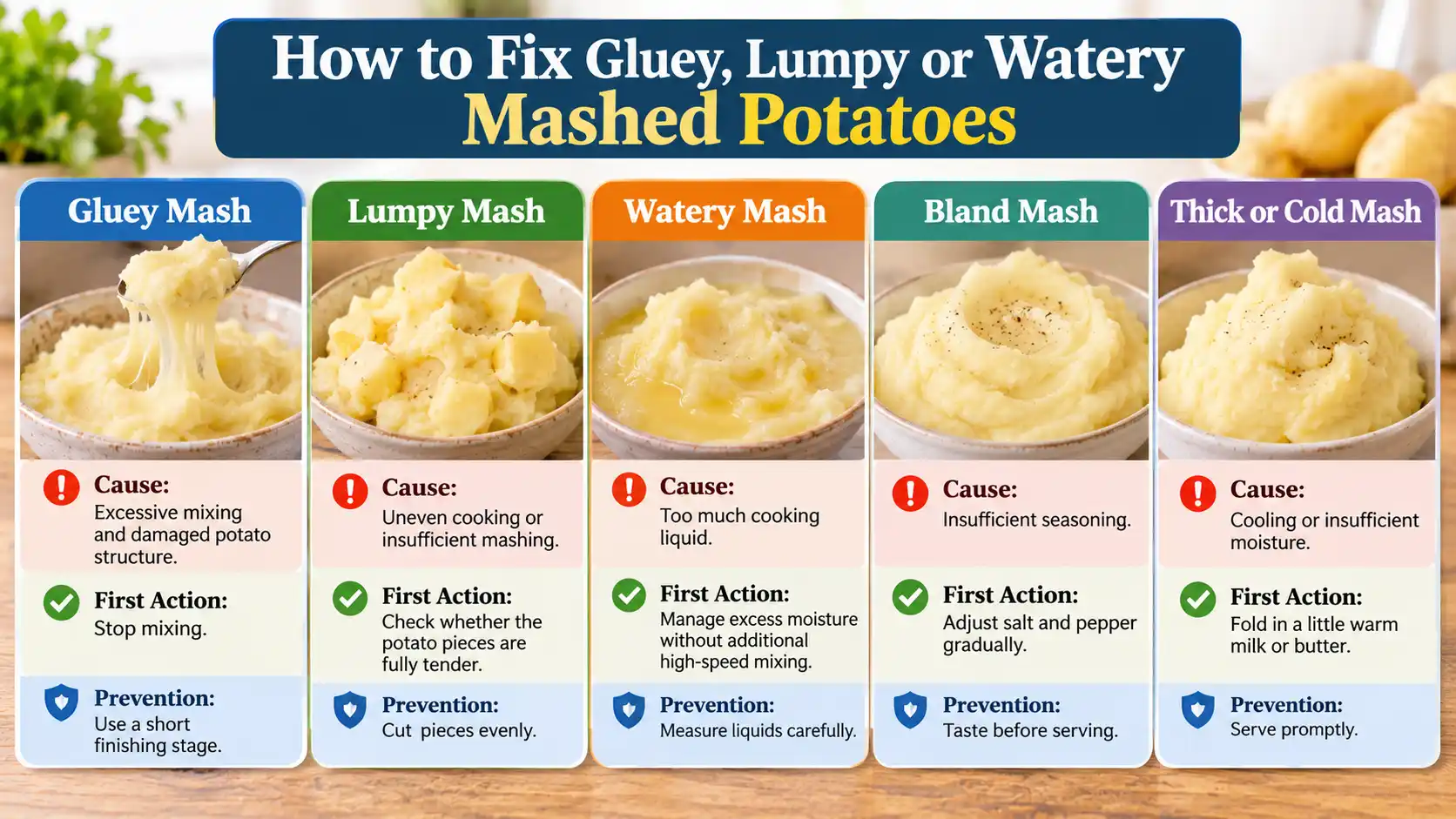
The best correction depends on the problem. Lumps and excess liquid may be easier to address than a batch that has already become gluey.
| Symptom | Why it happens | First correction to try | Prevention |
| Gluey | Excessive processing | Stop mixing; repurpose as a baked potato dish | Mash briefly |
| Lumpy | Uneven cooking or insufficient mashing | Check tenderness and use a manual masher or ricer | Cut evenly |
| Watery | Excess cooking liquid | Transfer to a pan and reduce gently, or add cooked drained potato | Measure liquid |
| Bland | Insufficient seasoning | Adjust salt and pepper gradually | Season and taste |
| Too stiff or cold | Excessive cooling or insufficient moisture | Fold in a little warm milk or butter | Serve promptly |
These are practical troubleshooting options, not results from a completed Kitchen Memo rescue comparison.
Can gluey mash be rescued?
Once potato cells have been heavily disrupted and the mash has become sticky, adding more milk or butter does not reliably restore its original fluffy texture.
Rather than repeatedly processing it, consider repurposing it into a potato bake or another oven-finished dish.
For a related oven-based potato preparation, see Kitchen Memo’s Thermomix potato bake guide.
The effectiveness of butter, additional milk and gratin baking as separate rescue treatments has not yet been compared in Kitchen Memo testing.
Variations and Dietary Swaps
Thermomix mashed potato can be adapted with different ingredients, but remember that substitutions affect richness, moisture and flavour.
| Variation | Replace or add | Expected change |
| Dairy-free | Unsweetened plant milk and olive oil | Less traditional dairy flavour |
| Vegan | Plant milk and suitable vegan butter | Dairy-free alternative |
| Lighter version | Reduce butter and adjust liquid carefully | Less richness |
| Cheesy | Add grated cheese after mashing | More savoury richness |
| Garlic | Add prepared roasted garlic | More pronounced flavour |
What is the one ingredient upgrade?
There is no universally proven single ingredient that guarantees fluffier mashed potatoes.
For a noticeable improvement, start with the potato itself. Choosing a suitable floury variety has a more direct effect on the desired fluffy texture than simply adding more butter or cream.
Additional dairy may increase richness, but it cannot reverse excessive starch release.
Thermomix vs Stovetop Mash (Ricer or Masher)
The Thermomix offers convenient weighing, cooking and mixing in one appliance. Traditional equipment gives the cook more direct control over how much the potatoes are worked.
| Method | Texture | Hands-on effort | Gluey risk | Best for |
| Thermomix | Smooth when carefully processed | Low | Requires careful timing | Convenience |
| Potato ricer | Fine, even and fluffy | Moderate | Lower when used correctly | Light mash |
| Manual masher | Can retain some small lumps | Higher | Depends on technique | Rustic mash |
A ricer presses cooked potato through small openings instead of repeatedly cutting through the mixture with rotating blades. This makes it a useful choice when a light, fluffy result is the priority.
A controlled side-by-side Kitchen Memo test comparing texture, effort and cleaning time has not yet been completed, so these are technique-based distinctions rather than measured performance rankings.
Make-Ahead, Keeping Warm, Freezing and Reheating
Mashed potatoes can be prepared ahead and frozen, but their texture may change during storage. Gentle reheating is preferable to processing them again at high speed.
The USDA recommends refrigerating leftovers within two hours, using shallow containers to promote cooling, and keeping refrigerated leftovers for 3–4 days.
See the USDA guidance on safe leftover handling.
| Storage | Temperature | Guidance |
| Refrigerator | 40°F (4°C) or below | 3–4 days |
| Freezer | 0°F (-18°C) or below | For longer storage; quality may decline over time |
| Reheating | 165°F (74°C) internally | Heat thoroughly before serving |
For freezing, divide the mash into individual portions and use suitable airtight containers. A mash-specific Kitchen Memo comparison of freezer durations and post-thaw texture has not yet been completed, so an exact best-quality freezing period cannot be claimed.
When reheating, use a saucepan or microwave and stir gently. Add a little warm milk or butter if the mash has become stiff.
The USDA recommends reheating leftovers to 165°F (74°C), checking the temperature with a food thermometer. See its safe reheating guidance.
Conclusion
Successful Thermomix mashed potato starts with the right variety, evenly cut pieces and fully tender potatoes. Follow a compatible cooking method, measure the ingredients and stop mixing early. The biggest difference between creamy mash and gluey mash is often how much the cooked potato is worked.
Frequently Asked Questions
1. Can you make mashed potatoes in a Thermomix?
Yes. The Thermomix can cook and mash potatoes in the same bowl. A short finishing stage helps prevent excessive processing.
2. How do you boil potatoes in a Thermomix?
Follow a compatible recipe with measured liquid. One published method cooks 1,000 g of potato with milk and water for 25–30 minutes at 90°C and speed 1.
3. What is a common mistake when making mashed potatoes?
Over-mashing is a common mistake. Excessive processing can damage the cooked potato structure and create a sticky consistency.
4. Do you put milk or butter first?
There is no universal order. The published Thermomix Australia recipe cooks the potatoes with milk and water, then adds butter during the finishing stage.
5. Why put salt in water when boiling potatoes?
Salt seasons the potatoes during cooking, helping distribute flavour through the potato rather than relying entirely on seasoning at the end.
6. What is the one ingredient upgrade for the fluffiest mashed potatoes?
Choose a suitable floury potato, such as Russet or Maris Piper. Potato variety is more important to texture than simply adding extra dairy.
7. What is the secret to fluffy mashed potatoes?
Use an appropriate potato, cook it until tender, manage excess moisture and avoid excessive mixing.
8. Can you make Thermomix mashed potato ahead or freeze it?
Yes. Refrigerate promptly or freeze in individual portions. Reheat gently to 165°F (74°C), adding a little milk or butter if needed.