Introduction
A whole chicken cooked flat on the grill solves the two biggest problems of backyard barbecue: uneven cooking and dry breast meat. This technique, known as butterflying or spatchcocking, removes the backbone and presses the bird open so it lies flat against the grate. The result is a chicken that cooks faster, more evenly, and picks up far more smoky flavor than one roasted whole. This guide covers everything needed to butterfly, marinate, and BBQ a chicken correctly — including exact cooking times, temperatures, and troubleshooting for charcoal, gas, and Weber-style grills.
What Is a Butterflied (Spatchcocked) Chicken?
Butterflying a chicken means cutting out the backbone with kitchen shears and flattening the bird by pressing down on the breastbone until it cracks and lies flat. This creates one even, uniform surface instead of a rounded shape with legs tucked underneath. Because the whole bird now has a consistent thickness, heat reaches the thighs, wings, and breast at closer to the same rate, which is the main reason this method outperforms standard whole-roasted or spatchcocked-in-name-only preparations on a grill.
Why Butterfly a Chicken for the BBQ
Grilling a whole, unflattened chicken creates a timing conflict: dark meat (thighs, legs) needs to reach a higher internal temperature and benefits from longer cooking, while the breast dries out if left on the heat too long. Butterflying solves this by exposing more surface area directly to heat and reducing the distance between the grate and the thickest parts of the bird. It also increases crispy-skin surface area, since the skin sits flatter against direct or indirect heat rather than curving away from it.
Quick Summary
- Butterflying removes the backbone so the chicken cooks flat.
- A whole butterflied chicken takes roughly 45–60 minutes over indirect heat at 180°C (350°F) grill temperature.
- Bone-in butterflied breasts cook faster, typically 25–35 minutes.
- Doneness is confirmed by internal temperature, not cooking time: 74°C (165°F) in the thickest part of the breast and thigh.
- A simple oil, acid, garlic, and herb marinade for 2–8 hours improves flavor and moisture retention.
- Works on charcoal, gas, and Weber-style kettle or gas grills with slight technique adjustments.
Choosing Your Chicken
A whole chicken between 1.6 kg and 2 kg (3.5–4.5 lb) butterflies most easily and cooks evenly on a standard-size home grill. Larger birds take longer to butterfly and may not fit flat on smaller grates. For those who prefer working with parts rather than a whole bird, a butterflied (or “spatchcocked”) bone-in chicken breast is a smaller-scale version of the same idea — the breast is sliced horizontally and opened like a book, then pounded to an even thickness so it grills as quickly and evenly as a thin cutlet.
How to Butterfly a Chicken
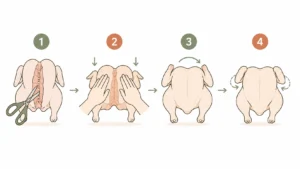
- Place the chicken breast-side down on a cutting board.
- Using kitchen shears, cut along both sides of the backbone from tail to neck and remove it.
- Flip the chicken breast-side up and press firmly on the breastbone with both hands until it flattens with an audible crack.
- Tuck the wing tips underneath to prevent them from burning.
Removing the backbone matters for two reasons beyond flattening: it opens up a wider, flatter cavity that marinade or rub can reach more evenly, and it eliminates the awkward pocket where raw juices tend to pool and slow cooking during roasting.
The Best BBQ Butterfly Chicken Marinade
A balanced marinade needs oil for moisture and heat transfer, an acid (lemon juice, vinegar, or yogurt) to tenderize the surface, and aromatics for flavor. A reliable base is olive oil, lemon juice, minced garlic, smoked paprika, dried oregano, salt, and black pepper. Marinating for at least 2 hours allows salt to draw out moisture and then reabsorb it along with the seasoning — a process called dry brining in reverse — while marinating longer than 8–12 hours with a strong acid can begin to break down surface texture and make the meat slightly mushy. For a Texas-leaning flavor profile, swapping oregano for cumin and chili powder shifts the marinade toward a BBQ rub style rather than a Mediterranean one, without changing the technique.
BBQ Setup: Charcoal, Gas, and Weber Methods
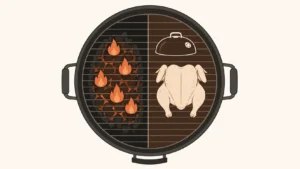
Butterflied chicken is best cooked using a two-zone or indirect-heat setup rather than direct high heat across the whole grate, because the skin will burn before the interior reaches a safe temperature if placed entirely over flame.
Charcoal BBQ: Bank the coals to one side of the kettle, creating a hot zone and a cooler indirect zone. Place the chicken skin-side up on the indirect side, close the lid, and use the vents to hold the grill around 180°C (350°F).
Weber gas BBQ: Light only the outer burners and leave the center burner off, then place the chicken over the unlit center section with the lid closed. This mimics the two-zone charcoal setup using consistent, adjustable heat.
Weber charcoal (kettle): The same banked-coal method applies; a Weber kettle’s dome lid and vent system make it easier to hold a stable indirect temperature over the full cooking time compared to an open grill.
Cooking Time and Temperature Guide
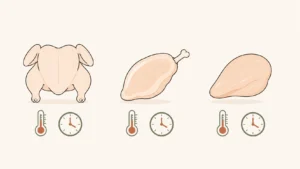
| Cut | Grill Temperature | Approximate Time |
|---|---|---|
| Whole butterflied chicken | 180°C (350°F) | 45–60 minutes |
| Bone-in butterflied breast | 180–200°C (350–400°F) | 25–35 minutes |
| Boneless butterflied breast | 200–220°C (400–425°F) | 12–18 minutes |
These times assume indirect or two-zone heat with the lid closed, which acts like a convection oven and cooks the chicken from all sides rather than just from below. Cooking entirely over direct flame shortens these times but sharply increases the risk of a charred exterior with an undercooked interior, since direct heat only browns the surface facing the flame.
Checking Internal Temperature
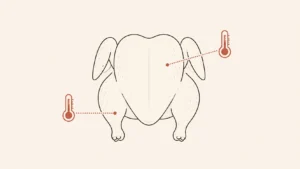
Cooking time is only ever an estimate, since grill temperature, chicken size, and outdoor conditions vary. The reliable marker is internal temperature, checked with an instant-read thermometer in the thickest part of the breast and the thigh without touching bone. Poultry is safe to eat at 74°C (165°F); pulling it at that point in both locations ensures the dark meat is fully cooked without the white meat drying out from overcooking. Letting the chicken rest for 5–10 minutes after removing it from the grill allows the internal juices, which are pushed toward the center during cooking, to redistribute evenly through the meat.
Texas-Style BBQ Butterfly Chicken
Texas-style barbecue typically favors a dry rub over a wet marinade, built around coarse black pepper, paprika, garlic powder, and salt, often finished with a light mop of vinegar-based sauce during cooking rather than a heavy glaze. Applied to a butterflied chicken, this style relies on lower, slower indirect heat and wood smoke (commonly oak or pecan) for flavor, rather than a marinade doing most of the work — a different balance of technique than the oil-and-herb approach, though the same flattening and indirect-heat principles apply.
Oven Method (No BBQ Needed)
Butterflying works in an oven using the same flattening logic. Roast the prepared chicken skin-side up on a rack set inside a baking tray at 220°C (425°F) for 40–50 minutes, until the internal temperature reaches 74°C (165°F). The higher, more consistent heat of an oven compensates for the lack of smoke flavor, and the flat shape still promotes faster, more even cooking than a whole roasted bird, plus more exposed skin for browning.
Common Mistakes and How to Avoid Them
- Cooking entirely over direct heat: causes charred skin before the interior finishes; use indirect or two-zone heat instead.
- Skipping the rest period: cutting immediately after cooking releases juices onto the board rather than back into the meat.
- Relying on time alone: grill hot spots and bird size vary enough that a thermometer reading is the only reliable doneness check.
- Over-marinating with strong acid: more than 12 hours in a citrus- or vinegar-heavy marinade can turn the surface texture soft and stringy rather than tender.
Storing and Reheating Leftovers
Cooked butterflied chicken keeps in an airtight container in the refrigerator for up to 4 days. Reheat gently in a covered oven-safe dish at 160°C (325°F) until warmed through, rather than in a microwave, since slower, lower heat is less likely to dry out meat that has already been cooked once.
Conclusion
Butterflying a chicken before it goes on the BBQ addresses the core challenge of grilling poultry: getting dark meat fully cooked without drying out the breast. By flattening the bird, using a two-zone or indirect heat setup, and checking internal temperature rather than relying on the clock, home cooks can produce a chicken that’s evenly cooked, well-flavored, and crisp-skinned — whether on charcoal, gas, or a Weber kettle, and whether following a herb-and-citrus marinade or a Texas-style dry rub.
FAQ
How long does it take to BBQ a butterfly chicken?
A whole butterflied chicken typically takes 45–60 minutes over indirect heat at around 180°C (350°F), though actual time depends on the bird’s size and the grill’s consistency.
What temperature should butterfly chicken be cooked to?
The chicken is done when it reaches an internal temperature of 74°C (165°F) in both the thickest part of the breast and the thigh.
Can I butterfly chicken breast instead of a whole bird?
Yes — a bone-in butterflied breast cooks in about 25–35 minutes, while a boneless butterflied breast is ready in as little as 12–18 minutes.
Do I need a BBQ to cook butterflied chicken?
No. It can be roasted in an oven at 220°C (425°F) for 40–50 minutes using the same flattening principle, though it won’t pick up grill smoke flavor.
Should I use charcoal or gas for butterfly chicken?
Both work well; the key factor is setting up indirect or two-zone heat rather than the fuel type itself.