Introduction
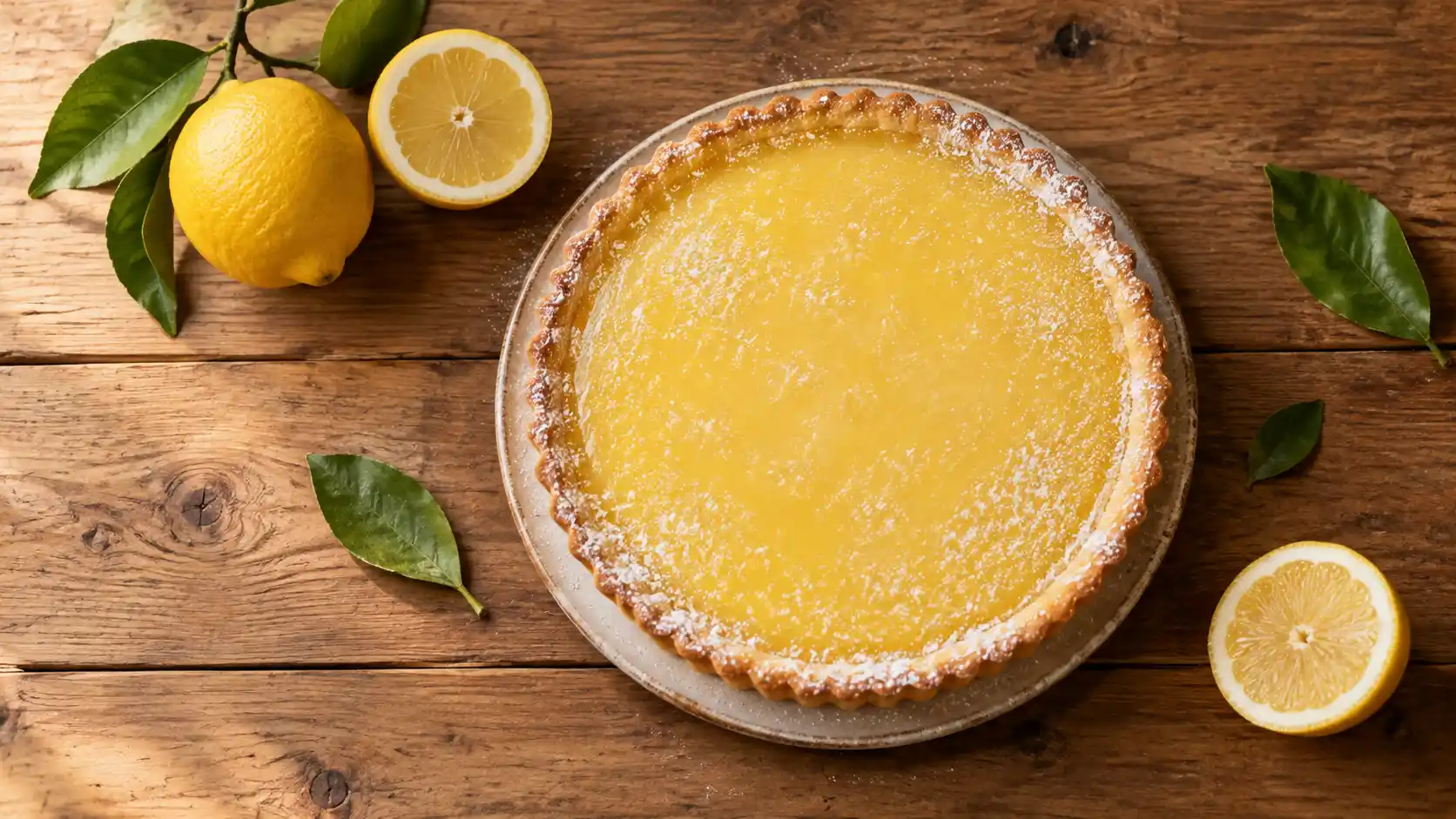
A lemon tart is a short, buttery pastry shell filled with a set lemon custard or curd, prized for balancing sharp citrus against sweet, rich filling. In Australia, the dessert appears everywhere from café display cabinets to Christmas dessert tables, and home bakers search for it in several distinct forms: a quick condensed-milk version for weeknight baking, a no-bake biscuit-base tart for hot weather, and more traditional curd-based tarts closer to French or Italian technique. This guide covers every major approach so you can pick the method that matches your time, equipment, and dietary needs.
Quick Summary
- A basic lemon tart needs three components: a pastry or biscuit base, a lemon filling, and (optionally) a meringue or cream topping.
- The fastest Australian home-baking method uses condensed milk, lemon juice, and egg yolks whisked together and baked briefly to set — no cooking on the stove required.
- Traditional lemon curd tarts (the style closer to Sicilian and French versions) cook the filling on the stovetop before it goes into a blind-baked shortcrust shell.
- No-bake versions rely on a biscuit crumb base and a filling set by refrigeration rather than an oven.
- Gluten-free and lighter versions substitute the pastry or reduce sugar without changing the core lemon-to-fat ratio that gives the tart its set and tang.
What Makes a Lemon Tart “Australian” in Style
Australian lemon tart recipes typically favour convenience and pantry staples over classical French pâtisserie technique. Where a French tarte au citron uses a cooked crème with fresh lemon juice and zest simmered slowly, the Australian home-style version often swaps this for sweetened condensed milk combined directly with lemon juice and egg, which sets through a chemical reaction between the acid and the milk proteins rather than through slow stovetop cooking. This method, popularised through community cookbooks and family recipe collections, produces a denser, sweeter filling with less hands-on cooking time — a practical adaptation suited to home kitchens without a double boiler or extensive pastry experience.
Choosing Your Base: Shortcrust Pastry vs. Biscuit Base
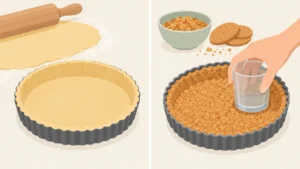
The base determines both texture and how much active baking is required.
Shortcrust pastry (homemade or premade) gives a crisp, sandy texture that holds its shape when sliced. It requires blind baking — lining the pastry with baking paper and weights, baking it empty first — so the base doesn’t turn soggy once the wet filling is added. Premade pastry sheets are a common substitution that cuts preparation time significantly while still delivering a proper baked crust.
Biscuit bases, made from crushed digestive biscuits or similar plain sweet biscuits bound with melted butter, are pressed into the tin and chilled or briefly baked rather than fully baked through. This is the foundation for nearly all no-bake lemon tart recipes, since the biscuit base sets through refrigeration and butter solidifying, not through oven heat. Biscuit bases are softer and more crumbly than shortcrust, and they’re generally the easier starting point for beginners or anyone without a rolling pin.
The Filling: Condensed Milk Method vs. Traditional Lemon Curd
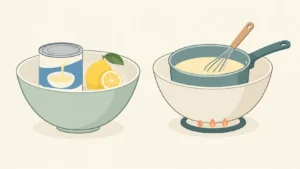
These two methods produce noticeably different textures, and choosing between them is really the central decision in any lemon tart recipe.
The condensed milk filling combines sweetened condensed milk, lemon juice, lemon zest, and egg yolks. The acidity of the lemon juice thickens the condensed milk on contact, and a short bake (around 15 minutes) firms it further. The result is a dense, mousse-like set — sweeter and less tart than a classical curd, because condensed milk’s sugar content is high relative to the lemon juice added.
The lemon curd filling is cooked gently on the stovetop from lemon juice, zest, sugar, eggs, and butter, whisked continuously until thickened, then strained for smoothness before it’s poured into a pre-baked shell. This method gives a sharper, more tart flavour and a silkier, custard-like set, because butter rather than condensed milk provides the richness. If a recipe calls for baking the filled tart briefly after pouring in cooked curd, that step is there to set the eggs fully and create a stable slice — skipping it, or under-baking, is the most common reason a tart filling stays runny.
Step-by-Step: Simple Lemon Tart Recipe
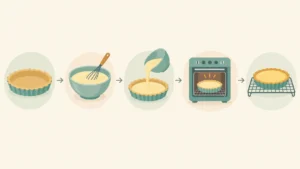
Base:
- Blind-bake a 23cm shortcrust pastry shell at 180°C (160°C fan-forced) for 12–15 minutes until pale gold, then cool slightly.
Filling (condensed milk method): 2. Whisk together one tin of sweetened condensed milk, the zest and juice of 3–4 lemons, and 4 egg yolks until smooth. 3. Pour the filling into the warm pastry shell. 4. Bake at 160°C for 15–18 minutes, until the centre is just set but still has a slight wobble — it will firm further as it cools. 5. Cool to room temperature, then refrigerate for at least 3 hours before slicing.
The wobble at the end of baking matters: an overbaked filling turns rubbery and can crack, while an underbaked one won’t hold a clean slice once cooled.
No-Bake and Mini Lemon Tart Variations
For a no-bake version, crushed biscuits mixed with melted butter are pressed into a tart tin or muffin tin (for minis) and chilled for at least 30 minutes to firm up. The filling is usually a lightened mix of lemon juice, condensed milk, and whipped cream folded through, rather than an egg-based custard, since there’s no baking step to cook eggs safely. This sets purely through refrigeration, typically needing 4+ hours.
Mini lemon tarts follow the same ratios as a full-size tart but portioned into individual tins or a muffin tray lined with cases, reducing both bake and set time — useful for parties or portion control, and popular for their neater presentation.
Healthy and Gluten-Free Adaptations
A “healthy” lemon tart typically reduces added sugar, swaps some condensed milk for Greek yoghurt or reduced-fat cream, or uses a nut-and-date base instead of butter-heavy pastry or biscuits. These substitutions change texture — yoghurt-based fillings are looser and tangier, and nut-date bases are denser and chewier than biscuit crumb — so set times and slice-ability shift accordingly.
For gluten-free versions, the pastry or biscuit base is the only component that needs adjusting, since the filling itself contains no gluten. A gluten-free shortcrust blend or gluten-free biscuits (crushed the same way as standard ones) work as direct substitutes, with no change needed to the filling recipe or bake time.
Sicilian and Italian-Style Lemon Tarts: What’s Different
Italian and Sicilian lemon tarts (torta al limone) generally use a pasta frolla base — a slightly sweeter, more cake-like shortcrust made with whole eggs rather than just butter and water — and a filling built from fresh lemon juice, ricotta or mascarpone, and less sugar than the Australian condensed-milk style. Sicilian lemons themselves are notably more aromatic and less acidic than many varieties used elsewhere, which is part of why the same recipe made with standard supermarket lemons can taste sharper; adding extra zest helps compensate for that aromatic difference.
Lemon Meringue Tart: Adding the Topping
A lemon meringue tart takes either filling style and adds a whipped egg-white meringue on top, either baked briefly to lightly brown the peaks or torched for a faster finish. The meringue must go onto a fully set filling, or the weight and moisture from the topping will cause the layers to separate when sliced.
Storage, Make-Ahead, and Troubleshooting
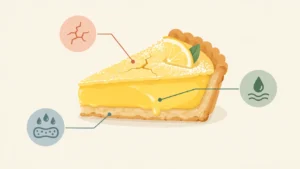
Lemon tarts keep for 3–4 days refrigerated, uncovered or loosely covered so the pastry base doesn’t turn soggy from trapped condensation. They don’t freeze well once filled, since both custard and biscuit bases change texture unpleasantly on thawing — it’s better to freeze an unfilled baked pastry shell and add the filling fresh.
Common issues and their causes:
- Runny filling: underbaked, or too little acid relative to condensed milk/egg volume.
- Cracked surface: overbaked, or oven temperature too high.
- Soggy base: filling poured into a base that wasn’t fully blind-baked or cooled first.
Conclusion
Whether you’re after a five-minute no-bake biscuit tart or a stovetop-cooked curd in a hand-rolled shortcrust shell, the core lemon tart formula stays the same: a stable base, a filling set by either heat or acid, and enough lemon to cut through the sweetness. Once you understand what each substitution — condensed milk versus curd, pastry versus biscuit, baked versus refrigerated — actually changes in texture and flavour, you can adapt any lemon tart recipe to whatever you have on hand.
FAQ
What is the easiest lemon tart recipe for beginners? The condensed milk method with a premade pastry shell is the simplest: no stovetop cooking, just whisking and one short bake.
Can I make a lemon tart with a biscuit base instead of pastry? Yes — crushed plain biscuits bound with melted butter, pressed into the tin and chilled, work as a no-bake alternative to shortcrust.
Why is my lemon tart filling not setting? It’s usually underbaked (for baked versions) or under-refrigerated (for no-bake versions); both need enough time for the acid-protein or gelatine-style set to fully firm up.
What’s the difference between lemon curd and lemon tart filling? Lemon curd is cooked on the stovetop with butter and eggs; many Australian tart fillings skip that step by using condensed milk, which thickens on contact with lemon juice.
Is Sicilian lemon tart different from a standard lemon tart? Yes — it typically uses a pasta frolla base and a lighter, ricotta-based filling with less sugar than a condensed-milk style tart.
Can lemon tart be made gluten-free? Yes, by substituting a gluten-free pastry or biscuit base; the filling itself is naturally gluten-free.