Introduction
Preserved kumquats turn a short, intensely seasonal fruit into something that lasts for months. Because the whole fruit — peel, pith, flesh, and seeds — is edible, kumquats respond well to several different preservation methods, each pulling moisture out or replacing it with sugar, salt, or alcohol so the fruit resists spoilage. The method chosen changes the final texture, sweetness, and use: salt-cured kumquats become a savory, umami-rich condiment; sugar and syrup versions turn soft and jammy; alcohol-preserved kumquats stay firm and take on a boozy, citrus-forward flavor. This article covers the major preservation traditions — including Chinese, Vietnamese, and Ottolenghi-style approaches — and explains the technique behind each one.
Quick Summary
- Preserved kumquats are whole kumquats cured in salt, sugar, syrup, honey, or alcohol to extend shelf life and concentrate flavor.
- Salt-cured kumquats are savory and used like preserved lemons; sugar, syrup, and honey versions are sweet and used in desserts, drinks, and glazes.
- Chinese and Vietnamese preserved kumquats are typically salt- or sugar-based and used in teas, sore-throat remedies, and Lunar New Year dishes.
- Yotam Ottolenghi’s version preserves kumquats in a spiced sugar syrup, softening the peel while keeping the fruit’s shape.
- Alcohol-preserved kumquats are cured in vodka, brandy, or rum, keeping the fruit firm and infusing the liquor with citrus oil.
- Properly preserved kumquats stored in a sealed jar can last several months to over a year, refrigerated or at room temperature depending on the method.
What Preservation Does to a Kumquat
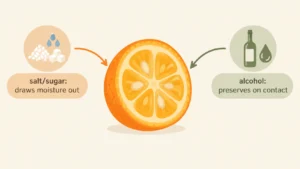
Kumquats are unusual among citrus because the peel is thin, sweet, and safe to eat raw, while the flesh is tart. This structure matters for preservation: because there’s no thick pith to remove, the whole fruit can be cured intact, and preserving agents penetrate quickly through the peel. Salt and sugar work by osmosis, drawing water out of the fruit’s cells; this concentrates natural sugars and acids while creating an environment too dry or too salty for spoilage organisms to thrive. Alcohol works differently, denaturing microbial cell walls on contact rather than removing water. This is why salt- and sugar-cured kumquats often shrink and soften considerably over weeks, while alcohol-preserved kumquats stay closer to their original size and firmness even after months.
Preserving Kumquats in Salt
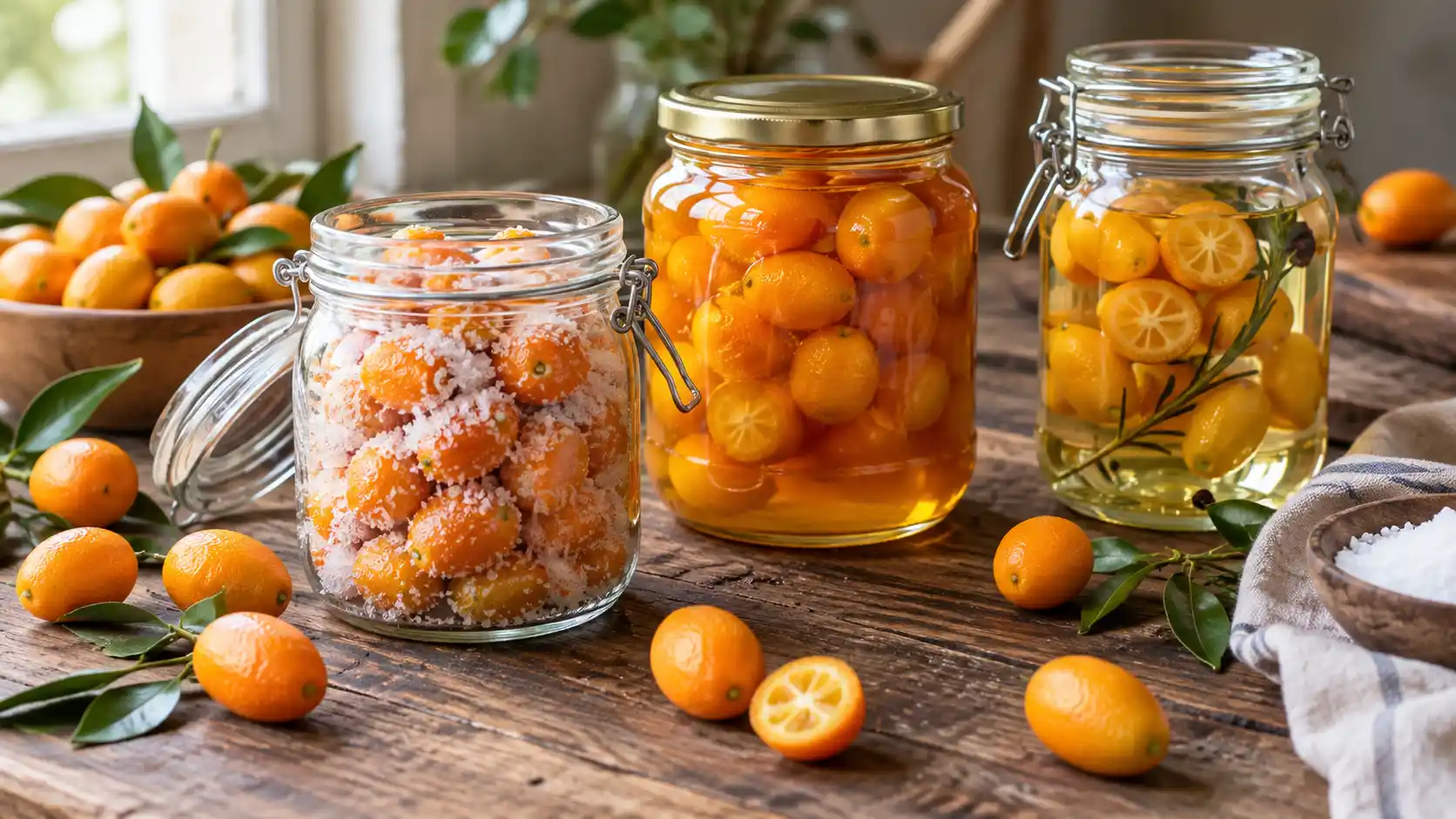
Salt-preserved kumquats follow the same logic as preserved lemons. Whole kumquats are scored or halved, packed tightly into a jar with coarse salt, and left to sit until the salt draws out juice that forms a natural brine. Over two to four weeks, the peel softens and the flavor turns from bright and citrusy to deep, salty, and slightly fermented. If the kumquats aren’t submerged in their own brine, the exposed fruit can develop mold, so many recipes add a splash of fresh kumquat or lemon juice to top up the liquid. Salted preserved kumquats are typically minced and used as a seasoning — stirred into dressings, rubbed into roasted meats, or added to braises for a citrus-forward umami note.
Preserving Kumquats in Sugar
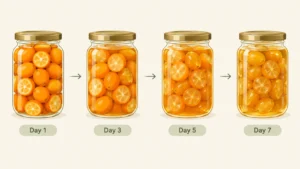
Sugar preservation is the most common approach for a sweet, spoonable result. Whole or halved kumquats are simmered repeatedly in a sugar syrup over several days, with the sugar concentration increasing each round. This slow, staged process — rather than one long boil — prevents the peel from turning tough or bitter, since a sudden high sugar concentration can pull moisture out too fast and case-harden the skin. The result is a translucent, glossy fruit suspended in thick syrup, closer to candied citrus than a jam. These are the kumquats most often used on cheese boards, folded into cakes, or spooned over yogurt.
Preserving Kumquats in Syrup
“Preserved kumquats in syrup” usually describes a lighter, less concentrated version of the sugar method above — the fruit is cooked just until tender in a simple syrup and stored in that liquid rather than being repeatedly re-boiled to a thick candy stage. This version keeps more of the kumquat’s natural tartness and a softer bite, making it better suited to spooning over pancakes, stirring into cocktails, or using the syrup itself as a citrus simple syrup for drinks.
Preserving Kumquats in Honey
Honey-preserved kumquats swap sugar syrup for raw or lightly warmed honey. Because honey is naturally low in moisture and mildly acidic, it can preserve whole or sliced kumquats without any cooking at all — the fruit is simply submerged and left to macerate, releasing juice that thins the honey into a citrus-infused syrup over one to two weeks. This method is popular for sore-throat remedies and teas, since gentle heat (rather than a hard boil) protects some of honey’s antibacterial compounds. Honey-preserved kumquats also make a straightforward glaze for roasted vegetables or poultry.
Preserving Kumquats in Alcohol
Alcohol-preserved kumquats are made by submerging whole, washed kumquats — sometimes pierced or lightly scored to help the liquid penetrate — in a high-proof spirit such as vodka, brandy, or white rum, often with added sugar. Unlike salt or sugar curing, this method doesn’t rely on drawing moisture out, so the fruit keeps more of its original firmness and shape for months or even years. The kumquat’s essential oils infuse into the alcohol, producing a citrus liqueur that can be strained and used on its own, while the boozy fruit is often served over ice cream or folded into desserts. In Australia, this is a popular way to use a heavy backyard cumquat harvest, since the finished liqueur and fruit both keep well without refrigeration.
Chinese and Vietnamese Preserved Kumquats
In Chinese cooking, preserved kumquats (蜜金桔 or 咸金桔, depending on whether sugar or salt is used) are closely tied to Lunar New Year, when kumquat trees symbolize prosperity. The salted version is often dried slightly after curing, then simmered with rock sugar and used in a warming tea believed to soothe coughs and sore throats. Vietnamese preserved kumquats (quất) follow a similar salt-and-sugar approach; the fruit is flattened, seeded, and dried before preserving, then blended into a honey-kumquat drink (mứt quất or trà quất) that’s a common home remedy for colds. Both traditions favor smaller, more sour kumquat varieties, which hold up better to the flattening and drying steps than sweeter cultivars.
The Ottolenghi Method
Yotam Ottolenghi’s preserved kumquat recipe leans toward the sugar-and-syrup family but adds warm spices — commonly star anise, cinnamon, or cardamom — to the poaching syrup. The kumquats are scored and blanched first to soften the peel and remove some bitterness, then poached gently in the spiced syrup until tender rather than fully candied. This produces a fruit that’s softer than a salt cure but less intensely sweet than a full candying process, designed to be served as a garnish or condiment alongside roasted meats, grain salads, or cheese, rather than as a standalone sweet.
How to Use Preserved Kumquats

- Sweet versions (sugar, syrup, honey): stir into yogurt or oatmeal, top cakes and tarts, mix into cocktails, or use the syrup as a glaze.
- Salt-cured versions: mince finely and use as a seasoning in dressings, marinades, and braises, much like preserved lemon.
- Alcohol-preserved versions: serve the fruit over desserts or strain and drink the infused liquor; both keep well without refrigeration.
- Chinese and Vietnamese versions: dissolve in hot water for a soothing tea, or blend into a drink with additional honey.
Storage and Shelf Life

Sugar-, syrup-, and honey-preserved kumquats should be kept in a sealed, sterilized jar in the refrigerator, where they typically last two to three months; unopened and properly sealed, sugar versions can last up to a year in a cool, dark pantry. Salt-preserved kumquats keep at room temperature for several weeks and even longer refrigerated, as long as the fruit stays submerged in its brine. Alcohol-preserved kumquats are the most stable and can be stored at room temperature for a year or more, since the alcohol content prevents most spoilage.
Conclusion
Preserved kumquats are less a single recipe than a family of techniques, and the right one depends on what you want at the end: a savory condiment (salt), a jammy sweet (sugar or syrup), a gentle home remedy (honey), a spiced accompaniment (the Ottolenghi method), a warming tea (Chinese and Vietnamese traditions), or a long-lasting boozy treat (alcohol). Because kumquats are eaten whole, peel and all, every one of these methods works with the fruit’s natural structure rather than against it, which is part of why the tradition of preserving kumquats spans so many different cuisines.
FAQ
Can you eat the seeds in preserved kumquats?
Kumquat seeds are edible but bitter and are usually removed before or after preserving, especially in Vietnamese preparations where the fruit is flattened and deseeded first.
Do preserved kumquats need refrigeration?
It depends on the method: sugar, syrup, and honey versions generally need refrigeration once opened, salt-cured versions keep at room temperature if submerged in brine, and alcohol-preserved versions are shelf-stable at room temperature.
What’s the difference between preserved kumquats and kumquat marmalade?
Preserved kumquats keep the fruit mostly whole or in large pieces in a curing medium, while marmalade cooks the fruit down into a spreadable set jam, usually with added pectin from the peel and a firmer, jelled consistency.
Are preserved kumquats the same as candied kumquats?
They overlap — candied kumquats are one style of sugar-preserved kumquat, cooked to a fully translucent, syrup-soaked state, while other preserved versions (salt, honey, alcohol) are less sweet and have a different texture.