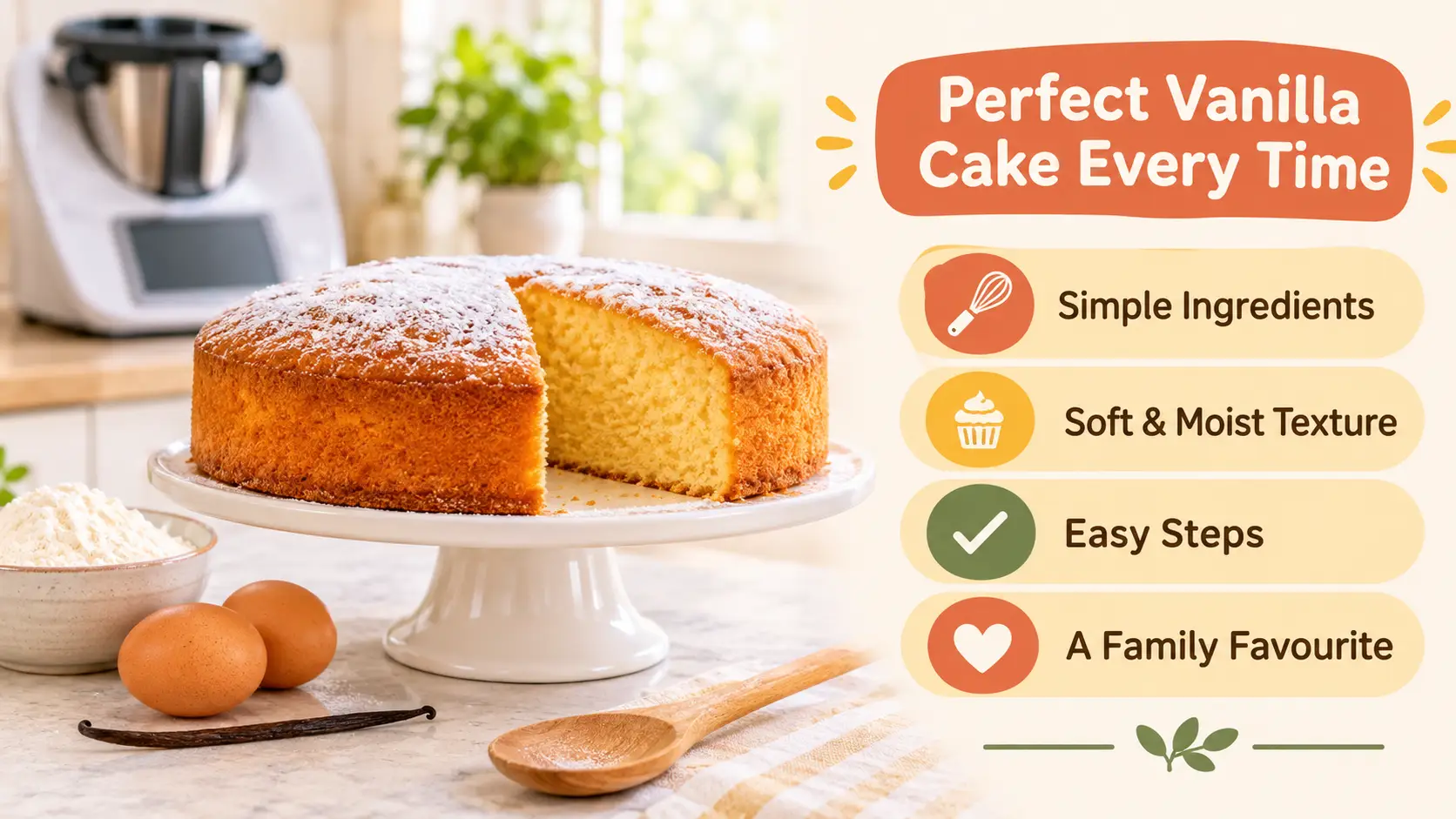
Thermomix cake recipes make preparing cake batter easier by combining weighing, mixing, melting and whipping in one appliance. The Thermomix prepares the ingredients, but a conventional oven still bakes the cake and develops its final structure. This distinction matters when a cake comes out dense, sinks in the middle or becomes dry. The right result depends on choosing a suitable cake formula, checking compatibility with your Thermomix model and following the correct mixing and baking instructions.
Different Thermomix models and cake methods can produce different preparation experiences, so it is worth checking the recipe settings before starting.
Quick Summary
- The Thermomix mixes, weighs, melts and whips; the oven bakes the cake.
- TM31 has a 2-litre maximum bowl capacity, while TM5, TM6 and TM7 have 2.2-litre maximum capacities.
- Overmixing, undermixing, ingredient temperature, excess raising agent and incorrect baking time can all affect cake texture.
- Start with one reliable vanilla cake formula before adapting it into chocolate, carrot, apple or gluten-free versions.
- Check the recipe’s model compatibility rather than assuming every Thermomix setting transfers directly.
Which Thermomix cake recipe fits what you want to bake?
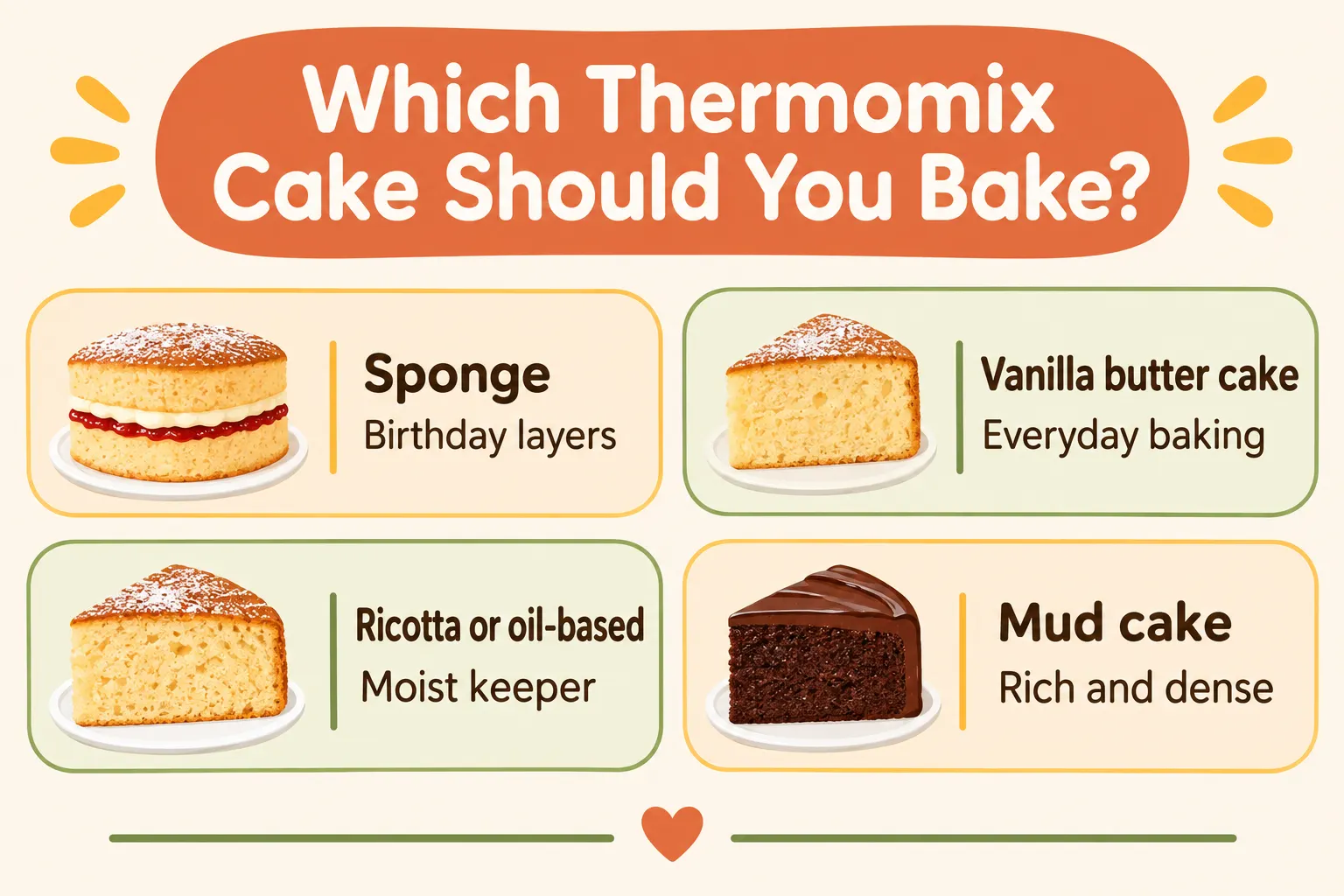
Choose a cake according to its texture and purpose. Sponge cakes are useful for light birthday layers, vanilla butter cakes suit everyday baking, and chocolate mud cakes offer a richer, denser result. Ricotta and oil-based cakes are other options when a moist crumb is the priority.
The difference comes from how each formula develops structure. Sponge cakes depend heavily on whipped eggs, butter cakes use a creamed fat-and-sugar mixture, and oil-based cakes use a different fat-and-liquid structure.
| Cake type | Best for | Expected texture | Difficulty | Models tested | Tested rise height |
| Sponge | Birthday and layered cakes | Light and airy | Medium–high | No Kitchen Memo test recorded | Not yet measured |
| Vanilla butter | Everyday baking | Tender and soft | Medium | No Kitchen Memo test recorded | Not yet measured |
| Chocolate | Chocolate desserts | Rich and moist | Medium | No Kitchen Memo test recorded | Not yet measured |
| Carrot or hummingbird | Fruit and vegetable cakes | Moist and substantial | Medium | No Kitchen Memo test recorded | Not yet measured |
| Apple | Everyday fruit cake | Soft and moist | Easy–medium | No Kitchen Memo test recorded | Not yet measured |
| Ricotta or mud | Rich dessert cakes | Close and rich | Medium | No Kitchen Memo test recorded | Not yet measured |
| Gluten-free | Gluten-free baking | Depends on flour blend | Medium–high | No Kitchen Memo test recorded | Not yet measured |
These are general cake-style descriptions rather than results from controlled Kitchen Memo comparisons. A future comparison can record the actual mixing settings, cake height and crumb texture for each tested model.
Birthday cakes and layer cakes
Choose a sponge or suitable butter cake when you need layers that can be levelled, filled and stacked. Structure matters as much as flavour: a very soft cake may need careful handling, while a heavier cake may support decoration more easily.
Easy cakes and slices for everyday baking
Vanilla, apple and simple chocolate cakes are practical starting points. Once the basic mixing sequence is understood, you can explore more options through Kitchen Memo’s Recipes collection.
Healthy and gluten-free options
The word healthy needs context. A cake with less added sugar, some wholemeal flour, fruit or vegetables may offer a different nutritional profile, but that does not automatically make it low-calorie or nutritionally complete.
Gluten-free baking also requires a suitable tested flour formulation. Different blends absorb moisture differently and may need changes to liquid, binding ingredients and resting time.
What the Thermomix does in cake making, and what the oven still does
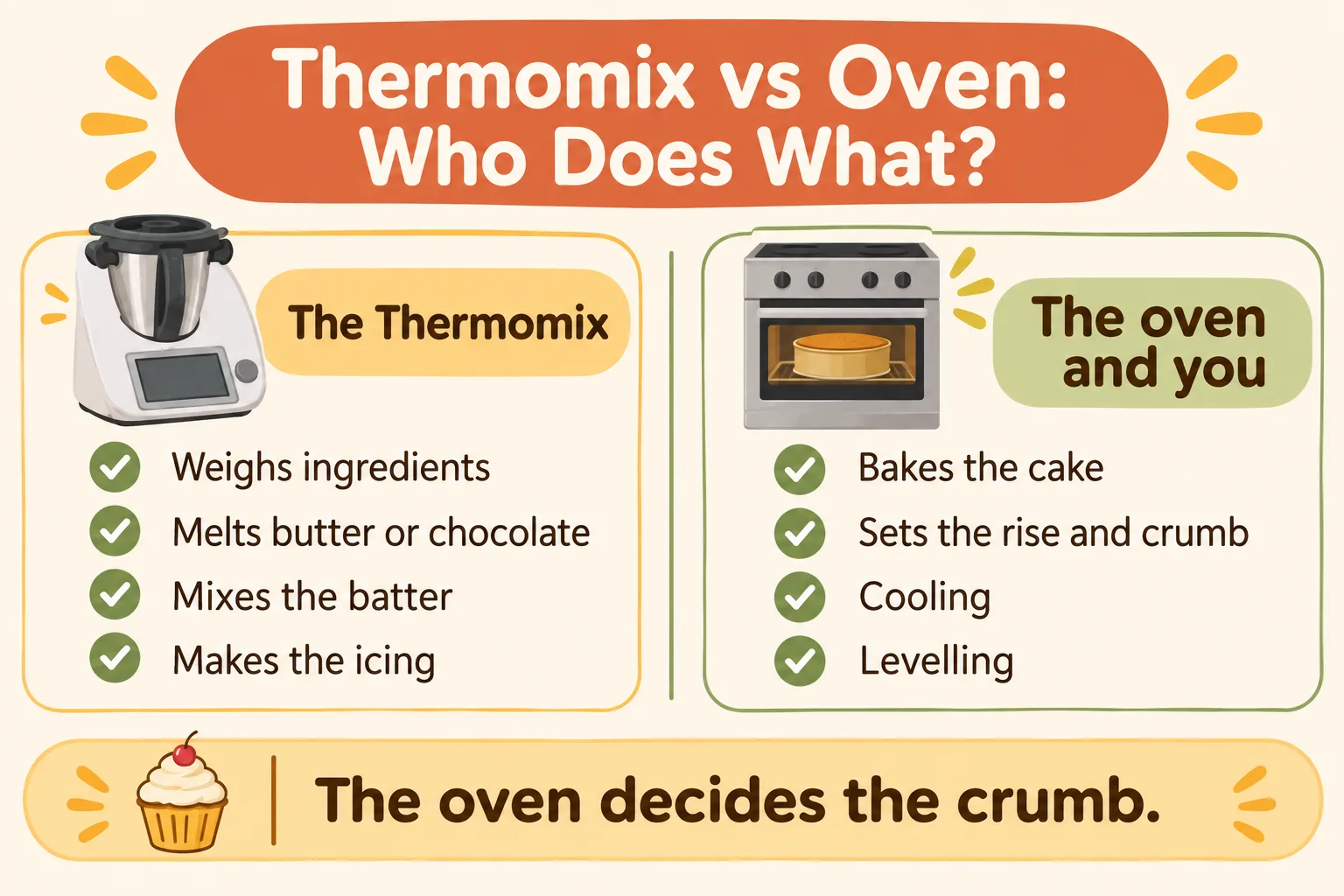
The Thermomix can perform many preparation jobs normally divided between a kitchen scale, saucepan and electric mixer. It can weigh ingredients, melt butter or chocolate, mix batters, prepare frosting and whip egg whites with a suitable butterfly whisk.
However, it does not bake a conventional cake. The oven supplies the dry heat that sets the cake’s structure, develops its crust and determines how evenly it cooks. Oven accuracy, baking tin dimensions and bake time therefore remain essential.
| Method | Preparation and aeration | Cleanup | Overmixing considerations | Suitable uses |
| Thermomix | Integrated weighing and mixing; whisking depends on the method and accessory | One main mixing bowl, plus accessories and tin | Settings must be controlled carefully | Batters, melting, icing and selected whipped preparations |
| Stand mixer | Good control over creaming and whipping | Separate bowl and attachments | Excess mixing can affect texture | Butter cakes, sponges and frosting |
| By hand | Direct control over mixing | Usually fewer machine parts | Consistency depends on technique | Simple batters and gentle incorporation |
The preparation time and cleaning effort depend on the recipe, batch size and equipment used. A fair comparison should measure the same cake prepared using each method rather than assume that one appliance always saves a particular amount of time.
For practical help with weighing, modes and accessories, see the Thermomix first-week beginner’s guide.
Can you use a TM5 or TM6 cake recipe on a TM31?
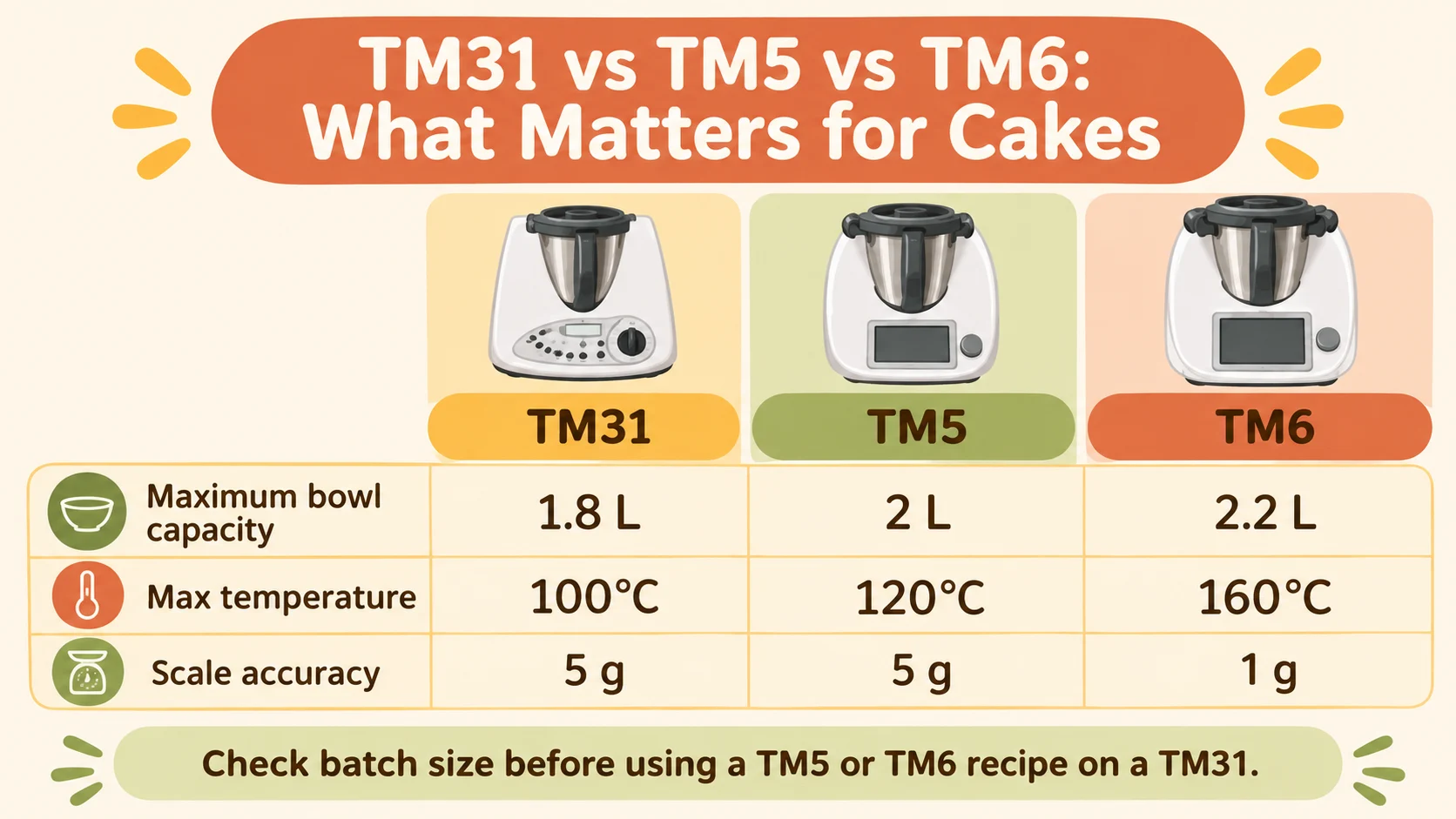
Sometimes, but recipe compatibility should be checked first. Vorwerk confirms that not all recipes transfer between models. The TM31 has a smaller mixing bowl, and later models have different functions and weighing specifications.
Model comparison
| Feature | TM31 | TM5 | TM6 | TM7 |
| Maximum bowl capacity | 2.0 L | 2.2 L | 2.2 L | 2.2 L |
| Temperature capability | Up to 100°C selectable, plus Varoma mode | Up to 120°C | Up to 120°C, plus recipe-restricted High Temperature Mode | Up to 160°C through specific modes |
| Scale increments | 5 g below 100 g; 10 g above | 5 g | 1 g | Approximately 1 g |
| Recipe interface | Manual controls | Touchscreen and selector | Touchscreen and selector | 10-inch touchscreen |
| Main baking consideration | Smaller capacity and less precise small-quantity weighing | Check batch capacity and settings | Check compatible recipe functions | Check recipe and accessory compatibility |
The capacities are manufacturer-stated maximums, not recommended cake-batter fill quantities. A maximum bowl marking does not establish how much batter a particular recipe can mix reliably.
The TM31 scale is particularly worth considering when weighing small quantities of baking powder or bicarbonate of soda. A separate fine-resolution digital scale is useful when the recipe requires measurements smaller than the machine can reliably distinguish.
For the exact specifications, check the official Thermomix manuals. Vorwerk’s recipe compatibility guidance also explains why model-specific recipes should not be transferred automatically.
The compatibility table describes manufacturer specifications, not results from Kitchen Memo cake tests. Check the relevant model manual and recipe instructions before changing batch sizes or machine settings.
Why did my Thermomix cake come out dense, sunk or dry?
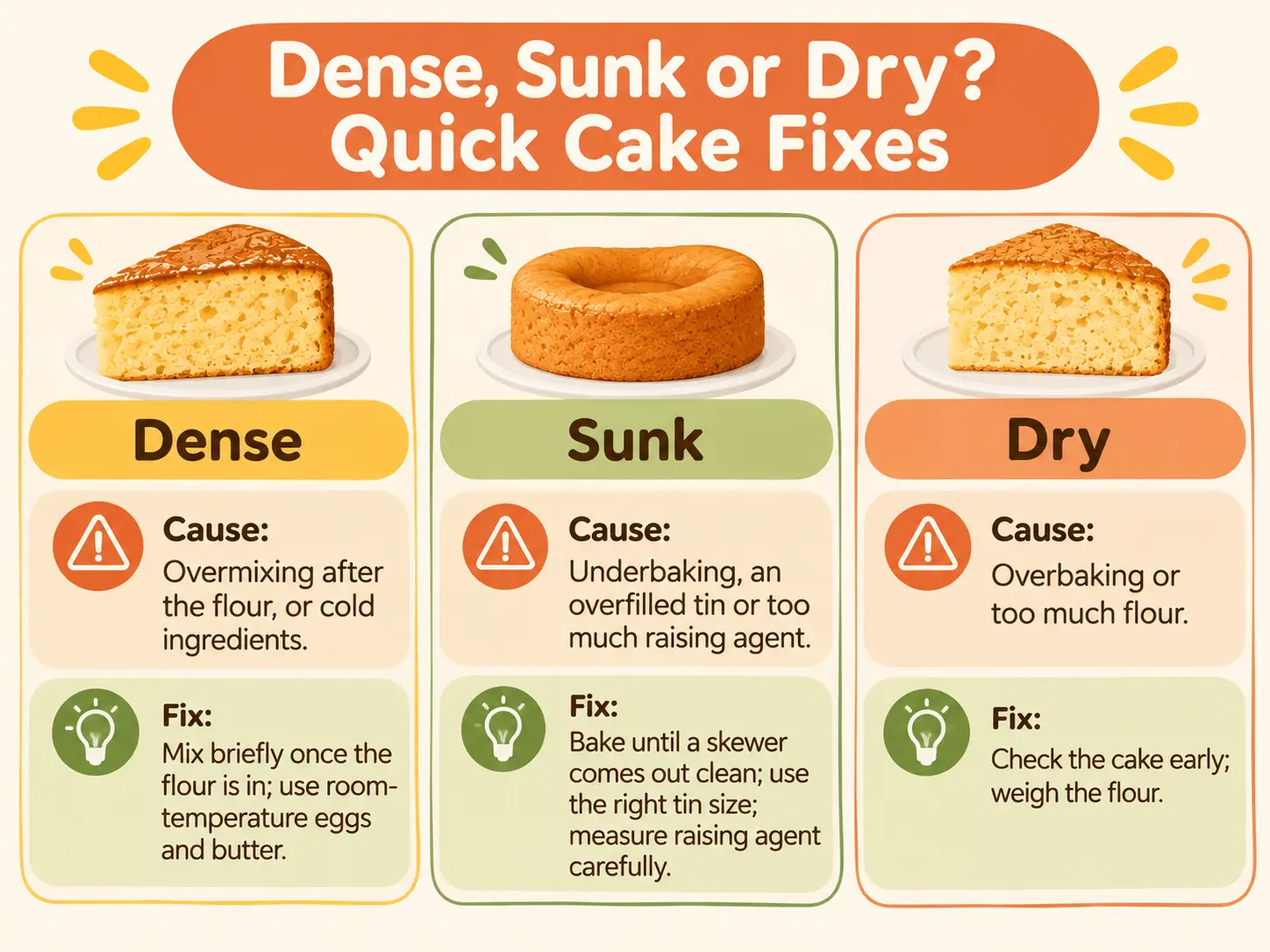
A dense cake is not necessarily the result of excessive Thermomix mixing. Both overmixing and undermixing can create texture problems. Too much mixing after flour is added may develop excessive gluten, while insufficient mixing can leave poorly incorporated ingredients and gummy patches.
| Symptom | Possible cause | Practical fix | Prevention |
| Dense and gummy | Overmixing, undermixing or poor ingredient incorporation | Check the batter and recipe mixing order | Mix until evenly combined, using the appropriate setting |
| Sunk in the centre | Underbaking or excess raising agent | Check doneness and ingredient quantities | Use a verified formula and correct tin |
| Dry and crumbly | Overbaking or too much flour | Review measurements and bake time | Weigh ingredients and monitor oven performance |
| Flour pockets at the bottom | Incomplete incorporation | Scrape and inspect the bowl before transferring | Check the bowl thoroughly |
| Uneven rise | Oven hot spots or uneven batter distribution | Check the oven and tin position | Spread batter evenly |
| Sticking to the tin | Inadequate preparation or unsuitable release timing | Follow the recipe’s cooling and release instructions | Grease and line the tin appropriately |
The King Arthur Baking explanation of cake batter mixing is useful because it explains why both too much and too little mixing can damage cake texture.
Thermomix-specific causes to test
A few possible problems deserve controlled testing rather than being treated as established Thermomix faults:
- Batter or flour remaining beneath the blades.
- Excessive speed after adding flour.
- A batch too large for the particular mixing process.
- Small raising-agent quantities measured on a 5 g scale.
The bowl should be inspected before transferring the batter. The scale issue is particularly relevant to TM31 and TM5, but its effect on an actual cake formula depends on the quantity being measured and the recipe’s proportions.
Altitude and humidity can also change baking conditions. In particular, high-altitude baking may require formula adjustments. Record the location, oven conditions and ingredient weights before applying a specific correction to a recipe.
The base recipe: moist vanilla Thermomix cake
A vanilla butter cake is a useful starting point for chocolate, carrot, apple and other variations. A dependable base needs a complete ingredient list and a consistent preparation method, with the quantities and settings matched to the selected Thermomix model.
Ingredients and quantities
Room-temperature butter and eggs are commonly specified in creaming-style cake recipes, but their required condition depends on the particular formula. Weigh the ingredients rather than estimating small quantities of raising agent, and check that the baking powder is within its recommended use period.
The exact flour, sugar, butter, egg and raising-agent quantities should come from a complete, verified vanilla cake formulation. Measurements should not be estimated simply to fill a recipe card.
Step-by-step method
- Weigh all ingredients using the measurements in the chosen formula.
- Prepare the butter and eggs according to the recipe’s specified temperature.
- Mix the butter, sugar and other ingredients using the specified sequence.
- Add the flour and raising agents, then use the appropriate mixing setting. Stop once the ingredients are evenly incorporated.
- Scrape and inspect the bowl, including the area beneath the blades, before transferring the batter.
- Bake in the prepared tin using the oven temperature and duration specified by the recipe.
The final mixing stage deserves particular attention. Once flour is added, prolonged mixing is generally unnecessary for a conventional cake batter. The aim is an evenly combined mixture without excessive agitation.
Time, yield and equipment
| Item | Recipe-specific information |
| Preparation time | Depends on the selected vanilla cake formula |
| Baking time | Determined by the batter depth, tin and oven |
| Yield | Depends on the tin size and portion size |
| Tin dimensions | Must match the selected recipe |
| Oven temperature | Follow the verified recipe |
| Thermomix models | Check compatibility before preparing the batter |
Doneness checklist
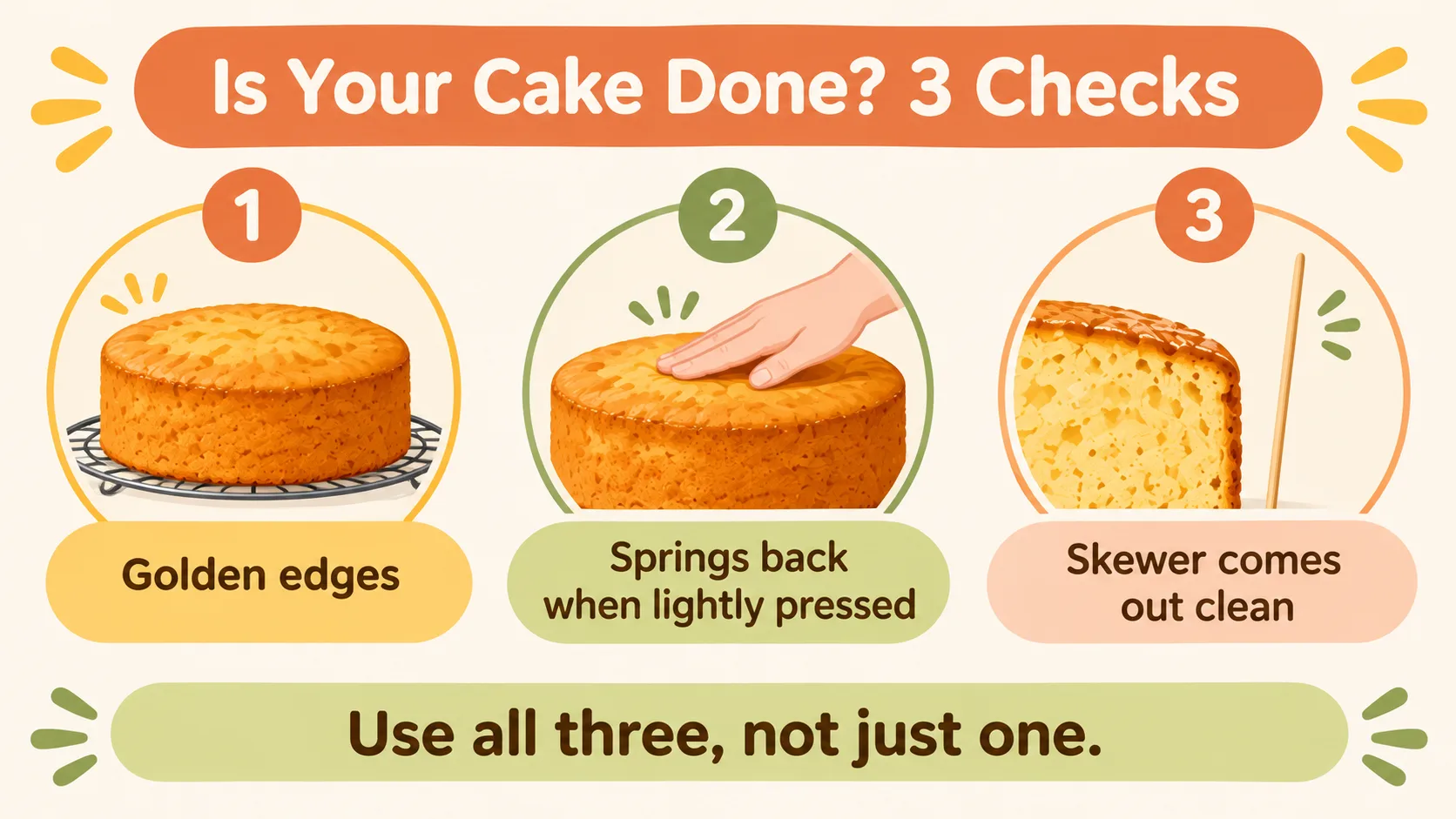
- The edges appear set and may begin pulling slightly away from the tin.
- The centre springs back gently when pressed.
- A skewer comes out without wet raw batter.
- The surface has the expected appearance for that particular cake.
Use more than one cue. There is no single internal-temperature threshold that is reliable for every cake formula. See King Arthur Baking’s cake doneness guide.
Cake variations
| Variation | Changes from vanilla base | What to consider |
| Chocolate | Add cocoa and adjust the dry and liquid balance | Cocoa changes the dry-ingredient balance and flavour |
| Carrot with pineapple | Add prepared carrot and pineapple | Additional moisture and solids can affect the crumb |
| Hummingbird with pineapple | Add banana, pineapple and other recipe-specific ingredients | Fruit preparation and moisture need consideration |
| Apple | Add prepared apple in the selected cut size | Apple variety and cut size influence the finished texture |
| Gluten-free chocolate | Use a suitable gluten-free flour formulation and cocoa | Flour blend and moisture absorption affect structure |
Each variation should be developed from its own ingredient quantities and baking observations. Adding fruit, cocoa or an alternative flour changes the original batter, so the vanilla cake’s baking time should not automatically be assumed to remain the same.
Ingredient swaps and dietary adaptations
Ingredient substitutions should be treated as recipe changes, not automatic one-for-one replacements.
| Swap | Ratio | What changes | Suitable cakes |
| Butter for oil | Depends on the tested formula | Flavour, aeration and crumb texture | Vanilla and chocolate |
| Plain flour for gluten-free blend | Depends on the specific flour blend | Moisture absorption and structure | Gluten-free chocolate and vanilla |
| Reduced sugar | Depends on the original recipe | Sweetness, tenderness, browning and moisture | Selected everyday cakes |
Butter-based and oil-based cakes use different methods to create their texture. Gluten-free blends also vary in ingredients and absorption, so one replacement ratio should not be treated as universal.
For reliable substitutions, compare the original and adapted cakes using the same tin dimensions and baking conditions. This makes it easier to identify changes in crumb, moisture and finished height.
Making matching icing and frosting in the bowl
The Thermomix can prepare buttercream, cream cheese frosting and chocolate ganache in the mixing bowl. Making the icing after the cake batter also gives the cake time to cool.
Use the butter temperature specified by the frosting recipe, and choose the butterfly whisk only when the method calls for it and the attachment is suitable for your model.
- Too soft: Check the ingredient temperature and follow the recipe’s chilling or consistency adjustment.
- Split: Review the temperature and incorporation order.
- Grainy: Check whether the sugar is sufficiently fine and incorporated.
Different frostings have different mixing requirements, so their speeds and durations should follow the individual recipe rather than one universal Thermomix setting.
Getting it right every time: scaling, storage and make-ahead
Doubling a cake recipe is not simply a matter of multiplying everything by two. Check the bowl capacity, mixing performance, tin dimensions and the depth of the batter. This is particularly important with the TM31 because its bowl maximum is smaller than the TM5, TM6 and TM7.
Cake storage guide
Storage depends on the recipe, moisture content, frosting and filling. The following are general reference periods rather than Kitchen Memo-controlled storage test results.
| Cake type | Room temperature | Refrigerator | Freezer |
| Plain, unfrosted cake | Often 2–3 days when properly covered | Up to about 1 week, depending on the recipe | Quality is commonly best within 3–4 months |
| Buttercream cake | Depends on buttercream formulation and room temperature | Up to about 1 week, depending on ingredients | Freezing may affect the icing texture |
| Cream cheese or mascarpone cake | Keep refrigerated | Around 3–4 days as a general guide | Texture may change after freezing |
| Whipped cream or custard filling | Keep refrigerated | Follow filling-specific storage guidance | Depends on the formulation |
For perishable fillings and frostings, refrigeration is important. The USDA’s two-hour food-storage rule advises that food requiring refrigeration should not remain at room temperature for more than two hours, or one hour above 90°F (32°C).
For make-ahead baking, allow the cake to cool completely before wrapping it securely. Thaw frozen cake in the refrigerator while covered, then allow it to reach a suitable serving temperature. Discard cake showing mould or other spoilage signs, and do not rely on appearance or smell alone to establish food safety.
Conclusion
Successful Thermomix cake recipes depend on three things: a suitable base formula, model-compatible preparation and accurate oven baking. Mix the flour carefully, check the centre for doneness and investigate the actual cause when a cake sinks or becomes dense. The Thermomix simplifies preparation, but the oven and recipe determine the finished cake.
FAQs
1. Can I bake a cake in the Thermomix itself?
The Thermomix can steam suitable cake or pudding recipes using the Varoma, but this is different from conventional oven baking. For a traditional cake with a baked crust, use a conventional oven.
2. Can I use TM5 or TM6 cake recipes on a TM31?
Sometimes, but check quantities, bowl capacity, settings and accessories first. The TM31 has a smaller maximum bowl capacity, and some later-model recipes depend on features it does not have.
3. Why did my Thermomix cake sink or turn out dense?
Possible reasons include excess raising agent, incomplete baking, overmixing or undermixing, cold ingredients in a creamed batter, and incorrect tin dimensions. Check the complete method before changing individual ingredients.
4. How long should I mix cake batter in a Thermomix?
There is no universal mixing time. It depends on the cake formula and mixing stage. Use the tested model-specific instructions and avoid both incomplete incorporation and excessive mixing after adding flour.
5. Can I make a gluten-free cake in the Thermomix?
Yes. The machine can mix gluten-free cake batter, but the flour blend, moisture and binding ingredients determine the finished texture. Use a tested gluten-free formulation rather than a direct flour replacement.
6. How long does a Thermomix cake keep, and can I freeze it?
Storage depends on the cake, frosting and filling. Many cakes freeze successfully when wrapped properly. Refrigerate perishable fillings and use the appropriate storage guidance for each ingredient.
7. Can I double a Thermomix cake recipe?
Do not assume that doubling works. Check the mixing-bowl capacity, batter volume, mixing performance and tin size. A separately tested larger batch is more reliable than automatic scaling.