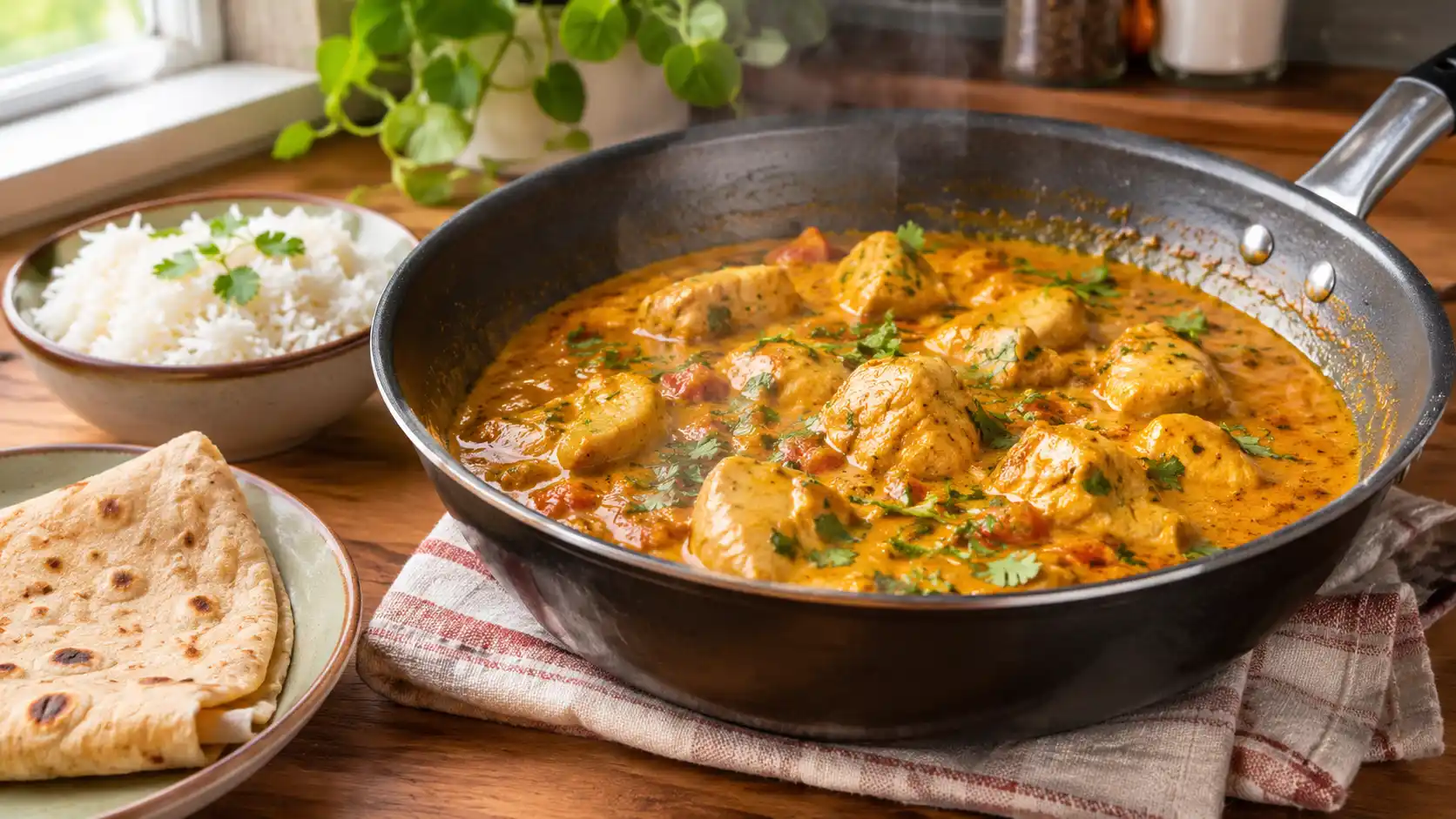
Easy chicken curry for beginners should be simple enough to prepare in one pot without worrying about watery sauce, raw-tasting spices or separated yogurt. A reliable starting point uses boneless chicken thighs, onion, garlic, ginger, mild curry powder and coconut milk. These ingredients create a gently spiced, creamy sauce without requiring a long list of individual spices. The important principles are to soften the onion, cook the spices briefly in oil, control the liquid and simmer the chicken until it reaches a safe internal temperature.
Quick Summary
- Best starting style: Mild curry powder with coconut milk.
- Best chicken cut: Boneless, skinless thighs because they are more forgiving during simmering.
- Important technique: Cook the curry powder in oil before adding liquid.
- Safe chicken temperature: 165°F (74°C), checked with a food thermometer.
- Common problems: Watery sauce, split yogurt, excessive sourness and insufficient seasoning can usually be addressed by identifying the underlying cause.
- Serving suggestion: Serve with basmati rice, naan or roti.
Which Easy Chicken Curry Should a Beginner Make?
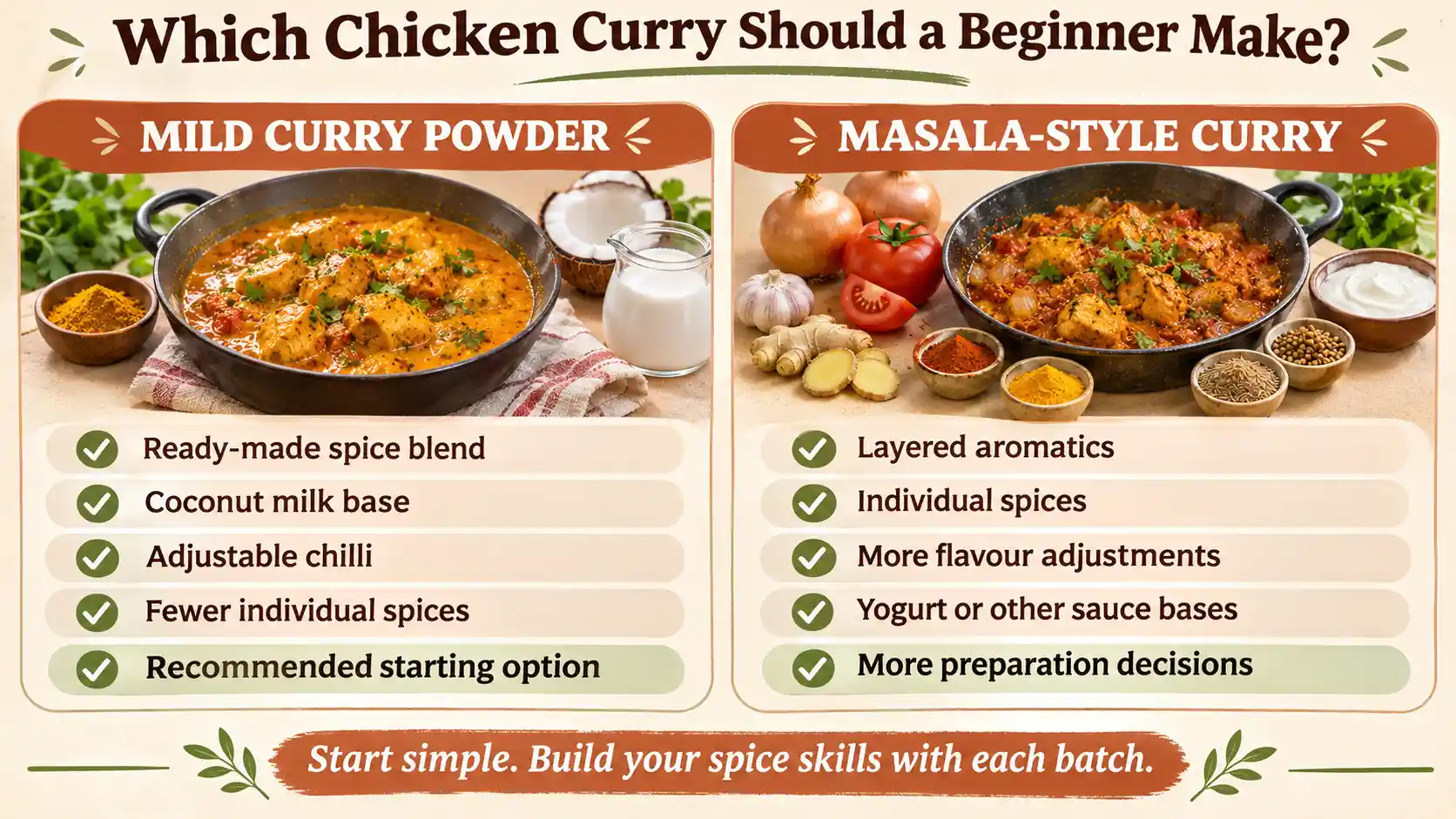
A beginner has two main options: a simple curry-powder version or a more layered masala-style curry.
The curry-powder version is the easier starting point. It uses an existing spice blend and coconut milk, so there are fewer individual ingredients to balance.
An Indian masala-style curry builds flavour through ingredients such as onions, ginger, garlic, tomatoes and individual spices. Some versions use yogurt, while others use different combinations of liquid and seasoning. Indian curries are diverse, so there is no single universal method.
| Style | Key flavour source | Ingredient count | Difficulty | Heat level | Best for |
| Mild curry powder | Ready-made spice blend | Fewer individual spices | Beginner-friendly | Easily adjustable | First-time cooks |
| Masala-style curry | Layered aromatics and individual spices | More ingredients and seasonings | More preparation | Depends on chilli and spice choices | Cooks wanting more depth |
| Curry-paste version | Prepared concentrated paste | Depends on the product | Beginner-friendly | Varies by brand | Convenient preparation |
A curry-powder version is generally the simplest starting point because it reduces the number of individual spices that need to be balanced. Preparation effort and cost depend on the recipe and products selected.
Curry powder vs. garam masala vs. curry paste
Curry powder is a ready-made dry spice mixture. Depending on the brand, it may contain turmeric, coriander, cumin, chilli and other seasonings.
Curry powder is a ready-made spice mixture rather than a single spice. Its ingredients and proportions vary between blends, with combinations commonly including turmeric, coriander, cumin and chilli. For additional background, read this overview of curry powder on Wikipedia.
Garam masala is another spice blend, commonly used toward the end of cooking to add warmth and aroma. It is not automatically a one-for-one replacement for curry powder.
Curry paste is different again. It is a concentrated wet mixture containing spices and aromatics. Its chilli content, salt level and intensity depend on the product.
For a first chicken curry, mild curry powder is a straightforward choice. It provides a convenient starting flavour without requiring you to measure and combine several individual spices.
Coconut milk, coconut cream, yogurt or neither
| Ingredient | Effect on sauce | Flavour | Beginner consideration |
| Coconut milk | Creamy, pourable consistency | Mild and slightly sweet | Easiest starting option |
| Coconut cream | Richer and thicker | Stronger coconut character | Can make the sauce very rich |
| Plain yogurt | Creamy but more delicate | Tangy | Requires gentle heating |
| Greek yogurt | Thick and creamy | Tangy | Needs careful incorporation |
| Neither | Depends on tomato, stock or water base | More pronounced spices | Requires separate liquid adjustment |
Coconut milk is a practical choice because it provides both liquid and creaminess. Coconut cream can make the sauce heavier, while yogurt gives it a different, tangier flavour.
Yogurt-based curry needs more attention during cooking because its proteins can coagulate when acidity and heating conditions are unsuitable. Adding it carefully and avoiding vigorous boiling helps maintain a smoother sauce.
Easiest curry and best curry for beginners
My recommendation for a first attempt is mild chicken curry made with curry powder and coconut milk.
It does not require balancing several whole spices or incorporating a delicate dairy ingredient into a hot sauce.
The goal is not to create the most complicated curry. It is to prepare a consistent one-pot dinner, understand the cooking stages and learn how to adjust the sauce.
Why Beginner Curries Go Wrong
Four things have the biggest influence on the finished curry: the way the spices are cooked, how far the onion is softened, how much liquid enters the pan and how the chicken and creamy ingredients are heated.
Adding coconut milk before cooking the spices can leave their flavour underdeveloped. Too much liquid can produce a thin sauce, while covering an already watery curry slows moisture evaporation.
Yogurt presents another challenge. Its natural acidity affects milk proteins, which can cause them to coagulate. The type of yogurt and the way it is incorporated also influence the finished texture.
The best prevention is to control each stage rather than trying to rescue the finished curry. Let the onion soften, cook the spices in oil, measure the liquid and maintain a gentle simmer.
The Recommended Method: Easy Chicken Curry Step by Step
Ingredients and quantities
The following ingredient list provides a practical starting formula for approximately four servings. The quantities are intended as a baseline, and seasoning should be adjusted according to the curry powder, coconut milk and personal taste.
| Ingredient | Metric | US measurement | Role | Must-have or optional |
| Boneless, skinless chicken thighs | 700 g | 1.5 lb | Main protein | Must-have |
| Large onion | 1 | 1 large | Sauce base | Must-have |
| Garlic | 3 cloves | 3 cloves | Aromatic flavour | Must-have |
| Fresh ginger, grated | 1 tbsp | 1 tbsp | Warm aromatic flavour | Must-have |
| Mild curry powder | 2 tbsp | 2 tbsp | Main spice blend | Must-have |
| Coconut milk | 400 ml | 13.5 fl oz | Creamy sauce | Must-have |
| Salt | To taste | To taste | Seasoning | Must-have |
| Cooking oil | As needed to coat the pan | As needed to coat the pan | Cooking the aromatics | Must-have |
| Tomato paste | A small amount, if desired | A small amount, if desired | Additional depth | Optional |
| Potatoes | As desired | As desired | Extra texture and body | Optional |
| Mixed vegetables | As desired | As desired | Additional vegetables | Optional |
Understanding the main ingredients
Chicken thighs provide a relatively forgiving option for a simmered curry. Onion builds the base, while garlic and ginger add aromatic flavour. Curry powder provides the main spice character, and coconut milk gives the sauce its creamy consistency.
Salt should be added gradually because different curry powders and packaged coconut milk products have different seasoning levels.
If adding potatoes or vegetables, remember that they release moisture and change the amount of sauce available. Add firm vegetables earlier and quicker-cooking vegetables toward the end.
Easy ingredient substitutions
| Missing ingredient | Possible substitute | What changes |
| Fresh garlic | Prepared garlic paste | Texture and intensity may differ |
| Fresh ginger | Prepared ginger paste | Aroma and freshness may differ |
| Coconut milk | Tomato-based sauce with measured liquid | Less coconut flavour and different creaminess |
| Curry powder | A suitable individual spice blend | Requires a separately balanced flavour |
| Chicken thighs | Boneless chicken breast | Leaner texture and less tolerance for overcooking |
If coconut milk is unavailable, a tomato-based sauce with stock or water can provide another cooking liquid. The result will have a different flavour and consistency rather than tasting exactly like the coconut version.
For a yogurt-based alternative, stir plain yogurt into the prepared sauce gradually and use gentle heat. Avoid treating yogurt as a direct quantity-for-quantity replacement for coconut milk.
Thighs vs. breast: does it change the timing?
Chicken thighs and chicken breast behave differently during simmering. Thighs contain more fat and connective tissue, making them more forgiving in a slow-cooked sauce. Breast meat is leaner and can become dry when left in the pan longer than necessary.
| Chicken cut | Piece size | Cooking guidance | Internal temperature | Texture consideration |
| Boneless chicken thighs | Even bite-size pieces | Simmer until cooked through; check during cooking | 165°F / 74°C | More forgiving during simmering |
| Boneless chicken breast | Even bite-size pieces | Check earlier because lean pieces can dry out | 165°F / 74°C | Leaner and less tolerant of overcooking |
Piece size, starting temperature and simmer intensity all influence cooking time. Use a food thermometer rather than relying on a fixed duration or the colour of the chicken.
Both cuts must reach an internal temperature of 165°F (74°C). Check the thickest pieces to confirm they are safely cooked.
Time, yield and equipment
| Recipe detail | Cooking guidance |
| Intended yield | Approximately 4 servings |
| Preparation time | Depends on ingredient preparation |
| Cooking time | Depends on chicken-piece size and simmering conditions |
| Total time | Preparation, cooking the aromatics, simmering and temperature checking |
| Main equipment | Wide, heavy-based cooking pan |
| Cooking method | Stovetop |
A wide pan gives the sauce more exposed surface area, helping excess moisture evaporate. A heavy-based pan also helps distribute heat more evenly.
For this beginner method, the stovetop is the primary cooking option. Slow cookers and multi-cookers require different liquid levels and cooking instructions, so they should not automatically use the same method.
Method with sensory cues
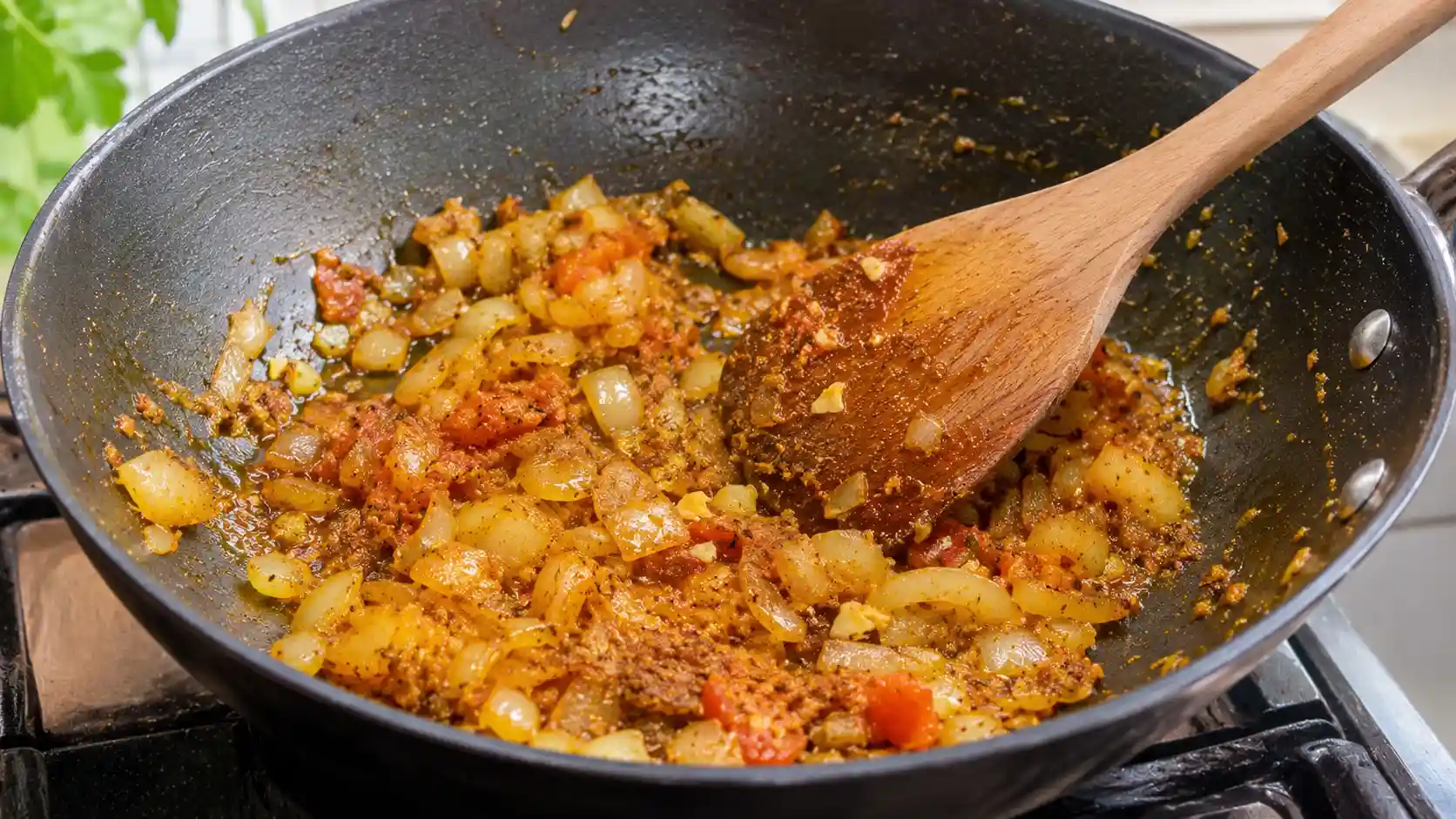
The sequence below focuses on what to look for at each stage rather than relying on a rigid cooking timer.
- Prepare the ingredients. Chop the onion, mince the garlic, grate the ginger and cut the chicken into reasonably even pieces. Similar-sized pieces help the chicken cook more consistently.
- Soften the onion. Heat the cooking oil over medium heat. Add the onion and cook until soft and lightly golden rather than deeply browned. Look for a softened texture and a sweet onion aroma.
- Add garlic and ginger. Stir them into the onion. Cook until fragrant, taking care not to let the garlic darken or burn.
- Bloom the curry powder. Add the mild curry powder and stir it through the oil and aromatics. The powder should become fragrant and slightly darker. The exact time depends on the pan and heat level, so use its aroma and appearance as your guide. Do not allow the spices to burn.
- Add chicken and coconut milk. Add the chicken and stir to coat it in the spice mixture. Pour in the coconut milk and combine everything gently. Stir or shake the can first so the contents are evenly mixed.
- Simmer and check. Cook gently, stirring occasionally. Keep the sauce uncovered when it needs to reduce. Check the thickest chicken pieces with a thermometer and confirm they have reached 165°F (74°C).
- Check the sauce. The finished sauce should cling lightly to the back of a spoon rather than run like thin liquid. If it is too thin, simmer gently for longer while monitoring the chicken.
The important checkpoint is the spice-frying stage. Adding liquid too early prevents you from properly developing the aroma of the dry spice mixture.
Also, coconut milk curry does not need to release a visible layer of oil to be finished. Judge the sauce by its consistency and the chicken by its measured internal temperature.
Fix It: Common Curry Problems, Causes and Prevention
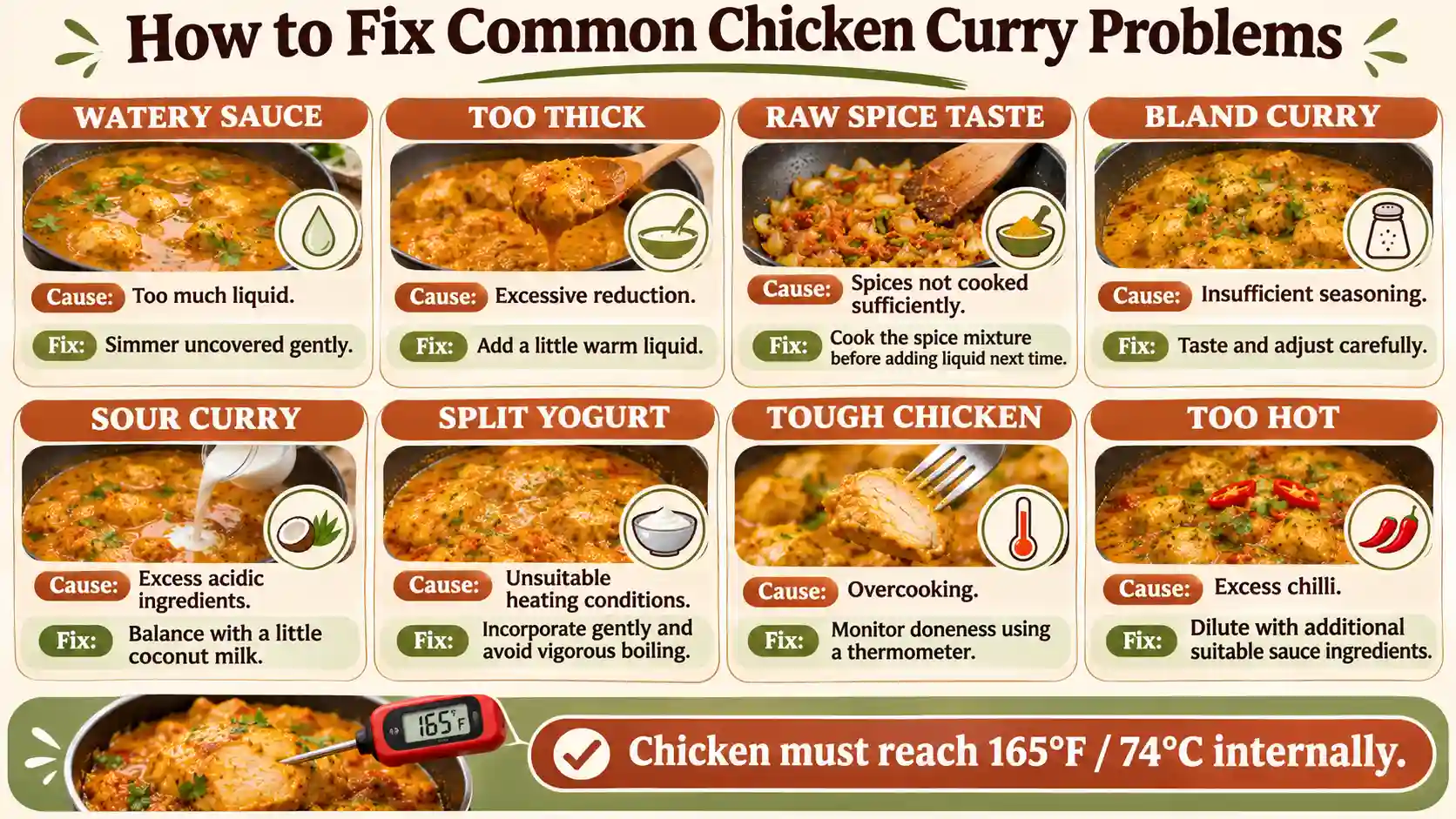
Most beginner curry problems become easier to solve when you identify the symptom before adding more ingredients.
| Symptom | Why it happens | How to fix it | How to prevent it |
| Watery sauce | Excess liquid, insufficient reduction or moisture from vegetables | Simmer uncovered gently | Measure liquid and use a suitable wide pan |
| Pasty or too thick | Excessive reduction or too little liquid | Add a little warm water or coconut milk | Monitor the sauce while simmering |
| Raw spice taste | Spices were not adequately cooked | Continue gentle cooking if the dish allows | Bloom spices in oil before adding liquid |
| Bland curry | Insufficient seasoning or weak spice flavour | Taste and adjust salt and seasoning | Season gradually and check the curry powder |
| Sour curry | Excess acidic yogurt or tomato | Add a little coconut milk to soften the flavour | Measure acidic ingredients and balance gradually |
| Split yogurt | Protein coagulation under unsuitable heating conditions | Remove from heat and gently stir; severe separation may not fully reverse | Incorporate yogurt gradually and avoid vigorous boiling |
| Tough or shredded chicken | Overcooking or uneven piece sizes | Stop cooking once safely done | Cut evenly and monitor internal temperature |
| Too hot | Excess chilli or a stronger spice blend | Dilute with additional suitable sauce ingredients | Start with a mild blend and add chilli gradually |
How to handle split yogurt
Yogurt-based sauces need gentler heating than coconut milk sauces. Sudden temperature changes, acidity and vigorous boiling can encourage the proteins in yogurt to clump together.
To reduce this risk, take the pan off the heat. Gradually mix a little warm curry sauce into the yogurt, then stir the yogurt mixture back into the pan. Reheat gently without bringing the sauce to a vigorous boil.
Full-fat Greek yogurt is a possible choice for a thicker sauce, but the final texture also depends on the yogurt’s formulation and how it is incorporated.
A useful kitchen habit is to add dairy-based ingredients gradually rather than tipping a cold quantity directly into a very hot pan.
How to fix watery or overly thick curry
A watery curry does not always need more spices. Sometimes the issue is simply excess liquid.
Remove the lid and allow the sauce to reduce gently. If vegetables have released additional moisture, they may also need a little more uncovered cooking.
For a curry that has become too thick, add warm water or coconut milk a little at a time. Stir after each addition so the sauce remains balanced instead of becoming thin all at once.
Make It Your Way: Heat, Kids, Substitutions and Regional Style
Heat-level guide
Chilli intensity varies according to its variety, freshness and preparation. A measured amount does not guarantee identical heat across different products.
The following amounts are suggested starting points for a four-serving batch, not fixed measures of heat.
| Level | Starting chilli amount per batch | Expected result |
| Mild | No added chilli | Gentle spice flavour |
| Medium | ¼ tsp | Noticeable warmth |
| Hot | ½ tsp | Stronger chilli flavour |
For a children’s version, begin without added chilli. Taste the curry before serving and offer additional chilli separately for people who prefer a hotter meal.
Remember that black pepper and ginger also contribute warmth, even when chilli powder is omitted.
Adjusting heat after cooking
If the curry tastes too hot, adding more coconut milk or another suitable unsalted sauce ingredient can dilute the chilli concentration. Increase the quantity gradually and taste between additions.
Adding sugar may balance some flavours, but it does not remove chilli heat. Avoid using large quantities of sugar to compensate for an overly spicy curry.
Indian-style vs. UK-style vs. Western-style
These labels describe broad approaches rather than fixed rules.
- Indian-style: Can build flavour using onions, ginger, garlic, tomatoes, individual spices and a variety of regional cooking techniques.
- UK-style: Many familiar curry-house preparations use prepared spice blends, layered sauces and different levels of creaminess or heat.
- Western-style: Often uses convenient curry powder with coconut milk, cream or another accessible sauce base.
There is considerable variation within all three descriptions. A simple coconut chicken curry can be inspired by familiar curry flavours without claiming to represent one traditional regional recipe.
For another one-pot curry idea, try Kitchen Memo’s Eggplant and Chickpea Curry, which uses a different combination of vegetables, legumes and seasonings.
Dietary adaptations
A few adjustments can help the recipe suit different ingredient preferences.
- Dairy-free: Coconut milk already provides a creamy dairy-free base. Check packaged products for dairy-derived additives.
- Gluten-free: Check the curry powder label, especially for added flour, starches or other ingredients that may contain gluten.
- Lower sodium: Measure salt carefully and select lower-sodium packaged ingredients where available.
- More vegetables: Potatoes, carrots, peas, cauliflower and spinach are possible additions.
Vegetables do not all cook at the same rate. Firmer vegetables should be introduced earlier than tender vegetables.
Kitchen Memo’s guide to vegetables for curry explains how to select and time different vegetables without making the finished sauce unnecessarily watery.
Serving, Storing and Scaling
Chicken curry works well with basmati rice, naan, roti or a simple salad. Rice is particularly useful for soaking up the creamy sauce, while flatbreads make it easy to serve the curry as part of a shared meal. Explore the Kitchen Memo Recipes collection for more everyday meal ideas.
Refrigeration: Transfer cooked curry into shallow, airtight containers and refrigerate within two hours. When the surrounding temperature is above 90°F (32°C), refrigerate within one hour. Keep the refrigerator at 40°F (4°C) or below and use cooked leftovers within three to four days.
Freezing: Portion the curry into suitable airtight freezer containers. For best quality, use frozen soups and stews within two to three months when kept at 0°F (-18°C) or below. Freezing for longer does not automatically make continuously frozen food unsafe, but quality can deteriorate.
Reheating: Reheat leftovers to 165°F (74°C) throughout. Stir thoroughly to distribute heat evenly and check the temperature in more than one place. Do not rely on steam or bubbling alone as proof of a safe reheating temperature.
Scaling: Halving or doubling the ingredients requires more than multiplying the liquid by the same factor. Consider the width of the pan, depth of the curry, evaporation and the amount of room available for the chicken. Recheck the cooking time and seasoning rather than assuming they will scale proportionally.
Yogurt-based versions may change texture after refrigeration or freezing. Stir gently while reheating, and avoid bringing the sauce to a vigorous boil.
Conclusion
The easiest chicken curry for beginners is a one-pot recipe built around mild curry powder, boneless chicken thighs and a creamy coconut milk sauce. Softened onions, properly cooked spices, controlled liquid and a thermometer check help prevent many common problems. Start with the mild version, learn the cooking cues and adjust the seasoning as you become more confident.
Frequently Asked Questions
1. What is a quick and easy way to make chicken curry?
Use one pot, boneless chicken thighs, onion, garlic, ginger, mild curry powder and coconut milk. Cook the aromatics and spices first, add the chicken and simmer until it reaches 165°F (74°C). The overall cooking time depends on chicken-piece size and simmering conditions.
2. What are the basic ingredients for chicken curry?
The basic ingredients in this recipe are chicken thighs, onion, garlic, ginger, mild curry powder, coconut milk, cooking oil and salt. Potatoes, tomato paste and mixed vegetables are optional additions.
3. What curry is best for beginners, and which is the easiest to make?
A mild curry-powder and coconut milk version is a straightforward starting point because it uses fewer individual spices and provides a creamy sauce without requiring a complicated preparation.
4. Can I make chicken curry without coconut milk?
Yes. Tomato-based sauces, stock-based sauces and yogurt-based preparations are alternatives. Each produces a different flavour and consistency, so adjust the liquid and seasoning according to the sauce you choose.
5. How do I stop yogurt from curdling in chicken curry?
Avoid adding cold yogurt directly to a vigorously boiling sauce. Remove the pan from the heat, gradually combine the yogurt with a little warm curry sauce, then stir it into the pan. Reheat gently without vigorous boiling.
6. How do I know when chicken curry is done, and can I use chicken breast?
Check the thickest chicken piece with a food thermometer. It must reach 165°F (74°C). Chicken breast can be used instead of thighs, but it is leaner and needs careful monitoring to avoid becoming dry.
7. Can I freeze chicken curry, and how do I reheat it?
Yes. Divide the curry into suitable containers and freeze promptly. For best quality, use frozen curry within two to three months. Thaw safely and reheat until the entire dish reaches 165°F (74°C), stirring to distribute the heat evenly.